¡Acompáñanos a viajar por el mundo de los libros!
Añadir este libro a la estantería
Grey
Escribe un nuevo comentario Default profile 50px
Grey
Suscríbete para leer el libro completo o lee las primeras páginas gratis.
All characters reduced
Jungle Ambushes - cover

Jungle Ambushes

Sabine Lorca

Traductor A AI

Editorial: Publifye

  • 0
  • 0
  • 0

Sinopsis

Jungle Ambushes explores how dense jungle landscapes have shaped warfare, turning it into a contest of adaptation and survival. The book examines the critical role of environmental dominance, where forces exploit natural features to overcome disadvantages, and analyzes the profound psychological impact of constant threats and isolation on combatants. Understanding these elements is vital for grasping 20th and 21st-century conflicts within such terrains. This study of military history emphasizes how the jungle fundamentally alters strategic calculations, favoring those who adapt to its constraints. For example, guerrilla tactics and ambush strategies often prove more effective than conventional military approaches. The book progresses logically, first defining the strategic significance of jungle terrain, then moving through historical case studies, examining psychological impacts, and concluding with an analysis of future challenges. It highlights survival techniques, psychological resilience, and logistical innovation. Drawing on military archives, veteran accounts, and academic research, Jungle Ambushes provides a comprehensive analysis of a frequently overlooked aspect of modern warfare. Its fact-based approach, clear style, and interdisciplinary connections to fields like environmental science and psychology offer valuable insights for military historians, students of military strategy, and anyone interested in the intersection of environment and conflict.
Disponible desde: 29/03/2025.
Longitud de impresión: 63 páginas.

Otros libros que te pueden interesar

  • Embrace Me Forever: Seven Conversations for Lifelong Love - A Group Discussion - cover

    Embrace Me Forever: Seven...

    Vines Graener

    • 0
    • 0
    • 0
    Embrace Me Forever: Seven Conversations for Lifelong Love is a powerful guide to nurturing deeper emotional connections in relationships. In this transformative audiobook, Dr. Sue Johnson, a renowned expert in Emotionally Focused Therapy (EFT), reveals the key to building lasting love through seven essential conversations that every couple needs. 
    These conversations aren’t just about words—they’re about emotional closeness, vulnerability, and understanding the underlying needs that shape how we connect with those we love. Embrace Me Forever is not just another relationship book; it’s a roadmap to creating unshakable bonds that withstand the test of time. 
    Through real-life examples and actionable advice, this audiobook will guide you through each conversation, helping you to communicate in ways that foster trust, security, and intimacy. Whether you're just starting out or have been together for years, Embrace Me Forever shows you how to strengthen the foundation of your relationship and make it more resilient than ever. 
    With Embrace Me Forever, you’ll learn how to:Deepen your emotional connection with your partnerOvercome recurring conflicts and patternsCreate a safe space for vulnerability and trustCommunicate in ways that bring you closer rather than push you apartBuild a relationship that lasts, with a love that grows stronger every day 
    Join Dr. Sue Johnson as she guides you through these seven vital conversations, and unlock the potential for a lifetime of love and connection. Embrace Me Forever is a journey to lasting intimacy, where love isn't just a feeling, but a bond that deepens with every conversation.
    Ver libro
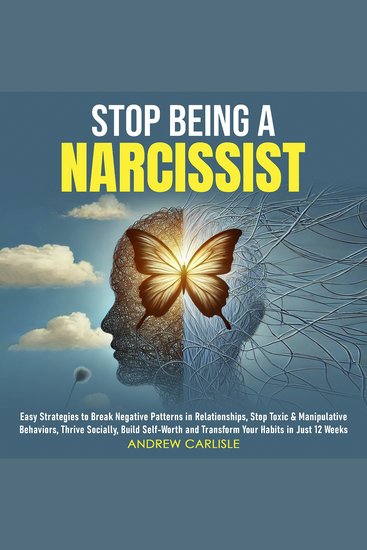
  • Stop Being a Narcissist - Easy Strategies to Break Negative Patterns in Relationships Stop Toxic & Manipulative Behaviors Thrive Socially Build Self-Worth and Transform Your Habits in Just 12 Weeks - cover

    Stop Being a Narcissist - Easy...

    Andrew Carlisle

    • 0
    • 0
    • 0
    You can change anything you want… including the harmful behavior patterns that hurt your relationships. Discover how! 
    You can retrain yourself, break free from old habits, and build bridges to repair your relationships. 
    Better yet, you can ensure those old patterns don’t resurface and that every relationship you build from here on is healthy and meaningful. 
    This empathetic and insightful guide is here to support you every step of the way—and after you’ve completed its simple 12-week plan, you won’t look back. 
    Inside, you’ll discover: 
    ● A deeper understanding of narcissism, how it impacts relationships, and why these traits have developed in you 
    ● A powerful self-assessment quiz you can use to gain eye-opening insights into yourself and your behavior patterns 
    ● How to understand your triggers and break the negative patterns that have been harming your relationships 
    ● Why you’ll need to let go of your need for control—and exactly how you can do this 
    ● Your complete guide to building your empathy skills and emotional intelligence… and why this is so important 
    ● What you need to know about boundaries—with practical advice for recognizing and respecting them 
    ● Why vulnerability isn’t the weakness you fear it is, how you can embrace it as a strength… and why this is going to be a game-changer 
    ● Practical strategies for repairing damaged relationships and rebuilding mutual respect 
    ● Why you’ve been disconnected from your true self (and what you can do to change this) 
    ● The power of a growth mindset for helping you to move forward and continually make positive changes 
    And much more. 
    No matter what state your relationships are in right now, you can undo the damage and set forth toward a brighter, healthier future. 
    Break the negative cycle and pave the way for deeper and more fulfilling relationships.
    Ver libro
  • French Invasion of Russia and the Battle of Leipzig The: The History and Legacy of the Defeats that Forced Napoleon into Exile at Elba - cover

    French Invasion of Russia and...

    Charles River Editors

    • 0
    • 0
    • 0
    Though Napoleon Bonaparte's unquenchable thirst for military adventurism eventually cost him both his throne and his freedom during the Napoleonic Wars of the late 18th and early 19th centuries, the French Emperor was not easily defeated even when most of Europe's nations united against him. Two military setbacks on a scale unprecedented in history until then were required before the high tide of Napoleon's success began to ebb towards the final denouement of the Hundred Days and the famous battle of Waterloo.  
    	Napoleon's Russian adventure gutted his veteran army, depriving him of the majority of his finest and most loyal soldiers. Those who remained formed the hard core of his new armies, but the Russian fiasco damaged their health and embittered their previously unquestioning loyalty. Napoleon raised vast new armies, but circumstances compelled him to fill the ranks with raw recruits, whose fighting skills did not equal their undoubted bravery and whose dedication to the Napoleonic cause was shaky, and in many cases due solely to coercion. The tough, experienced, faithful veteran found himself outnumbered by unwilling, sketchily trained amateurs. 
    These factors set the stage for the second setback, which essentially sealed the fate of Napoleon's empire. The four-day Battle of Leipzig in October 1813, romantically but accurately dubbed the "Battle of the Nations," proved the decisive encounter of the War of the Sixth Coalition and essentially determined the course the Napoleonic Wars took from that moment forward. 	The resultant collision was the single largest field action of the Napoleonic Wars, dwarfing Waterloo in size, complexity, and overall importance. The Battle of Leipzig was probably the combat which involved the highest concentration of men on a single extended battlefield on the planet up to that point in history, and would not be exceeded until the vast struggles of the First World War almost precisely a century later. 
    Ver libro
  • The Biggest Little Book About Hope - cover

    The Biggest Little Book About Hope

    Kathryn Goetzke

    • 0
    • 0
    • 0
    With hopelessness at unprecedented levels around the world, and a key predictor of suicide, violence, self-harm, and addiction, it is essential to teach the ‘how’ of hope. The Biggest Little Book About Hope teaches the hope skills necessary for anyone looking to integrate hope into their everyday lives. 
    Ver libro
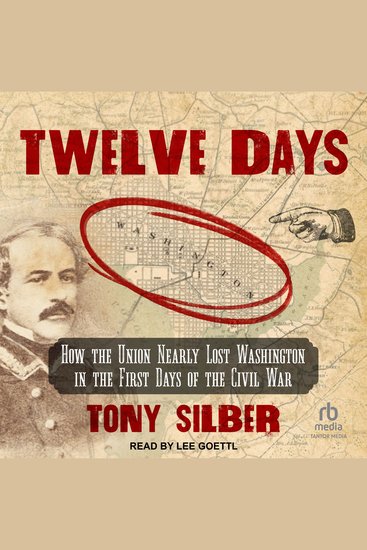
  • Twelve Days - How the Union Nearly Lost Washington in the First Days of the Civil War - cover

    Twelve Days - How the Union...

    Tony Silber

    • 0
    • 0
    • 0
    In the popular literature of the Civil War, the days immediately after the surrender at Fort Sumter are overshadowed by the battles and changes in American life. 


    Tony Silber's account starts on April 14, 1861, with President Lincoln's call for seventy-five thousand militia troops. Washington, a Southern slaveholding city, was the focal point. The capital was barely defended, by about two thousand local militia troops of dubious training and loyalty. In Charleston, the Confederates had an organized army that was larger and ready to fight. 


    Maryland's eastern sections were reeling in insurrection, and within days Virginia would secede. For half of the twelve days after Fort Sumter, Washington was severed from the North. The United States had a tiny standing army. The federal government's only defense would be state militias. 


    A Confederate success in capturing Washington would have changed the course of the Civil War. Instead, Lincoln emerged as the master of his cabinet, a communications genius, and a strategic giant. Twelve Days alternates between the four main scenes: Washington, insurrectionist Maryland, the advance of Northern troops, and the Confederate planning and military movements.
    Ver libro
  • Did Columbus discover America? - How was America discovered? - cover

    Did Columbus discover America? -...

    Shreyas Pande, Sharad Baggonkar

    • 0
    • 0
    • 0
    Christopher Columbus was an explorer, fine mapmaker and navigator. He also had deep interest in geography, astronomy, and history. Columbus loved sailing the high seas and was keen to explore a sea passage to the East which would help him reach India. With that in mind he went to the King of Spain in with a proposal in 1492 who immediately approved the plan. Thus began Columbus's voyage to reach India but little did he know that it was not going to be India but a completely different continent, that was waiting to be discovered.
    Ver libro