Junte-se a nós em uma viagem ao mundo dos livros!
Adicionar este livro à prateleira
Grey
Deixe um novo comentário Default profile 50px
Grey
Assine para ler o livro completo ou leia as primeiras páginas de graça!
All characters reduced
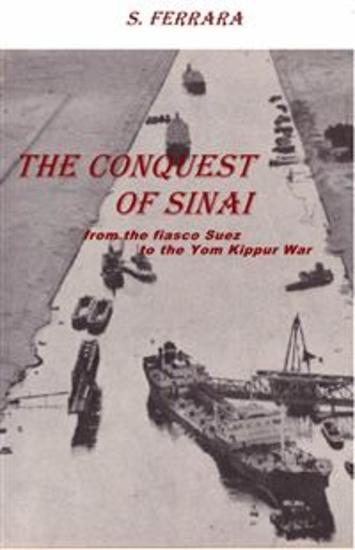
The Conquest Of Sinai - From The Suez Fiasco To The Yom Kippur War - cover
LER

The Conquest Of Sinai - From The Suez Fiasco To The Yom Kippur War

S. Ferrara

Editora: Babelcube

  • 0
  • 0
  • 0

Sinopse

Sinai has never been Israeli, it was Egyptian before the 1956 War but it was invaded by Israel's armed forces, which then had to retreat. During the 1967 War, it was reconquered by the Israelis who, following the peace treaties, had to cede it to Egypt again. In 1973, the Israelis defended it strenuously, this time after having been attacked by surprise, but following the Camp David Agreements, they gave it back to Egypt. 


Disponível desde: 11/03/2022.

Outros livros que poderiam interessá-lo

  • Ghost Writing Gold - Strike Gold When You Learn How to Hire the Best Ghostwriter For You! - cover

    Ghost Writing Gold - Strike Gold...

    Ben Geisler

    • 0
    • 0
    • 0
    Ghost Writing Gold: Strike Gold When You Learn How to Hire the Best Ghostwriter For You! 
    When you hire a writer for your eBook, what you are doing is enlisting the services of a ghostwriter. A ghostwriter is a writer who publishes under someone else's name, with the consent of both parties. Traditionally, ghostwriters have been and are still today hired by celebrities to write autobiographies when the celebrities are not talented writers. Ghostwriters also sometimes create works for well-known authors, such as Tom Clancy. This practice is done for business reasons, because the author's name alone will sell the books, no matter who actually wrote them. 
    In this audiobook, you will learn why eBooks are great ways to earn money these days and if you don’t have a talent for writing, you can employ the services of ghost writers that will help you write them. 
    This audiobook will cover the following topics: 
    - How to Select a Great Topic 
    - Where to Find Great Writers 
    - How to Choose the Best Writer For Your Project 
    - And many more! 
    Ultimately you will own the copyright of what the ghostwriter wrote, and you can sell the eBook as many times as you like. If it sounds like a pretty nice arrangement, it is. It's all completely legal and commonly done. To learn more, scroll up and click “add to cart” now!
    Ver livro
  • Bagavad Gita in Tamil - Chapter 6 - cover

    Bagavad Gita in Tamil - Chapter 6

    Viyasar

    • 0
    • 0
    • 0
    The Bhagavad Gita is a 700-verse Hindu scripture embedded within the epic Mahabharata, depicting a dialogue between Arjuna and Krishna on the battlefield of Kurukshetra. Arjuna, facing his relatives in battle, experiences despair and a crisis of conscience. Krishna, his charioteer and an avatar of Vishnu, provides philosophical and spiritual guidance, addressing themes of duty (dharma), action (karma), devotion (bhakti), and knowledge (jnana). The Gita explores the nature of the self, the divine, and humanity's place in the world, offering paths to liberation and spiritual fulfillment. 
    Ver livro
  • Governing by chaos - Social engineering and globalization - cover

    Governing by chaos - Social...

    Lucien Cerise

    • 0
    • 0
    • 0
    Given the growing success of this book, first published in 2009 and then updated in 2014, this third edition has been fully revised and updated by the author, incorporating the latest expressions of social chaos, instrumentalized by the powers that be for the past eight years.
    How to become the masters of the world in the age of the Internet? The good-old method of the pyromaniac fireman still works. Renamed “shock strategy” or social engineering, it consists of plunging populations into crisis and anguish to better centralize order and power in the hands of an oligarchy usurping the identity of the savior. In the twentieth century, politics has moved from the art of persuasion to technical issues of hacking minds and optimizing group management. To that end, several disciplines and approaches are applied—cybernetics, marketing, management—to trap the masses into organized chaos, while they try to respond to the panic provoked by a transhumanist computer dictatorship based on biometrics, the all-digital, the vaccine pass, and eventually the suppression of cash and privacy.
    Ver livro
  • The War on Critical Race Theory - Or The Remaking of Racism - cover

    The War on Critical Race Theory...

    David Theo Goldberg

    • 0
    • 0
    • 0
    "Critical Race Theory" is consuming conservative America. The mounting attacks on a once-obscure legal theory are upending public schooling, legislating censorship, driving elections, and cleaving communities. 


    In this much-needed response, renowned scholar David Theo Goldberg cuts to the heart of the claims expressed in these attacks. He punctures the demonization of Critical Race Theory, uncovering who is orchestrating it, funding the assault, and eagerly distributing the message. The book richly illustrates the enduring nature of structural racism, even as a conservative insistence on colorblindness serves to silence the possibility of doing anything about it. Crucially, Goldberg exposes the political aims and effects of the vitriolic attacks. The upshot of CRT's targeting, he argues, has been to unleash racisms anew and to stymie any attempt to fight them, all with the aim of protecting white minority rule.
    Ver livro
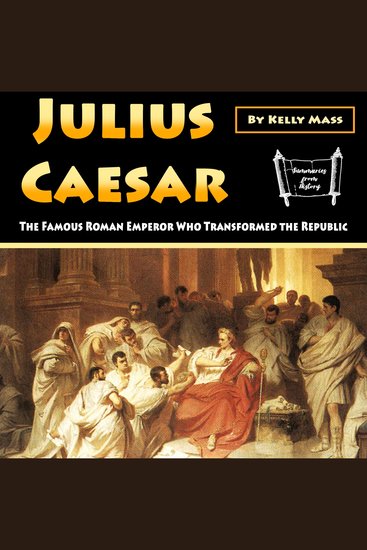
  • Julius Caesar - The Famous Roman Emperor Who Transformed the Republic - cover

    Julius Caesar - The Famous Roman...

    Kelly Mass

    • 0
    • 0
    • 0
    Gaius Julius Caesar remains one of the most influential and recognizable figures in history. A brilliant military commander and astute statesman, Caesar played a decisive role in the events that led to the collapse of the Roman Republic and the rise of the Roman Empire. His life and career were marked by political ambition, military conquests, and transformative reforms that forever changed the Roman world.  
    Born into a patrician family, Caesar rose to prominence in Roman politics through strategic alliances and persuasive rhetoric. In 60 BC, he formed the First Triumvirate with Marcus Licinius Crassus and Gnaeus Pompeius Magnus, known as Pompey. This informal political alliance dominated Roman politics for several years, enabling Caesar to secure the consulship in 59 BC. The Triumvirate sought to advance the interests of the Populares, a political faction advocating for the rights of the common people, in opposition to the Optimates, the conservative faction of the Roman Senate. Powerful senators such as Cato the Younger and orator Cicero resisted Caesar’s growing influence, leading to increased political tensions.  
    To solidify his power, Caesar launched a series of military campaigns known as the Gallic Wars from 58 BC to 51 BC. These campaigns significantly expanded Roman territory, bringing Gaul (modern-day France and Belgium) under Roman control. Caesar's military success earned him wealth, popularity, and the unwavering loyalty of his legions. His invasion of Britain and the daring construction of a bridge over the Rhine River showcased his strategic prowess and ambition. These victories, however, unsettled Pompey, who grew increasingly aligned with the Senate following Crassus’ death in 53 BC. Fearing Caesar’s rising power, the Senate ordered him to disband his army and return to Rome as a private citizen. 
    Ver livro
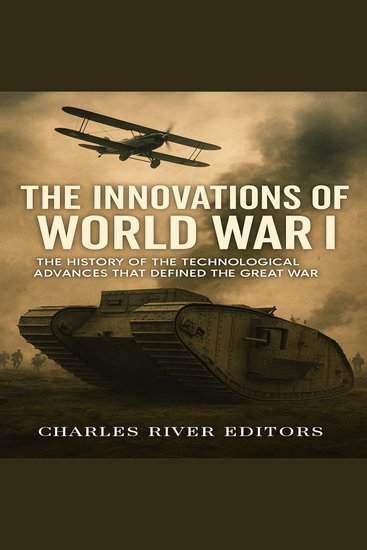
  • Innovations of World War I The: The History of the Technological Advances that Defined the Great War - cover

    Innovations of World War I The:...

    Charles River Editors

    • 0
    • 0
    • 0
    World War I, also known in its time as the “Great War” or the “War to End all Wars”, was an unprecedented holocaust in terms of its sheer scale. Fought by men who hailed from all corners of the globe, it saw millions of soldiers do battle in brutal assaults of attrition which dragged on for months with little to no respite. Tens of millions of artillery shells and untold hundreds of millions of rifle and machine gun bullets were fired in a conflict that demonstrated man’s capacity to kill each other on a heretofore unprecedented scale. 
    	Since the industrial revolution, arms and materiel output had increased by orders of magnitude, as had the quality and uniformity of the products. Several developments had already taken place in the years building up to the conflict, stepping stones towards the vast escalation in military innovation which took place immediately prior to and during World War I. Innovations included the adoption into service of the first belt-fed machine guns, predecessors of those which would wreak such slaughter in the trenches, and the development of cannon which did not roll backwards after each shot as 19th century pieces did, but remained fixed in place.  
    	The arms race before the war and the attempt to break the deadlock of the Western and Eastern Fronts by any means possible changed the face of battle in ways that would have previously been deemed unthinkable. Before 1914, flying machines were objects of public curiosity; the first flights of any account on rotor aircraft had been made less than 5 years before and were considered to be the province of daredevils and lunatics. By 1918, all the great powers were fielding squadrons of fighting aircraft armed with machine-guns and bombs, to say nothing of light reconnaissance planes. Tanks, a common feature on the battlefield by 1918, had not previously existed outside of the realm of science fiction stories written by authors like H.G. Wells.
    Ver livro