¡Acompáñanos a viajar por el mundo de los libros!
Añadir este libro a la estantería
Grey
Escribe un nuevo comentario Default profile 50px
Grey
Suscríbete para leer el libro completo o lee las primeras páginas gratis.
All characters reduced
Publishing is Broken but it Doesn't Have to Break Us - cover

Publishing is Broken but it Doesn't Have to Break Us

Russell Nohelty

Editorial: Wannabe Press

  • 0
  • 0
  • 0

Sinopsis

Publishing is broken, but it doesn't have to break you. In this candid, no-holds-barred guide, USA Today bestselling author and small-press publisher Russell Nohelty reveals why the traditional publishing model is stacked against most writers, and how to make the industry work for you.
 
Drawing on decades of experience and dozens of successful book launches, Nohelty offers a blueprint for building your creative career without selling your soul or burning yourself out. You'll learn how to break free from tired industry myths, connect directly with the readers who love your work, jettison traditional gatekeepers, construct a sustainable creative life. and leverage simple tools and strategies that actually pay off without all the needless hustle.
 
Whether you're a first-time writer or a seasoned pro, this book offers real-world strategies for breaking free of the status quo. Packed with straight talk, practical insights, and actionable advice, Publishing Is Broken Publishing, But It Doesn't Have to Break Us doesn't pretend there's a one-size-fits-all answer. Instead, it hands you the keys to design a publishing path that fits your goals, your schedule, and your sanity. If you're ready to build a thriving, bullshit-free writing career, this book will show you the way forward.
Disponible desde: 29/12/2025.
Longitud de impresión: 364 páginas.


Otros libros que te pueden interesar

  • What's Wrong with You - A Cure for Anxiety Depression and “Mental Illness” - cover

    What's Wrong with You - A Cure...

    Kevin Dees

    • 0
    • 0
    • 0
    After a few moments of intense and unexplainable anxiety his junior year of high school, Kevin’s brain health issues began to get worse. Over the next two decades, he experienced unremitting anxiety and months-long battles with intense depression. 
    As a driven athlete and competitor, Kevin became obsessed with finding both the cause and the cure. In spite of the psychiatric community's insistence that a “diagnosis is forever” and “management is the best you can hope for,” Kevin kept searching for just one person who had been diagnosed with a “mental Illness” and recovered. 
    Meanwhile, his issues haunted him into early adulthood, leading to hospital stays and a suicide attempt that nearly ended it all. Open to trying any healing modality that offered the hope of a cure, Kevin tried 1,000s of therapies and drugs. “What’s wrong with me” became his mantra. “What’s wrong with me” became the echoing backdrop that was both driving his brain health condition and propelling him forward with an obsession to find answers.
    Ver libro
  • Off-White - The Truth About Antisemitism - cover

    Off-White - The Truth About...

    Rachel Shabi

    • 0
    • 0
    • 0
    Why can't we talk about antisemitism? 


    As claims of antisemitism continue to distort our politics at home and abroad, it has become almost impossible to talk about constructively, even in private. Instead, we find ourselves in a storm of misinformation, political mudslinging, and bad-faith accusations. 


    There is, however, a way to deliberate more honestly. Looking beyond our polarizing headlines and interrogating the reasons racism takes hold, Off-White offers urgent analysis of one of the most divisive issues of our time. Taking in the contingency of whiteness, Judeo-Christian mythmaking, pro-Israel antisemitism, and the Palestinian struggle against colonialism, Rachel Shabi lights a hopeful way forward.
    Ver libro
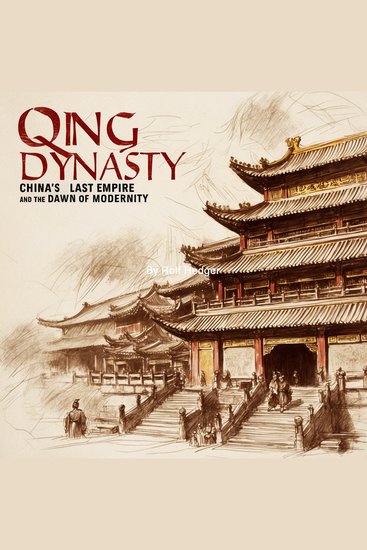
  • Qing Dynasty - China's Last Empire and the Dawn of Modernity - cover

    Qing Dynasty - China's Last...

    Rolf Hedger

    • 0
    • 0
    • 0
    The Qing Dynasty, China’s last imperial dynasty, emerged from the northeastern frontier, led by the Manchu people. Before establishing their rule over China, the Manchus were a semi-nomadic group descended from the Jurchens, who had previously ruled northern China under the Jin Dynasty. In the early 17th century, Nurhaci, a formidable leader, laid the foundation for Manchu power by unifying various Jurchen tribes and adopting administrative and military structures inspired by the Ming Dynasty. His successor, Hong Taiji, continued these efforts, formally establishing the Qing Dynasty in 1636. However, the conquest of China was still incomplete, as the Ming Dynasty continued to rule the heartland. 
    The decline of the Ming Dynasty provided an opportunity for the Qing to assert their dominance. By the early 17th century, the Ming government was weakened by internal corruption, peasant uprisings, and economic distress exacerbated by famine and mismanagement. The most devastating of these rebellions was led by Li Zicheng, a former postal worker turned insurgent, whose forces overran Beijing in 1644. The fall of the Ming capital marked a critical turning point. With the Ming emperor dead and the central government in disarray, a Ming general, Wu Sangui, faced a difficult choice: resist the rebel forces or seek outside aid. He chose the latter, opening the gates of the Great Wall at Shanhai Pass to the advancing Qing army. The Manchus, under the leadership of Prince Dorgon, seized the moment, swiftly capturing Beijing and declaring the establishment of Qing rule.
    Ver libro
  • Revolver And Rebellion - The Secret Role of Women Fighters in Northern Ireland's Conflict - cover

    Revolver And Rebellion - The...

    Davis Truman

    • 0
    • 0
    • 0
    This audiobook is narrated by an AI Voice.   
    "Revolver and Rebellion" delves into the untold stories of women who defied convention and transformed the landscape of Northern Ireland's Troubles. This book uncovers the hidden contributions of female fighters who played pivotal roles in the conflict, challenging traditional narratives and offering a fresh perspective on their complex involvement. 
    This book reveals how these women navigated a world dominated by men, balancing their revolutionary zeal with the harsh realities of gender expectations. From the covert operations of the IRA to the embattled Loyalist factions, "Revolver and Rebellion" explores these remarkable women's diverse motivations, struggles, and triumphs. 
    "Revolver and Rebellion" is essential for anyone interested in the hidden histories of conflict, the power dynamics of gender, and the extraordinary resilience of women who rose to challenge the status quo.
    Ver libro
  • The European Union - Unity and Challenges - cover

    The European Union - Unity and...

    Nova Ashford

    • 0
    • 0
    • 0
    The formation of the European Union (EU) is the result of decades of political, economic, and social evolution, shaped by the aftermath of two World Wars and the desire for long-lasting peace and prosperity in Europe. The idea of a united Europe emerged from the devastation of the Second World War, with leaders recognizing that unity among European nations could prevent future conflicts and create a foundation for collective economic growth. 
    The origins of European integration can be traced back to the 1950s, following the end of World War II. The primary motivation was the need to secure peace and ensure stability in a continent scarred by war. The first major step in the process was the creation of the European Coal and Steel Community (ECSC) in 1951. The ECSC, established by the six founding members—Belgium, France, Italy, Luxembourg, the Netherlands, and West Germany—was a pioneering effort in economic cooperation. By pooling coal and steel production, the ECSC aimed to make war between these countries materially impossible, as it would require the cooperation of nations whose economies were intertwined. 
    The next pivotal moment came in 1957, with the signing of the Treaty of Rome, which established the European Economic Community (EEC). The Treaty of Rome sought to deepen economic cooperation and foster a common market, removing trade barriers, creating a customs union, and enabling the free movement of goods, services, capital, and people. This was a significant step towards realizing the vision of a unified Europe.
    Ver libro
  • Commander in Chief - Partisanship Nationalism and the Reconstruction of Congressional War Powers - cover

    Commander in Chief -...

    Casey B. K. Dominguez

    • 0
    • 0
    • 0
    The constitutional balance of war powers has shifted from Congress to the president over time. Today, presidents broadly define their constitutional authority as commander in chief. In the nineteenth century, however, Congress was the institution that claimed and defended expansive war powers authority. This discrepancy raises important questions: How, specifically, did Congress define the boundaries between presidential and congressional war powers in the early republic? Did that definition change? 


    Casey Dominguez's Commander in Chief systematically analyzes the authority that members of Congress ascribe to the president as commander in chief and the boundaries they put around that authority. 


    Dominguez shows that for more than a century members of Congress defined the commander in chief's authority narrowly. But in a wave of nationalism during the Spanish-American War, members of Congress began to argue that Congress owed deference to the commander in chief. They also tended to argue that a president of their own party should have broad war powers, while the powers of a president in the other party should be defined narrowly. Together, these two dynamics suggest that the conditions for presidentially dominated modern constitutional war powers were set at the turn of the twentieth century, far earlier than is often acknowledged.
    Ver libro