¡Acompáñanos a viajar por el mundo de los libros!
Añadir este libro a la estantería
Grey
Escribe un nuevo comentario Default profile 50px
Grey
Suscríbete para leer el libro completo o lee las primeras páginas gratis.
All characters reduced
The Scaredy-Cat Kitten - cover

The Scaredy-Cat Kitten

Roz Rosenbluth

Editorial: Twin Sisters® Digital Media™

  • 0
  • 0
  • 0

Sinopsis

Fun sound-effects and whimsical music help tell the adventurous tale of “The Scaredy-Cat Kitten.” Mother cat has two very different kittens. Herbie is curious and brave. But his sister Sarah is afraid of everything. When the kittens go for a walk Sarah is even afraid of her own shadow. Find out what happens when Herbie gets caught in briars and Sarah needs to go get Mother for help. A positive ending adds interest to this adorable story and encourages a lifelong love for reading.
Disponible desde: 06/07/2023.

Otros libros que te pueden interesar

  • Patient Doctor Privilege - cover

    Patient Doctor Privilege

    David A Fulton

    • 0
    • 0
    • 0
    Being the subject matter and writer, David takes a no-holds-bar approach to deciphering his past. From being a teenager fed up with the lack of guidance from the adults in his life, to an angry 20-year-old that thinks he knows everything and ultimately a man who had to put the pieces back together after being committed to several psych wards on a number of occasions. He never saw the moment on the end of his bed thinking about the nature of the world resulting in him losing touch with reality. But it was the moment he broke through the pressures in the west: to be better; to work harder; and ultimately chase your dreams. That he realised nothing meant anything. The only purpose in life was to laugh when something was funny, cry when something was sad, move when the wind blew, eat when you were hungry and enjoy ever fleeting moment. However, being a disciplined, calculated, accomplished engineer, this new paradigm didn’t fit in with the persona he had spent a like time creating. On multiple occasions these two conflicting worlds clashed and opened up opportunities for growth and self-discovery. But be prepared. While talking about his underlying issues has become second nature for him, and he has been hospital free for several years, his autobiography is confronting, confusing and potentially eye opening. Unlike the hero he thought he was at a young age, he closes with identifying with the coward within and admitting that just because he couldn’t see a future, it didn’t mean one wasn’t awaiting him around the corner. Similarly, to that which is discussed behind closed doors, he opens with inviting you to his ‘Patient Doctor Privilege’. He contests such a privilege needs to be dissolved for the collective benefit and admits despite the necessity to disconnect at times, that each of us, no matter how fucked up we are or even if we’ve hurt someone, we need to talk about it with one another.
    Ver libro
  • Genealogy - A Guide to Genealogical Research and Finding Your Ancestors - cover

    Genealogy - A Guide to...

    Sophie Henner

    • 0
    • 0
    • 0
    Genealogy delves into the complex web of family relationships and historical contexts that shape individual and collective identities. It often begins with an inquiry into one's own family background, such as understanding the origins and branches of one’s family tree. Researchers use various resources, including birth, marriage, and death records, census data, military records, and immigration documents, to trace the lineage and connections of family members across generations. 
      
    The process typically starts with gathering information from living relatives and personal family records. This foundational knowledge helps in identifying potential research paths. Genealogists then use historical records and archives to fill in gaps, verifying information and uncovering new details about ancestors' lives, including their social, economic, and geographical contexts. 
      
    Genealogy also involves examining historical events, migrations, and cultural influences that impacted family histories. By integrating historical data with personal records, genealogists create a richer understanding of how family histories intertwine with broader historical narratives.
    Ver libro
  • Austerlitz or Death - cover

    Austerlitz or Death

    Auguste Vallois

    • 0
    • 0
    • 0
    "Austerlitz or Death" is an epic historical novel by Auguste Vallois, a captain of the Imperial Guard who recounts his memories from the battlefields of Europe to the solitude of inner exile. 
    From his revolutionary youth in Lyon to the Egyptian campaign, the victories in Italy, the glory at Austerlitz, the frozen hell of Russia, and the final tragedy at Waterloo, Auguste tells the story of the Napoleonic Empire in first person and with painful clarity—not from the pages of history books, but from the blood, mud, and soul of those who built it… and watched it fall. 
    Through these pages, the reader will march alongside a man who lost everything but his honor. You will witness how a soldier is forged, how faith fades, how a sword is held even on broken knees. Each chapter is filled with emotion, introspection, fire, and silence. Every victory bears the taste of sacrifice, and every defeat, the dignity of those who never surrendered. 
    Vallois's prose is both elegant and raw, intimate and epic, heir to the great traditions of war and memory literature such as All Quiet on the Western Front or The Disasters of War. This is not the official history of Napoleon, nor the tale of grand strategists. It is the story of the anonymous men who believed in something greater than themselves… and paid the price. 
    A novel that masterfully blends epic military drama, psychological depth, and historical tragedy. Ideal for readers of war literature, historical fiction, soldier memoirs, or explorations of the human condition in times of crisis. 
    "I served the Emperor. And I do not regret it." 
    — Auguste Vallois
    Ver libro

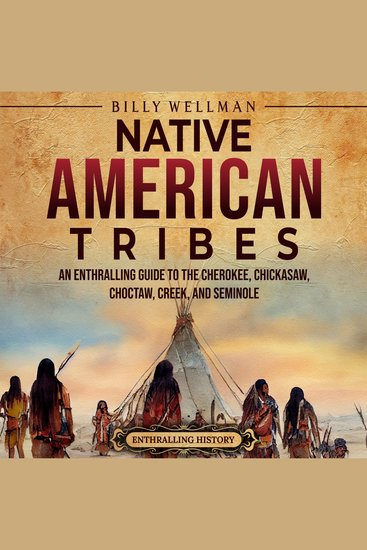
  • Native American Tribes: An Enthralling Guide to the Cherokee Chickasaw Choctaw Creek and Seminole - cover

    Native American Tribes: An...

    Billy Wellman

    • 0
    • 0
    • 0
    Do you know the story of the Native American tribes, from the earliest known histories to the first European contact to the modern day?  
    The “Five Civilized Tribes” tried to adapt to the American way of life, while others fought to keep their land. Which was more successful? This audiobook will attempt to tell their story, the story of those five tribes. It will not go back into the distant past, and it will not be able to cover modern issues within the Native American community. But it will tell the story of how a group of people dealt with a world that had suddenly and drastically changed—and continued to change—and how they dealt with these changes as Native Americans. 
    In this audiobook, you’ll learn about:The Five Civilized Tribes: Cherokee, Muscogee (Creek), Seminole, Choctaw, and ChickasawThe role of disease in the European colonization of AmericaGreat Native American fighters like Tecumseh, Crazy Horse, and Black HawkGreat Native American leaders like Pushmataha, Chief John Ross, and Blue JacketWhat role Andrew Jackson played in the Indian Removal ActThe reality of Native Americans who owned slavesThe real story behind the Trail of TearsGreat battles like Fallen Timbers, Tippecanoe, Little Bighorn, and St. Clair's DefeatMassacres at Sand Creek and Wounded Knee and the devastation at Prospect BluffHow the Native Americans used and were used by the Americans, British, and Spanish in the southeastern United StatesAnd so much more! 
     Scroll up and click the “add to cart” button to learn more about Native American tribes!
    Ver libro
  • How to be Happy - Danish & Japanese Art of Happiness - cover

    How to be Happy - Danish &...

    360K Pro Publishing

    • 0
    • 0
    • 0
    For many people, happiness is just an illusion; a mystic dream that seems to be forever outside of their grasp. For millennia, philosophers, psychologists, medical professionals, and theologians have all weighed in on how to achieve it. It seems that everyone has a theory on how to find happiness, but few people would readily say they have actually found it. This book is all about finding happiness. 
    This Audio book consists of 4 chapters. Let’s have a look at the table of contents. 
    Section 1: How to be Happy 
    Section 2: Hygge, the Danish Art of Happiness 
    Section 3: Ikigai, the Japanese Art of Happiness 
    Chapter 4: Affirmations Section 
    You can listen to Sample Audio and see if this book is good for you. I hope you'll liked it. 
    This book is a worthy investment in your life. Go ahead and click the buy button now!
    Ver libro
  • Economic Impacts of Imperialism - How Empire Building Shaped Global Trade and Economics - cover

    Economic Impacts of Imperialism...

    Arlo Holders

    • 0
    • 0
    • 0
    Imperialism, as a driving force in global history, established the foundation for much of the modern world's economic and political systems. The roots of imperialism stretch back to ancient civilizations, where conquest and control of territories provided the resources and labor necessary for expansion and prosperity. Over time, the concept evolved, shaped by cultural ambitions, geopolitical competition, and economic incentives. By the late 15th century, the age of exploration began a new phase of empire building, marked by the European powers seeking wealth and influence beyond their borders. 
    At the heart of imperialism was the pursuit of economic gain. Wealth from foreign lands, particularly precious metals, spices, and other coveted resources, spurred the earliest imperial endeavors. These ventures not only enriched nations but also fueled rivalry among emerging powers. The drive for resources and markets intensified during the Renaissance and the early modern period, as advancements in navigation and maritime technology made long-distance expeditions feasible. Imperial powers sought to expand their influence by establishing colonies, which would serve as sources of raw materials and as markets for manufactured goods. 
    Cultural and ideological factors also played a role in shaping imperialism. The belief in the superiority of certain civilizations over others justified the conquest and subjugation of indigenous peoples. Religion was another motivator, with missionary efforts often accompanying territorial expansion. Christianity, in particular, became a tool for legitimizing imperial control, as colonizing powers framed their endeavors as missions to civilize and convert native populations. This intertwined economic exploitation with a sense of moral and cultural obligation, creating a complex dynamic between the colonizers and the colonized.
    Ver libro