¡Acompáñanos a viajar por el mundo de los libros!
Añadir este libro a la estantería
Grey
Escribe un nuevo comentario Default profile 50px
Grey
Suscríbete para leer el libro completo o lee las primeras páginas gratis.
All characters reduced
If You Don't Try To Fly You Can't Even Fall - cover

If You Don't Try To Fly You Can't Even Fall

Rosario Stefanelli

Editorial: Rosario

  • 0
  • 0
  • 0

Sinopsis

One Act
Node is an ambivalent term, like chains, absence, risk, bond. Noemi lives the ambiguous meaning of these words daily and deeply in relation to her origins and her present.  
Chains. On the one hand they make her feel safe, immune from the risk of falling, on the other they hold her back, preventing her from being deeply herself
Absence. For Noemi it is a lack of someone or something stable, but also liberation from that someone
Risk. For her it is fear of losing what she has built up from her past, but it is also an opportunity to achieve something new
Bonding. It is the ancestral and also institutional affection for loved ones, but can represent a symbiotic union and blurred boundaries
Finally, Node. For Noemi, it is a shared feeling, which eases any pain, but also entangles one's own breathlessness
Disponible desde: 20/12/2022.
Otros libros que te pueden interesar

  • Transformations in China - Cultural and Economic Shifts (3 in 1) - cover

    Transformations in China -...

    Jun Liu

    • 0
    • 0
    • 0
    Transformations in China explores the sweeping cultural, political, and economic changes that have reshaped China from ancient times to the modern era. This 3-in-1 volume covers pivotal periods in Chinese history, focusing on three major forces of transformation: Modernization and Reform, The Cultural Revolution, and The Silk Road. From the ancient trade routes that connected China to the rest of the world, to the turbulent policies of the 20th century, this book captures the resilience and complexity of a civilization in constant evolution. 
    The journey begins with the Silk Road, which served as the lifeblood of commerce and cultural exchange for centuries. More than a trade route, it was a corridor for sharing religions, inventions, languages, and ideas between East and West. The narrative then moves to the 20th century, examining The Cultural Revolution, a period of radical upheaval that profoundly altered Chinese society. Spearheaded by Mao Zedong, this political campaign reshaped education, tradition, and family life, leaving a lasting mark on Chinese identity. 
    Finally, the book explores Modernization and Reform, spotlighting China’s transition from a closed, agrarian state to a global economic superpower. Beginning with Deng Xiaoping’s reforms in the late 20th century, this section details the rapid industrialization, urbanization, and globalization that have defined modern China. Transformations in China presents a sweeping yet accessible account of how a nation has continuously redefined itself—often through conflict, always through change.
    Ver libro
  • Counterfeit Worlds - The Cinematic Universes of Philip K Dick - cover

    Counterfeit Worlds - The...

    Brian J. Robb

    • 0
    • 0
    • 0
    Dive into the worlds of Philip K. Dick who inspired some of the most famous sci-fi movies of all time!
    
    Philip K. Dick struggled to make a living during his lifetime, but his work has since served as a deep seam of ideas to be mined by filmmakers such as Ridley Scott, Paul Verhoeven, Steven Spielberg, John Woo and Richard Linklater, resulting in some of the most successful and influential SF movies of all time.
    
    For the still-unequalled future world of Blade Runner to the mind-bending A Scanner Darkly, via the blockbusting action/adventure of Total Recall, Paycheck and Minority Report – not to mention the debt of gratitude films like The Matrix and The Truman Show owe to his work – the legacy of Philip K. Dick has revolutionised Hollywood.
    Ver libro
  • Kiki Man Ray - Art Love and Rivalry in 1920s Paris - cover

    Kiki Man Ray - Art Love and...

    Mark Braude

    • 0
    • 0
    • 0
    In freewheeling 1920s Paris, Kiki de Montparnasse captivated as a nightclub performer, sold out gallery showings of her paintings, starred in Surrealist films, and shared drinks and ideas with the likes of Jean Cocteau and Marcel Duchamp. Her best-selling memoir—featuring an introduction by Ernest Hemingway—made front-page news in France and was immediately banned in America. All before she turned thirty. 


    Kiki was once the symbol of bohemian Paris. But if she is remembered today, it is only for posing for several now-celebrated male artists, including Amedeo Modigliani and Alexander Calder, and especially photographer Man Ray. 


    Kiki and Man Ray met in 1921 during a chance encounter at a café. What followed was an explosive decade-long connection, both professional and romantic, during which the couple grew and experimented as artists, competed for fame, and created many of the shocking images that cemented Man Ray's reputation as one of the great artists of the modern era. 


    Charting their volatile relationship, award-winning historian Mark Braude illuminates for the first time Kiki's seminal influence not only on Man Ray's art, but on the culture of 1920s Paris and beyond.
    Ver libro
  • The 5 Keys to a Clear Mix - Create YOUR Mix Philosophy for Christian Artists Songwriters and Church Sound Mixers - cover

    The 5 Keys to a Clear Mix -...

    Stephen Robert Cass

    • 0
    • 0
    • 0
    Do you feel like there's no way you'll mix a song demo as good as (insert name here)? 
    Are you struggling to understand how to make the worship band sound better? 
    Do you want to start being confident with your mixes? 
    Stephen Robert Cass has been playing and mixing songs in church and for bands for over 50 years. He has 14 album projects and hundreds of studio hours as a musician and producer and wants to help produce your next song demo or worship team mix. Find your new mix philosophy with the 5 Key method. Take charge behind the mixing console, physical or digital. 
    These 5 Keys, plus two bonus strategies with immediate results for a professional mix, will inform and prepare you, instilling the confidence you need to manage a multi-track recording or a live band.
    Ver libro
  • The Gothic Cathedral - Architecture of Faith - cover

    The Gothic Cathedral -...

    Harris Ropes

    • 0
    • 0
    • 0
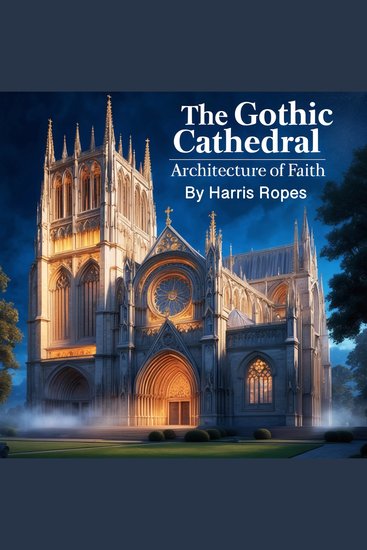
    The origins of Gothic architecture lie in the transition from the Romanesque style that dominated Europe in the early medieval period. Romanesque churches, with their thick walls, small windows, and rounded arches, provided a sense of solidity but limited natural light and height. By the 12th century, new architectural innovations emerged, driven by a desire for greater verticality, spacious interiors, and an infusion of divine light. These aspirations led to the birth of the Gothic style, first appearing in France before spreading across Europe. 
    One of the key figures in this transition was Abbot Suger of the Abbey of Saint-Denis, near Paris. In the 1130s, he initiated the reconstruction of the abbey church, incorporating pointed arches, ribbed vaults, and extensive stained glass windows. Suger believed that light was a manifestation of the divine, and through these architectural changes, he sought to transform the church into a place of spiritual illumination. His innovations set a precedent for what would become the defining characteristics of Gothic architecture. 
    The pointed arch, a hallmark of the Gothic style, replaced the rounded arch of the Romanesque period. This architectural shift was more than an aesthetic change; it allowed for greater structural efficiency, enabling builders to construct taller and more spacious interiors. The ribbed vault, another significant innovation, helped distribute weight more evenly, allowing for thinner walls and the introduction of expansive stained glass windows. These windows, often adorned with biblical scenes, served both a decorative and didactic function, educating the largely illiterate medieval population about religious narratives.
    Ver libro
  • Directing Great Television - Inside TV’s New Golden Age - cover

    Directing Great Television -...

    Dan Attias

    • 0
    • 0
    • 0
    Whether it’s the high-stakes pressure of solving a last-minute problem on set, or the joy of pulling off a perfect shot by the skin of your teeth, Attias brings you right into the director’s chair, sharing his knowledge and taking you through the process one challenging episode at a time. Offering a fundamental focus on story, and eschewing industry language for plain talk, Attias offers in-depth guidance how best to work with actors, how to “speak” through the camera, how to work with a showrunner, and how to be ready for the many ways a director will be challenged, large and small. Directing Great Television is a fascinating window into television’s best shows, compelling to directors and non-directors alike. Attias’s book transcends other filmmaking guides by detailing his journey to a surprising place of self-discovery, one with applications beyond entertainment.
    Ver libro