¡Acompáñanos a viajar por el mundo de los libros!
Añadir este libro a la estantería
Grey
Escribe un nuevo comentario Default profile 50px
Grey
Suscríbete para leer el libro completo o lee las primeras páginas gratis.
All characters reduced
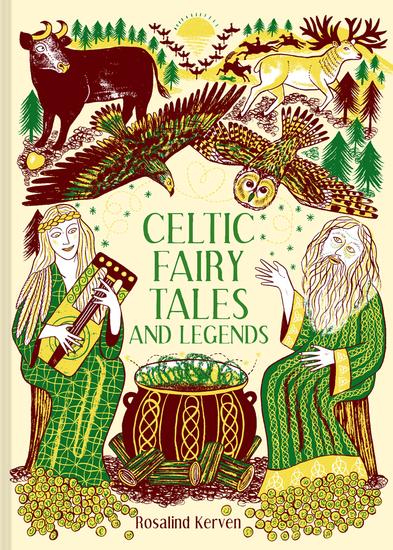
Celtic Fairy Tales and Legends - cover

Celtic Fairy Tales and Legends

Rosalind Kerven

Editorial: Batsford

  • 0
  • 0
  • 0

Sinopsis

From mermaids to dragons, 16 ancient Celtic fairy tales retold with their histories
The Celtic cultures of the British Isles – Ireland, Scotland and Wales – have produced some of the richest traditional tales in Europe. Three words best sum up their themes and flavour: adventure, enchantment and romance. 
In this book, Rosalind Kerven has revived the best Celtic fairy tales for a new generation. The stories are sourced from old folk tale collections from all three regions, alongside selected medieval Welsh and Irish texts. 
• Visit mysterious Otherworlds inside the hills and below the sea – including a land where only the truth is ever spoken.
• Meet iconic characters such as the first great Welsh poet, Taliesin, and the mighty Irish hero, Fionn mac Cumhaill.
• Cheer on bold Scots lasses such as Mallie Whuppy, as she outwits a fearsome giant, and Kate Crackernuts, who rescues a prince from bewitchment.
• Encounter witches, fairies, a bogle, talking animals and strange underwater beings.
Each story is retold from the medieval texts and oral storytelling traditions of Ireland, Scotland and Wales, with fascinating background notes and a long list of sources and further reading included. The background notes feature a list of source material, analyses of themes, and examples of similar legends from all over Europe.
Disponible desde: 01/02/2024.
Longitud de impresión: 208 páginas.


Otros libros que te pueden interesar

  • Ancestral Puebloans - The Cliff Dwellers of Mesa Verde and the Architects of the Southwest - cover

    Ancestral Puebloans - The Cliff...

    Rolf Hedger

    • 0
    • 0
    • 0
    The Ancestral Puebloans, once known as the Anasazi, were among the earliest inhabitants of the American Southwest, establishing complex societies that thrived in the arid landscapes of present-day Colorado, New Mexico, Arizona, and Utah. Their origins trace back thousands of years to nomadic hunter-gatherers who gradually transitioned into settled agricultural communities. Archaeological evidence suggests that the ancestors of the Pueblo people descended from early groups who migrated into the region over 10,000 years ago, following game and adapting to the changing environment. 
    As these early populations settled, they developed strategies to cope with the harsh desert conditions. By around 2000 BCE, they had begun cultivating maize, a crop introduced from Mesoamerica, which allowed for more stable food sources and led to the formation of permanent villages. The adoption of agriculture marked a significant shift in their way of life, as they built storage pits for surplus grain and started domesticating turkeys for additional sustenance. Over time, these settlements expanded, and small familial clusters evolved into larger communities. 
    The Basketmaker period, beginning around 1200 BCE, represents a crucial stage in Ancestral Puebloan development. During this era, people lived in semi-subterranean pit houses, circular structures dug into the earth and covered with wooden frames and mud plaster. These early homes provided insulation against the region’s extreme temperatures. The Basketmakers were also known for their exceptional weaving and basketry skills, crafting intricate containers and sandals from yucca fibers and other natural materials. Pottery, which became a defining feature of Puebloan culture, gradually emerged during the later stages of this period, allowing for improved food storage and cooking techniques.
    Ver libro
  • The Body Image Workbook - An Eight-Step Program for Learning to Like Your Looks Second Edition - cover

    The Body Image Workbook - An...

    PhD Thomas F. Cash

    • 0
    • 0
    • 0
    Have you ever wondered what it would feel like to accept and enjoy the way you look instead of constantly worrying about and criticizing your appearance? What if instead of focusing on your flaws, you felt confident with the body you have right now? 


    If you don't like what you see when you look in the mirror, you may not realize that these feelings are entirely within your grasp. You don't need extensive cosmetic surgery, pricey beauty treatments, or weight loss programs, but you may need to do something even more drastic-change your perspective and the way you view yourself. The Body Image Workbook offers a comprehensive program to help you stop focusing on your perceived imperfections and start feeling more confident about the way you look. 


    You'll learn to celebrate your body instead of feeling ashamed of it. This new edition includes discussions of our obsession with physical appearance and with body-fixing options. It helps you discover your personal body image strengths and vulnerabilities and then guides you in creating new, life-changing experiences of mindfulness and body acceptance. After completing this eight-step program, you'll look at yourself in a whole new light-seeing the beauty of the real you.
    Ver libro
  • The Betrayal - How Mitch McConnell and the Senate Republicans Abandoned America - cover

    The Betrayal - How Mitch...

    Ari Shapiro

    • 0
    • 0
    • 0
    In two previous highly regarded books on the US Senate, Ira Shapiro chronicled the institution from its apogee in the 1970s through its decline in the decades since. Now, Shapiro turns his gaze to how the Senate responded to the challenges posed by the Trump administration and its prospects under President Biden. The Founding Fathers gave the US Senate many functions, but it had one fundamental responsibility—its raison d'etre: to provide the check against a dangerous president who threatened our democracy. Two hundred and thirty years later, when Donald Trump, a potential authoritarian, finally reached the White House, the Senate should have served as both America's first and last lines of defense. Instead, we had the nightmare scenario: today's Senate, reduced through a long period of decline to a hyper-partisan, gridlocked shadow of its former self, was unable to meet its fundamental responsibility. Shapiro documents the pivotal challenges facing the Senate during the Trump administration, arguing that the body's failure to provide leadership represents the most catastrophic failure of government in American history. The last section covers the Senate's performance during President Biden's first year in office and looks forward to the 2022 Senate elections and beyond.
    Ver libro
  • The Era of Liberation - 1862-1894 - cover

    The Era of Liberation - 1862-1894

    Louis Kossuth, Abraham Lincoln,...

    • 0
    • 0
    • 0
    The late 19th Century was a time of liberation. After the collapse of empires, people of all creeds demanded their equality.We begin with two speeches that represent the old order, by Bismarck. Between the two speeches he went from being Prussia’s last Minister President to being the Germany’s first Chancellor. A statesman in the oldest mold, he argues for nationalist dominance against forces temporal and religious.The counter is given by Sullivan, who excoriates the British government for the Zulu war, asking why the country supported wars of aggression in foreign lands.From there, we move to the liberation of nations and peoples. Louis Kossuth embodied Hungary’s struggle against imperial oppression, Castelar argues for a Spanish republic, and Gambetta for the education of the peasantry in France. Across Europe, a tide rose demanding the government serve the people rather than use them.In America, Lincoln defined the struggle between the Union and Confederacy as the start of universal emancipation and freedom for all men. In contrast, Chief Joseph’s speech drips with pathos, as he lays down his spear forever, desperate to find what is left of his massacred and desolate peoples in the wilderness. After the Civil War ends, Susan Anthony’s speech demands that women should have the vote, as guaranteed in the constitution for all citizens.A series of speeches by Swami Vivekananda follow, given at the first World’s Parliament of Religions. These speeches brought Buddhism and Hinduism into the Anglosphere, and began a trend of searching for spiritual liberation alongside the more material demands of the time.We finish on a lighter tone, as Mark Twain bemoans the decay of the art of lying. In an age of such seriousness, the tall tale fell out of fashion, and the simple joy of telling a fisherman’s tale was lost.
    Ver libro
  • Bee Better - cover

    Bee Better

    Howard Steel

    • 0
    • 0
    • 0
    Have you ever wondered why honey bees are so vital to the health and vitality of our world? Join retired educator, Howard Steel, as he whimsically shares his passion for these amazing creatures and his experiences with beekeeping. Discover why these incredible producers are endangered and how we can help protect them with simple, personal lifestyle changes. Find out about the intricate and fascinating role of the honey bee in eco-system pollination. Be inspired and learn how to start up your own hive right in your backyard! Students: This book will be a helpful resource for your research paper or project. Start reading BEE BETTER today and find out what all the BUZZ is about!
    Ver libro
  • The Man Who Mistook His Wife for a Hat - cover

    The Man Who Mistook His Wife for...

    Oliver Sacks

    • 0
    • 0
    • 0
    This work provides a concise synthesis of the key insights and analysis from The Man Who Mistook His Wife for a Hat. It is an independent summary, not the original book, and has no affiliation with or endorsement from the original publication. Created for readers who want a clear, thought-provoking overview, it distills the central themes and ideas while preserving the depth and relevance of the work. 
    A collection of fascinating case histories from clinical neurology, describing patients whose brain injuries and disorders lead to bizarre perceptual distortions, memory gaps and identity shifts. Through these stories, the book explores what happens when specific mental functions fail, and what that reveals about the nature of consciousness, self and reality.
    Ver libro