Unisciti a noi in un viaggio nel mondo dei libri!
Aggiungi questo libro allo scaffale
Grey
Scrivi un nuovo commento Default profile 50px
Grey
Iscriviti per leggere l'intero libro o leggi le prime pagine gratuitamente!
All characters reduced
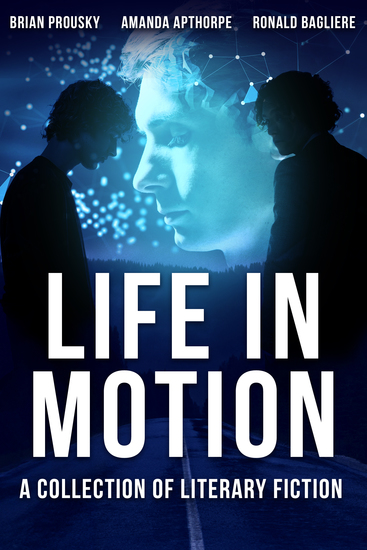
Life in Motion - A Collection Of Literary Fiction - cover

Life in Motion - A Collection Of Literary Fiction

Ronald Bagliere, Amanda Apthorpe, Brian Prousky

Casa editrice: Next Chapter

  • 0
  • 0
  • 0

Sinossi

A collection of three novels by Amanda Apthorpe, Brian Prousky & Ronald Bagliere, now available in one volume!Whispers In The Wiring: After the death of his twin brother, Catholic priest Rupert Brown is burdened with grief. When neuroscientist Athena Nevis invites him to take part in her research on heightened religious experiences, Rupert begins to question his life. Soon, Athena’s and Rupert’s interest begins to extend beyond their professional relationship, bringing them both face to face with their values and spirituality.
 
Auden Triller (Is A Killer): Simon and Auden Triller are twins whose only similarity is the surname they share. Auden’s life is as sparse as Simon’s is full. Auden realizes that the solitude he’s chosen for himself is less peaceful than insanity-making. When he finally loses his grip on reality, his actions precipitate a tragedy that threatens to sever his fraternal bond, just when he needs Simon the most.
 
Starting Over: After a devastating loss, Janet Porter’s life in Oregon's Willamette Valley has begun to settle down. When her son Nate returns home from Iraq on a medical discharge, he just wants to be left alone. Desperate for help, Janet confides in Andy McNamara - a war veteran who volunteers at the local V.A. clinic. Soon, it becomes clear that Nate's wounds go far deeper than his torn-up leg. As a tornado touches down in Willamette Valley, they're all thrown into a new world - a world of starting over.
Disponibile da: 04/08/2023.
Lunghezza di stampa: 752 pagine.

Altri libri che potrebbero interessarti

  • Gentle Breathing - From their pens to your ears genius in every story - cover

    Gentle Breathing - From their...

    Ivan Bunin

    • 0
    • 0
    • 0
    Ivan Alekseyevich Bunin was born on 22nd October 1870 in Voronezh province, in the South-West of the Russian Empire. 
    His early life was plagued by his Father’s gambling habits which caused his education to be erratic and the family to lose most of their wealth. 
    Bunin published his first poem in 1887 in St Petersburg and later in Oryol he worked for the local paper and became its editor, handily allowing him to publish his own poems and short stories.  There he met and married Varvara Pashchenko.  Ivan Bunin's debut book of poetry ‘Poems (1887–1891)’ was published in 1891. 
    This poetry and his translation of Longfellow garnered him his first Pushkin Prize.  Now he switched to writing prose and his novella ‘Antonov Apples’ is regarded as his first masterpiece.  Many more would follow. 
    The October Revolution of 1905 found Bunin in the Crimea.  Scenes of ‘class struggle’ he saw more as the oppressed people's craving for anarchy and destruction. 
    In November 1906 he began a passionate affair with Vera Muromtseva, within a few months they were touring through Egypt and Palestine.  ‘The Bird's Shadow’ collection was the result.   
    His second Pushkin Prize came in 1909 for Poems (1903–1906) and further translations.  He was now elected to the prestigious Russian Academy. 
    More widespread fame came in 1910 with ‘The Village’, a controversial and bleak portrayal of Russian country life.  Travel too beckoned them back to the Middle East, Ceylon (now Sri Lanka) and for winters in Capri with their friend Maxim Gorky.  
    That friendship suddenly ended in April 1917 as the revolution began to ferment in war-ravaged Russia.  After the Bolsheviks took power and the upheavals continued, he decided to leave Russia, finally achieving that in early 1920.  
    It would take some time to heal the wounds and stress he had been under and for his writing to begin again.  Settled in France, Bunin published many of his previous works and collections of novellas.  He also made regular contributions to the Russian emigre press.  
    Although reluctant to become involved in politics, Bunin was now feted as both a writer and the figurehead of non-Bolshevik Russian values and traditions.  In 1933 he became the first Russian to be awarded the Nobel Prize for Literature ‘for following through and developing with chastity and artfulness the traditions of Russian classic prose.’  
    In 1938 Bunin began working on the celebrated cycle of nostalgic, and erotically themed stories known Dark Avenues (or Dark Alleys).  
    As World War II broke out he chose to remain in Grasse spending the war at his remote Villa Jeanette, high in the mountains.  
    Ivan Bunin was a staunch anti-Nazi, and often, under difficult conditions, sheltered fugitives after Vichy was occupied by the Germans.  He wrote but did not publish during these years until on August 23rd the Nazi’s fled Grasse without a fight.  The next day the Americans came.  
    In May 1945 he returned to Paris and, apart from convalescing at times in Juan-les-Pins, he stayed for the rest of his life. 
    After 1948, with his health deteriorating, Bunin concentrated upon writing his memoirs and a book on Chekhov.  His last years were overshadowed by bitterness and despair at the situation in Russia and the treatment of its peoples.  He was suffering now from asthma, bronchitis and chronic pneumonia. 
    Ivan Alekseyevich Bunin died in a Paris attic flat on 8th November 1953.  Heart failure, cardiac asthma and pulmonary sclerosis were given as the causes of death.  He was 83.
    Mostra libro
  • The Tales of Willowdean Forest - Short Stories and Legendary Tales - cover

    The Tales of Willowdean Forest -...

    William D Batts

    • 0
    • 0
    • 0
    The Tales of Willowdean Forest: 
    A secret realm. A stolen relic. A forest on the brink of war. 
    Long before maps and kingdoms, when dragons still guarded the skies and elves walked freely beneath the trees, a single act of greed broke the peace that bound them all. Now, the balance of magic and man teeters on the edge of ruin. 
    As a firestorm gathers over the enchanted Willowdean Forest, strange heroes rise from its shadows: a talking scarecrow with a mysterious past, a clever owl who sees what others cannot, and a proud stag bound by duty and destiny. Guided by a queen whose heart hides both sorrow and fire, they must uncover a truth powerful enough to heal the realm they love—or destroy it forever. 
    Old magic is stirring. Legends are waking. And the forest is ready to choose a side. 
    Perfect for fans of The Chronicles of Narnia, The Hobbit, and Redwall, The Tales of Willowdean Forest weaves magic, myth, and adventure into an unforgettable journey. With dragons, elves, enchanted forests, and talking creatures, this vivid fantasy anthology captures the timeless struggle between greed and grace, hope and despair, loyalty and fate. Written to captivate older children, teens, and fantasy-loving adults alike, these stories are a lyrical escape into a world where dragons dominate the skies and magic reigns supreme.
    Mostra libro
  • The Diary of a God - From their pens to your ears genius in every story - cover

    The Diary of a God - From their...

    Barry Pain

    • 0
    • 0
    • 0
    Barry Eric Odell Pain was born at 3 Sydney Street in Cambridge on 28th September 1864. He was one of 4 children. 
    He was educated at Sedbergh School and then Corpus Christi College, Cambridge where he read classics and contributed to and edited Granta. 
    Four years of service as an Army coach followed before he moved to London. In 1889, Cornhill Magazine published his short story ‘The Hundred Gates’.  This opened the way for Pain to advance his literary career on several fronts. He became a contributor to Punch and The Speaker, as well as joining the staff of both the Daily Chronicle and Black and White.  
    In 1897 he succeeded Jerome K Jerome as editor of To-Day but still contributed regularly, until 1928, to the Windsor Magazine. 
    It is often said that Pain was discovered by Robert Louis Stevenson, who compared his work to that of Guy de Maupassant.  It’s an apt comparison. Pain was also a master of disturbing prose but able to inject parody and light comedy into many of his works.  A simple premise could in his hands suddenly expand into a world very real but somehow emotionally fraught and on the very edge of darkness as many of these short stories demonstrate.   
    Despite applying his talents to several genres and forms today Pain is more readily thought of, especially during the first decade of the 20th Century, as perhaps the leading British humorist of his day.  These stories reveal a darker side and beg to differ. 
    Barry Pain died on 5th May 1928 in Bushey, Hertfordshire.
    Mostra libro
  • A Trip to the Other World - From their pens to your ears genius in every story - cover

    A Trip to the Other World - From...

    Kálmán Mikszáth

    • 0
    • 0
    • 0
    The bookshelves of World literature are incredible collections that have gathered together centuries of very talented authors.  From their countries and continents their fame spread and whilst among their number many are now forgotten or neglected their talents endure.  Among them is Kálmán Mikszáth.
    Mostra libro
  • Stories To Make You Cry - Sometimes you need a good cry - cover

    Stories To Make You Cry -...

    Anton Chekhov, Stephen Crane,...

    • 0
    • 0
    • 0
    When we read or listen, words can have a transforming effect.  Our mood can alter in the space of a few sentences from joy to sadness.  And not just our mood.  These words can affect us physically, they can engage our emotions and even in their sadness bring a lump to our throat and tears to our eyes.  Sometimes the relief can be palpable. 
     
    Our authors, from Anton Chekhov, Stephen Crane, Willa Cather, Katherine Mansfield and a wealth of others are well aware of what their talents will evoke.   Genius has many names.   
     
    1 - Short Stories To Make You Cry  - An Introduction 
    2 - Vanka by Anton Chekhov 
    3 - A Dark Brown Dog by Stephen Crane 
    4 - Suicides by Guy de Maupassant 
    5 - The Life of Ma Parker by Katherine Mansfield 
    6 - The District Doctor by Ivan Turgenev 
    7 - Paul's Case by Willa Cather 
    8 - Hands by Sherwood Anderson 
    9 - Silence by Leonid Andreyev 
    10 - The Stones of the Village by Alice Dunbar Nelson 
    11 - Hide And Seek or Pliatki by Fyodor Sologub
    Mostra libro
  • 3 Stories About - Alcoholism - A trio of classic tales perfect for a commute walk or quiet night in - cover

    3 Stories About - Alcoholism - A...

    James Joyce, F. Scott...

    • 0
    • 0
    • 0
    There is something about the number 3.    
     
    The Ancient Greeks believed 3 was the perfect number, and in China 3 has always been a lucky number, and they know a thing or two.   
     
    Most religions also have 3 this and 3 that and, of course, in these more modern times, three’s a crowd may be too many, except when it’s a ménage à trois.  It seems good things usually come in threes. 
     
    Whatever history and culture says WE think 3, a hat-trick of stories, is a great number to explore themes and literary avenues that classic authors were so adept at creating. 
     
    From their pens to your your ears.
    Mostra libro