¡Acompáñanos a viajar por el mundo de los libros!
Añadir este libro a la estantería
Grey
Escribe un nuevo comentario Default profile 50px
Grey
Suscríbete para leer el libro completo o lee las primeras páginas gratis.
All characters reduced
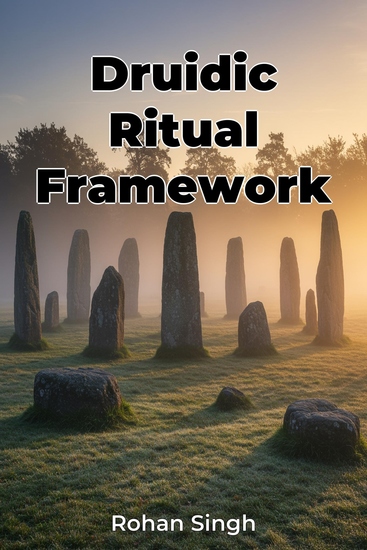
Druidic Ritual Framework - cover

Druidic Ritual Framework

Rohan Singh

Traductor A AI

Editorial: Publifye

  • 0
  • 0
  • 0

Sinopsis

"Druidic Ritual Framework" explores the structured system of ritual practices of the ancient Celtic druids, moving beyond the idea of simple, nature-based observations. By synthesizing classical texts with archaeological evidence, the book offers a fresh perspective on often misunderstood aspects of Celtic history and religion, particularly their environmental ethics. The druids, acting as religious leaders and keepers of knowledge, held rituals that were deeply intertwined with their ecological understanding, demonstrating a sophisticated connection between humanity and the natural world. The book examines foundational texts from classical authors like Julius Caesar alongside archaeological findings like votive offerings, acknowledging the limitations of each source. It progresses through three core themes: the cosmological and theological underpinnings of druidic ritual, specific practices such as sacrifice and divination, and the druids' profound environmental philosophy, including tree worship and reverence for sacred groves. This approach provides a comprehensive model of the druidic ritual framework, revealing the significance of sacred spaces and ancient rituals within Celtic society.
Disponible desde: 05/05/2025.
Longitud de impresión: 63 páginas.

Otros libros que te pueden interesar

  • David Farragut and David Dixon Porter: The Lives and Careers of the Adoptive Brothers Who Became the US Navy’s First Admirals - cover

    David Farragut and David Dixon...

    Charles River Editors

    • 0
    • 0
    • 0
    Americans have long been fascinated by the Civil War, marveling at the size of the battles, the leadership of the generals, and the courage of the soldiers. Since the war's start over 150 years ago, the battles have been subjected to endless debate among historians and the generals themselves. The Civil War was the deadliest conflict in American history, and had the two sides realized it would take 4 years and inflict over a million casualties, it might not have been fought. Since it did, however, historians and history buffs alike have been studying and analyzing the biggest battles ever since.  
    	Meanwhile, the North managed to have spectacular success jointly coordinating operations between the Army and Navy, thanks in large measure to the leadership of officers like David Farragut. While generals like Ulysses S. Grant and William Tecumseh Sherman received the lion’s share of the credit for Union victories, especially in the Western Theater, naval forces were instrumental in the capture of New Orleans and Vicksburg, as well as at Fort Donelson and Fort Henry, and Farragut was immediately recognized for his service. Congress made him the nation’s first Rear Admiral in history in 1862, and Farragut would also go on to become the first man in the history of the U.S. Navy to attain the rank of Admiral.  
    	Porter was recognized throughout the Civil War for his service, even as he was subjected to the kind of politicking that marked the war effort in Washington, and he became just the second man in the history of the U.S. Navy to attain the rank of Admiral. He would also have a distinguished career after the war as he helped reform the Navy.  
    David Farragut and David Dixon Porter: The Lives and Careers of the Adoptive Brothers Who Became the U.S. Navy’s First Admirals chronicles their backgrounds, and how they gained the experiences that proved so critical for the Civil War. 
    Ver libro
  • Hitler's Army - Soldiers Nazis and War in the Third Reich - cover

    Hitler's Army - Soldiers Nazis...

    Omer Bartov

    • 0
    • 0
    • 0
    In Hitler's Army, Omer Bartov focuses on the titanic struggle between Germany and the Soviet Union—where the vast majority of German troops fought—to show how the savagery of war reshaped the army in Hitler's image. Both brutalized and brutalizing, these soldiers needed to see their bitter sacrifices as noble patriotism and to justify their own atrocities by seeing their victims as subhuman. In the unprecedented ferocity and catastrophic losses of the Eastern front, soldiers embraced the idea that the war was a defense of civilization against Jewish/Bolshevik barbarism, a war of racial survival to be waged at all costs. Bartov describes the incredible scale and destruction of the invasion of Russia in horrific detail. Even in the first months—often depicted as a time of easy victories—undermanned and ill-equipped German units were stretched to the breaking point by vast distances and bitter Soviet resistance. Bartov goes on to explore letters, diaries, military reports, and other sources, showing how widespread Hitler's views became among common fighting men—men who grew up, he reminds us, under the Nazi regime. In the end, they truly became Hitler's army. 


    This book sheds new light on how deeply Nazi ideology penetrated the nation. Hitler's Army makes an important correction not merely to the historical record but to how we see the world today.
    Ver libro
  • Beacon Lights of History V5 - Booktrack Edition - cover

    Beacon Lights of History V5 -...

    John Lord

    • 0
    • 0
    • 0
    Listen to Beacon Lights of History V5 with a movie-style soundtrack and amplify your audiobook experience. 
    Volume 5 continues the commentary on world history begun in the first four volumes. This volume looks at some of the main religious figures of the Middle Ages, as well as social issues like the Crusades and the feudal system.
    Ver libro
  • History of Brazil: An Enthralling Guide to Ancient Indigenous Civilizations Portuguese Colonization the Imperial Era and Modern Times - cover

    History of Brazil: An...

    Billy Wellman

    • 0
    • 0
    • 0
    Explore Brazil’s Fascinating History! 
    Ever wondered how Brazil became the country it is today? This audiobook is your chance to dive into its past, from the early indigenous civilizations to modern times. You’ll follow the stories of brave explorers, witness the fight for independence, and see how different cultures shaped Brazil along the way. 
    As you listen, you'll uncover how Brazil's people—ranging from the first indigenous communities to European settlers—faced challenges, built cities, and created a unique society. Discover the key events that turned Brazil from a Portuguese colony into an independent nation, including the rise of the Brazilian Empire and the struggles of the modern Republic. You'll learn about Brazil’s dramatic shift from monarchy to democracy, the social and economic hurdles it faced, and the impact of colonization on its diverse population. 
    Inside, you’ll learn about:The vibrant indigenous cultures that thrived before European contactThe first encounters between native peoples and European explorers, and how these meetings changed everythingPortuguese colonization, driven by the sugar industry and the brutal realities of the slave tradeThe harsh conditions of slavery and the long fight for freedomThe rise and fall of the Brazilian Empire, including key figures and eventsBrazil’s transition from an empire to the First Republic, and the changes that followedMajor 20th-century events, such as the Vargas era and the period of military ruleAnd much more! 
    Perfect for anyone curious about Brazil, this audiobook makes complex history easy to understand. It’s not just a history lesson—it’s a journey through the events and people that made Brazil what it is now. 
    Get your copy and start exploring Brazil’s past today!
    Ver libro
  • Eyewitnesses to the Indian Wars 1865–1890 - The Struggle for Apacheria - cover

    Eyewitnesses to the Indian Wars...

    Peter Cozzens

    • 0
    • 0
    • 0
    This volume explores the history of the Apache Wars of the late 19th century Southwest through diaries, army reports, and other primary sources. Stretching from the Colorado River to the mountains east of the Rio Grande, and from northern Arizona into Sonora, Mexico, is the sprawling region once known as Apacheria. By the time the first Americans ventured into the region, the indigenous peoples known as the Apache had already been clashing with Spanish and Mexican interlopers for some time.   Eyewitnesses to the Indian Wars, 1865–1890: The Struggle for Apacheria presents a selection of outstanding original accounts pertaining to the epic struggle between American and the Apache for those coveted lands. It is the first in a five-volume series telling the saga of the military struggle for the American West in the words of the soldiers, noncombatants, and Native Americans who shaped it
    Ver libro
  • Thinking Life Through - cover

    Thinking Life Through

    Archbishop Fulton Sheen

    • 0
    • 0
    • 0
    In the face of a world crisis, which is manifestly deeper than one can imagine, many are inclined to ask: “Has Christianity failed?” Fulton Sheen’s Thinking Life Through seeks to answer this critical question. The conclusions the author proposes are far-reaching and touch upon subjects as diverse as the truth and meaning of human sexuality, the purpose of life, discordant marriages, angels, alcoholism, the vocation of the soldier, materialism, parenting, and even the question of spanking children.  
    On the critical subject of freedom, Sheen writes, “The true definition of freedom is the right to do whatever one ought, and oughtness implies law, goals, purposes, and perfection. Freedom is a moral power and not a physical one. It revolves around what man is rather than what man does. We are more free within the law than outside of it.” 
    Thinking Life Through also addresses the world’s political climate, something that in many ways mirrors the present political discourse. Focusing on the tragic decline of post-Christian society, Sheen gives special attention to both the threat of communism and the dangers of socialism. Sheen also gives clarity to the role of the individual and the family while living in a time of moral and political uncertainty. Finally, Sheen addresses good manners and politeness as he states in his quintessential style, “Another effect of materialism is to be seen in the decline of courtesy. There is politeness and decorum and a desire to please others when it is generally recognized that every person bears within himself an image of the Divine.” For anyone seeking to grow in wisdom, Thinking Life Through will be your guide.
    Ver libro