Join us on a literary world trip!
Add this book to bookshelf
Grey
Write a new comment Default profile 50px
Grey
Subscribe to read the full book or read the first pages for free!
All characters reduced
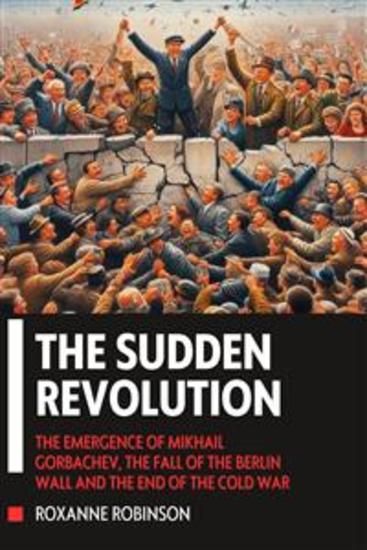
The Sudden Revolution: The Emergence of Mikhail Gorbachev the Fall of the Berlin Wall and the End of the Cold War - cover

The Sudden Revolution: The Emergence of Mikhail Gorbachev the Fall of the Berlin Wall and the End of the Cold War

Robinson Roxanne

Publisher: BookRix

  • 0
  • 0
  • 0

Summary

The Cold War defined the latter half of the 20th century, and at its center stood two superpowers locked in an ideological battle for global dominance. Yet, in an unexpected turn of events, the seemingly indestructible Soviet Union crumbled from within, leading to the fall of the Berlin Wall and the end of a decades-long standoff.

This book delves deep into this dramatic shift in world history, exploring how one man—Mikhail Gorbachev—ushered in a new era that shaped the global order.
 
In this meticulously researched book, Robinson takes readers through the critical events that unraveled the Iron Curtain, exploring Gorbachev’s rise to power, his bold reform policies of Glasnost and Perestroika, and his diplomatic efforts with world leaders like Ronald Reagan. This book provides a riveting narrative of how cracks began to form in the Soviet Bloc, leading to the 1989 fall of the Berlin Wall—a symbol of division that, for nearly 30 years, split not only a city but the world.
 
Key events such as the nuclear arms race, proxy wars, and the growing dissent within the Soviet Union are brought into sharp focus, offering readers a comprehensive understanding of the Cold War’s most crucial moments. Additionally, the book captures the global reaction to these earth-shattering changes, from scenes of jubilation in Berlin to the collapse of communist regimes across Eastern Europe, and the eventual dissolution of the USSR itself.
 
Perfect for history enthusiasts, students, and anyone fascinated by the intersection of politics, diplomacy, and human perseverance, the book provides fresh insights into the end of the Cold War and the legacy of Gorbachev—a man whose vision changed the course of history.
 
Discover the events that tore down walls, ended an era of conflict, and shaped the world we live in today.
Available since: 09/28/2024.

Other books that might interest you

  • The Mythology of the Slavs - Folk Tales and Legends from Eastern Europe - cover

    The Mythology of the Slavs -...

    Odessa Nightshade

    • 0
    • 0
    • 0
    Slavic mythology is a rich and complex tradition that has been shaped by centuries of oral storytelling, cultural exchanges, and historical transformations. Rooted in the beliefs of ancient Slavic tribes, this mythology reflects a deep connection to nature, a reverence for powerful deities, and a world teeming with spirits, gods, and legendary heroes. Unlike the more widely documented mythologies of the Greeks and Romans, Slavic myths were primarily passed down through oral tradition, making them fluid and ever-evolving. As a result, variations exist across different Slavic nations, yet common themes and figures remain central to the mythology as a whole.  
    The natural world played a crucial role in shaping Slavic beliefs. The Slavs were deeply tied to the cycles of the seasons, the power of the sun, and the mysteries of the forests and rivers. Deities like Perun, the god of thunder, and Veles, the god of the underworld, represented the dual forces of order and chaos, life and death. Forest spirits like the Leshy guarded the woods, while the Rusalka, eerie water nymphs, were believed to lure unsuspecting travelers to a watery grave. These myths not only explained the forces of nature but also provided a spiritual framework for daily life.  
    Storytelling was the primary means of preserving these myths. Legends were shared around fires, during village gatherings, and at seasonal festivals. Oral tradition allowed for constant reinterpretation, with each storyteller adding new details to fit the cultural and historical context of their time. Folklore heroes, such as Ilya Muromets and Dobrynya Nikitich, emerged as symbols of courage and perseverance, their tales reinforcing the values of strength, loyalty, and wisdom. These stories also carried moral lessons, cautioning against greed, deceit, and disrespect for the natural and supernatural world. 
    Show book
  • The Elixir of Life - cover

    The Elixir of Life

    Philip Gardiner

    • 0
    • 0
    • 0
    This audiobook has been recorded using Text to speech (TTS). 
     
    For thousands of years mankind has sought out the mythical substance we now call the Elixir of Life. The tablet, pill, fluid or even spiritual concept that will enable us to live forever. 
     
    From ancient Egypt to medieval Europe, great civilizations have secretly worked tirelessly to discover the power of nature. To alter God's predestined human life span and unlock the mysteries of life eternal. 
     
    Along the way there have been many false claims and foolish ideas. But one secret remained hidden. Locked away in a belief system now lost to us and hidden by a jealous Church. The secret of the Elixir of Life was discovered. A substance that protected mankind from illness and extended his life. A natural poison that was also a natural cure. 
     
    We shall discover the secret locked away in the mythology of the ancient worship of the serpent. It will reveal to us the truth behind the Holy Grail and the Philosophers Stone. And now, with modern science we will see the wonder of our ancestors and their amazing discovery of the Elixir of Life.
    Show book
  • Michel Foucault - The Archaeology of Knowledge - cover

    Michel Foucault - The...

    Hector Davidson

    • 0
    • 0
    • 0
    Michel Foucault, a French philosopher, historian, and social theorist, is renowned for his critical exploration of power, knowledge, and social institutions. Born in 1926, Foucault’s work spans a range of disciplines, from philosophy to sociology, psychology, and political science. His intellectual journey reflects a unique approach to understanding human societies, focusing not on abstract metaphysical systems but on the structures that shape human behavior, knowledge, and institutions. 
    Foucault’s work is marked by a critique of the traditional ways of understanding the relationship between individuals and society. He challenged the dominant historical narratives and sought to uncover the deeper structures of power that influenced the development of knowledge. One of his central ideas was that knowledge and power are intimately connected—knowledge is not neutral but shaped by power relations that determine what is considered true or false. In this sense, his work was not just theoretical but deeply political, as it explored how systems of power create the conditions for knowledge and vice versa. 
    Foucault’s philosophy is often associated with his concept of "genealogy," a method he developed to investigate historical processes and the ways in which ideas, norms, and practices evolve over time. However, it is in his "archaeology of knowledge" that he makes his most significant philosophical contributions. The archaeological method is a way of analyzing the historical layers of knowledge and uncovering the deep structures that underlie our understanding of the world. Unlike traditional historiography, which tends to focus on narratives and individuals, Foucault's archaeology examines the discourses and institutions that create and maintain knowledge, highlighting the ways they shape and limit what can be known.
    Show book
  • Undercover Angels - Virginia Hall And The Spy Women Who Fought The Nazis During World War II - cover

    Undercover Angels - Virginia...

    Davis Truman

    • 0
    • 0
    • 0
    Step into the covert world of World War II's untold heroes, the female agents of the Special Operations Executive (SOE). While history often overlooks their pivotal roles, these daring women defied societal norms and infiltrated enemy lines, rewriting the rules of warfare. 
    "Undercover Angels: Virginia Hall And The Spy Women Who Fought The Nazis During World War II" uncovers their remarkable journey, from recruitment to undercover operations and imprisonment. Drawing from classified documents and personal accounts, this gripping tale reveals their dual identity as combatants and strategic spies, leveraging femininity as a formidable weapon. 
    Explore how these extraordinary women challenged perceptions of wartime roles, leaving a legacy that continues to captivate the world's imagination, morphing from combatants into the enigmatic realm of espionage.
    Show book
  • Sartor Resartus - cover

    Sartor Resartus

    Thomas Carlyle

    • 0
    • 0
    • 0
    Sartor Resartus is one of the most unusual, even quirky, British novels to emerge from the first half of the 19th century. Published in 1836, its varied heritage reflects the earlier eccentricities of Sterne and Swift, curiously mixed with influences from Goethe. 
     
    Its subject matter is strange: it concerns a book called Clothes: Their Origin and Influence by one Diogenes Teufelsdröckh, a German philosopher. And though Thomas Carlyle (1795-1881) became a household name in his lifetime, especially for his essays, and his work as an historian and philosopher, his comic novel Sartor Resartus would prove to have a lasting effect on contemporary writers. American figures in particular - Emerson, Dickinson, Melville and Twain among them - acknowledged its influence. 
     
    In addition, Jorge Luis Borges was among the 20th-century writers to salute the work, which he encountered aged 17. Borges reflects: 'I read Sartor Resartus, and I can recall many of its pages; I know them by heart.' Sartor Resartus (which means 'The Tailor Re-tailored') chronicles the struggles of an unnamed editor attempting to produce an English-language edition of a publication, which, according to the man who has sent it to him, is 'a work of philosophy which has taken all Europe by storm'. 
     
    This is the book on clothes by Teufelsdröckh, with whom the editor was briefly acquainted on his travels. However, the more vigorously the editor sets himself to his task, the more thankless and perhaps impossible it proves. In frustration, he shares fragments of the translated work with his readers, in the search for some collective insight. When a biography of the author arrives, promising to bring some context to the work, the editor finds himself even further at a loss. His trust in Teufelsdröckh begins to unravel, and he becomes suspicious that nothing about this book, not even its author, is as it appears to be. Is it a work of genius? A palimpsest with a secret hidden in its depths? Or is the editor in receipt of something completely different and wholly unexpected? Sartor Resartus may now largely exist in the shadows of On Heroes, Hero-Worship, and the Heroic in History, and his account of the French Revolution, but this early novel represents an interesting phase in Carlyle’s literary output.
    Show book
  • Waterfall - True strange tales - cover

    Waterfall - True strange tales

    Susan Specht Oram

    • 0
    • 0
    • 0
    Mystery-thriller author Susan Specht Oram shares strange but true tales in this eighth book in the Strangers on a Train series, including a disastrous boating incident, a bizarre business conversation, a job offer with shocking hidden expectations, a surprise visit to a sacred pool and other captivating, complicated anecdotes. 
     
    This short collection of weird real-life situations might make you laugh and cry. Join her and share the surprising happenings of her life, with her humiliations and triumphs. Pick up your copy today!
    Show book