

Join us on a literary world trip!
Add this book to bookshelf
Grey
Write a new comment Default profile 50px
Grey
Subscribe to read the full book or read the first pages for free!
All characters reduced
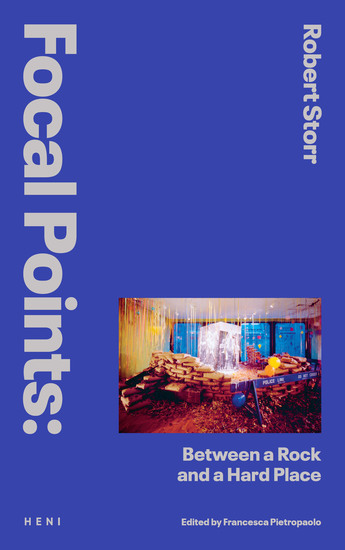
Between a Rock and a Hard Place - cover

Between a Rock and a Hard Place

Robert Storr

Publisher: HENI Publishing

  • 0
  • 0
  • 0

Summary

Focal Points is a new book series of essays, articles and reviews by acclaimed curator and critic Robert Storr. Expertly edited by art historian and curator Francesca Pietropaolo, and richly illustrated, it lends Storr’s illuminating insights into some of the critical themes across recent decades that are of timely urgency. Brilliantly scholarly, accessible and engaging, Focal Points offers fresh interpretations of the varied territory of modern and contemporary art. This third volume grapples with one of the most critical topics at the heart of culture in the United States: racial division. In the essay, originally produced in 1994 when Storr lived in the diverse neighborhood of Flatbush, Brooklyn and worked as a curator in the then predominantly white, male world of New York’s Museum of Modern Art, the author vividly describes the role of the modern art museum and multiculturalism, and analyses issues of identity and representation explored in the works of a range of artists including David Hammons, Byron Kim, Glenn Ligon and Adrian Piper, among others.
Available since: 05/22/2025.

Other books that might interest you

  • Modern Nations - The Making of Australia New Zealand and Māori Identity (2 in 1) - cover

    Modern Nations - The Making of...

    Lillian Brooks

    • 0
    • 0
    • 0
    "Modern Nations: The Making of Australia, New Zealand, and Māori Identity (2 in 1)" explores the transformative journey of two nations as they evolved from colonial settlements into independent, modern states, while also examining the ongoing struggle for recognition and identity among Indigenous communities. This two-part volume captures the complex and often challenging histories that shaped Australia and New Zealand, revealing how these countries forged their national identities amidst cultural clashes, political shifts, and social change.  
    The first section, The Making of Modern New Zealand, traces New Zealand's path from British colony to sovereign nation, highlighting the impact of European settlement, the Treaty of Waitangi, and the ongoing fight for Māori rights and cultural preservation.  
    The second section, History of Australia, explores the formation of modern Australia — from its origins as a British penal colony to its emergence as a diverse and independent nation — while also acknowledging the profound and lasting effects of colonization on Aboriginal communities.  
    Together, these narratives provide a comprehensive understanding of how colonial histories, Indigenous resistance, and nation-building efforts have shaped the modern identities of Australia, New Zealand, and their Indigenous peoples. This book is an essential resource for anyone seeking to understand the dynamic and often contested histories that continue to influence these nations today.
    Show book
  • Looking Out - Welsh Painting Social Class and International Context - cover

    Looking Out - Welsh Painting...

    Peter Lord

    • 0
    • 0
    • 0
    The six sequential essays in this collection provide a narrative of a century and a half of Welsh painting, written with an emphasis on issues of social class and national identity. Through his earlier writing, Peter Lord has contributed to the establishment of an historical tradition of Welsh painting, but because it does not feature in the wider story of Western art history as presently told, the work revealed continues to be perceived as marginal, existing in isolation from ideas and movements in other countries. These essays break new ground by discussing the concerns of Welsh painters not only in domestic terms but also in the context of the ways in which artists in other parts of Europe and in the United States reacted to the common underlying causes of those concerns. The author challenges the idea that the work of Welsh painters is relevant only to the evolution of their own communities and, through confident and detailed analysis, validates their pictures also in terms of the arts of other Western cultures.
    Show book
  • Kilwa Sultanate - The Swahili City-State That Dominated Indian Ocean Trade - cover

    Kilwa Sultanate - The Swahili...

    Rolf Hedger

    • 0
    • 0
    • 0
    Nestled along the shores of the Indian Ocean, Kilwa emerged as a vibrant cultural and trading hub whose origins can be traced back to the mingling of diverse peoples and traditions. Long before it became known as a dominant maritime power, the region was home to indigenous communities that thrived on the rich resources of the East African coast. The arrival of Arab and Persian traders introduced new goods, ideas, and cultural practices, setting in motion a transformation that would lay the groundwork for Kilwa’s future prominence. 
    The early formation of Kilwa was not the result of a single event but rather a gradual process influenced by its strategic geographic location. Its natural harbor provided an ideal meeting point for merchants navigating the vast Indian Ocean, linking the interior of Africa with the markets of Arabia, India, and even China. This advantageous position allowed Kilwa to evolve from a modest trading outpost into a bustling urban center, where economic opportunities attracted people from far and wide. 
    As the trade networks expanded, so did the cultural exchange. The integration of Islamic traditions played a significant role in shaping the identity of the nascent city-state. Early Muslim traders and scholars brought with them not only the teachings of Islam but also innovative approaches to governance, education, and law. This infusion of new perspectives blended with existing local customs, creating a unique cultural synthesis that became characteristic of the Swahili coast. Over time, the fusion of indigenous and foreign elements fostered a distinct identity, one that celebrated both its African roots and the influences of distant lands.
    Show book
  • Sustainability in Software Engineering - Harnessing Eco-Efficient Techniques for Modern Development - cover

    Sustainability in Software...

    Steve Abrams

    • 0
    • 0
    • 0
    In "Sustainability in Software Engineering: Harnessing Eco-Efficient Techniques for Modern Development," readers are invited into the evolving world of sustainable software practices where innovation meets environmental responsibility. This book equips software engineers, tech leaders, and sustainability advocates with the essential knowledge and tools needed to integrate eco-efficiency into every stage of software development. 
    From foundational concepts and principles of sustainability to advanced techniques and strategies, the book provides a thorough exploration of how software engineering can contribute positively to the environment. Readers will discover how to optimize code for energy efficiency, select the right tools and technologies that reduce environmental impact, and implement green algorithms and architectures that promote sustainability. 
    Each chapter is enriched with real-world case studies, practical examples, and actionable insights that illuminate the path toward more sustainable software practices. Metrics and measurement tools are discussed in detail, providing readers with the means to assess their progress and impact. 
    "Sustainability in Software Engineering" is more than just a guide—it's a call to action for software professionals to lead the charge in creating a more sustainable future through thoughtful, responsible, and innovative engineering practices. Whether you're a developer, a project manager, or a CTO, this book will inspire and challenge you to make sustainability a core part of your professional projects and products. 
     
    Show book
  • Alfred Hitchcock's Frenzy - The Last Masterpiece - cover

    Alfred Hitchcock's Frenzy - The...

    Raymond Foery

    • 0
    • 0
    • 0
    After an unparalleled string of artistic and commercial triumphs in the 1950s and 1960s, Alfred Hitchcock hit a career lull with the disappointing Torn Curtain and the disastrous Topaz. In 1971, the depressed director traveled to London, the city he had left in 1939 to make his reputation in Hollywood. The film he came to shoot there would mark a return to the style for which he had become known and would restore him to international acclaim.  Like The 39 Steps, Saboteur, and North by Northwest before, Frenzy repeated the classic Hitchcock trope of a man on the run from the police while chasing down the real criminal. But unlike those previous works, Frenzy also featured some elements that were new to the master of suspense’s films, including explicit nudity, depraved behavior, and a brutal act that would challenge Psycho’s shower scene for the most disturbing depiction of violence in a Hitchcock film.  In Alfred Hitchcock’s Frenzy: The Last Masterpiece, Raymond Foery recounts the history—writing, preprod
    Show book
  • Cognitive accesibility architecture and the autism spectrum - Keys to design - cover

    Cognitive accesibility...

    Berta Brusilovsky

    • 0
    • 1
    • 0
    This text deals fundamentally with design and architecture: the route of spatial recognition, which is the least known —or worked on— within the approaches of the autism spectrum given its difficulty in being synthesized in a paradigm or normative set. The objective is to create a framework to approach the design of environments and buildings, in order to facilitate spatial development in everyday life and, especially, in learning situations.
    The spatial route, which is the project, creates:
    - A set of spatial coordinates that liberates the user from the anguish of not recognizing, of not understanding the space in which he is developing. And that offer him the possibility of finding the way, directing him to where he needs or wants to go.
    - Structure of the exterior and interior, with their corresponding activities placed in a comprenssible way through concepts of organization: functional and sensorial sequence of events. And creation of spaces for group and individual tasks, paying special attention to places of transition and recovery between opposite or different activities, both physical and emotional.
    - The aspects that are developed in terms of recommendations are synthesized in a construct that brings together the aspects of general, functional, formal and sensory organization of plans, elevations and details. Achieving with these “person-space” adjustments a  higher quality of personal life and of its affective and learning  environment.
    - Design components that in the case of autism should be considered in order to seek with the project greater facility of understanding, use and space-emotional development of people from childhood to adult life.
    Show book
