¡Acompáñanos a viajar por el mundo de los libros!
Añadir este libro a la estantería
Grey
Escribe un nuevo comentario Default profile 50px
Grey
Suscríbete para leer el libro completo o lee las primeras páginas gratis.
All characters reduced
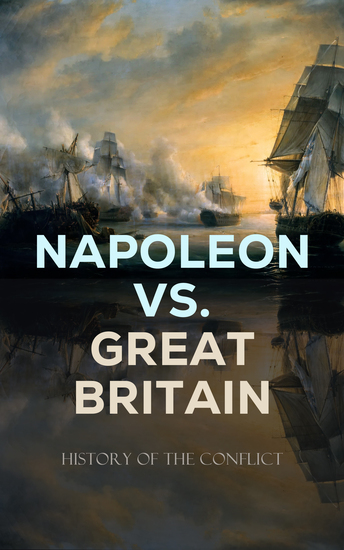
Napoleon vs Great Britain – History of the Conflict - Including Biographies & Memoirs of the Leading Commanders as well as Autobiographies of Regular Soldiers - cover

Napoleon vs Great Britain – History of the Conflict - Including Biographies & Memoirs of the Leading Commanders as well as Autobiographies of Regular Soldiers

Robert Southey, George Simmons, William Lawrence, S. E. Winbolt, Donat Henchy O'Brien, John Kincaid, Joseph Moyle Sherer, Charles Cornwallis Chesney, William Henry Fitchett

Editorial: e-artnow

  • 0
  • 0
  • 0

Sinopsis

Between 1793 and 1815, Great Britain was the most constant of France's enemies. Through its command of the sea and active military intervention in the Peninsular War, Britain played the central role in Napoleon's downfall, even as all other major powers switched back and forth. This unique collection sheds the light on this historical conflict which changed the course of history and includes historical works that cover the course of the conflict, but also memoirs of participating soldiers and commanders. 
This collection includes:
England and Napoleon (1801-1815) (S. E. Winbolt)
Battle of Waterloo (Charles Cornwallis Chesney)
Military Memoirs of Field Marshal the Duke of Wellington (Joseph Moyle Sherer)
The Autobiography of Sergeant William Lawrence (William Lawrence)
Twenty-Five Years in the Rifle Brigade (William Surtees)
Wellington's Men: Some Soldier Autobiographies (William Henry Fitchett)
A British Rifle Man (George Simmons)
Adventures in the Rifle Brigade, in the Peninsula, France, and the Netherlands from 1809 to 1815 (John Kincaid)
My Adventures During the Late War (Donat Henchy O'Brien)
The Life of Horatio Lord Nelson (Robert Southey)
Disponible desde: 04/12/2023.
Longitud de impresión: 2406 páginas.
Otros libros que te pueden interesar

  • Francesca Caccini at the Medici Court - Music and the Circulation of Power - cover

    Francesca Caccini at the Medici...

    Suzanne G. Cusick

    • 0
    • 0
    • 0
    A “priceless” study of the life and career of the Renaissance-era Italian who was the first woman to have composed an opera (Gender & History).“Extraordinary in its breadth, its detail, its insight, and its worth to all participants in early music…. Its contribution is not limited to the musical world, however, as Cusick’s remarkable command and analysis of her material…has immense value for scholars engaged in cultural studies, performance studies, history, politics, or the study of difference.”—Renaissance Quarterly A contemporary of Shakespeare and Monteverdi, and a colleague of Galileo and Artemisia Gentileschi at the Medici court, Francesca Caccini was a dominant musical figure there for thirty years. Dazzling listeners with the transformative power of her performances and the sparkling wit of the music she composed for more than a dozen court theatricals, Caccini is best remembered today as the first woman to have composed opera. Francesca Caccini at the Medici Court reveals for the first time how this multitalented composer established a fully professional musical career at a time when virtually no other women were able to achieve comparable success. Suzanne G. Cusick argues that Caccini’s career depended on the usefulness of her talents to the political agenda of Grand Duchess Christine de Lorraine, Tuscany’s de facto regent from 1606 to 1636. Drawing on Classical and feminist theory, Cusick shows how the music Caccini made for the Medici court sustained the culture that enabled Christine’s power, thereby also supporting the sexual and political aims of its women. In bringing Caccini’s surprising story so vividly to life, Cusick ultimately illuminates how music making functioned in early modern Italy as a significant medium for the circulation of power.
    Ver libro
  • Black and Female - Essays - cover

    Black and Female - Essays

    Tsitsi Dangarembga

    • 0
    • 0
    • 0
    The first wound for all of us who are classified as "black" is empire. 


    In Black and Female, Tsitsi Dangarembga examines the legacy of imperialism on her own life and on every aspect of black embodied African life. This paradigm-shifting essay collection weaves the personal and political in an illuminating exploration of race and gender. Dangarembga recounts a painful separation from her parents as a toddler, connecting this experience to the ruptures caused in Africa by human trafficking and enslavement. She argues that, after independence, the ruling party in Zimbabwe only performed inclusion for women while silencing the work of self-actualized feminists. She describes her struggles to realize her ambitions in theater, film, and literature, laying out the long path to the publication of her novels. 


    At once philosophical, intimate, and urgent, Black and Female is a powerful testimony of the pervasive and long-lasting effects of racism and patriarchy that provides an ultimately hopeful vision for change. Black feminists are "the status quo's worst nightmare." Dangarembga writes, "our conviction is deep, bolstered by a vivid imagination that reminds us that other realities are possible beyond the one that obtains."
    Ver libro
  • John Stuart Mill - Theories about the Economy and Utilitarianism - cover

    John Stuart Mill - Theories...

    Hector Davidson

    • 0
    • 0
    • 0
    John Stuart Mill, a British philosopher and political economist, remains one of the most influential thinkers of the 19th century. Born in 1806, Mill was exposed to rigorous intellectual training from an early age, particularly through his father, James Mill, a prominent utilitarian philosopher. This early exposure shaped Mill's understanding of the world, leading him to become a key figure in the development of utilitarianism, a moral theory that evaluates actions based on their ability to promote the greatest happiness for the greatest number of people. 
    Mill’s contribution to utilitarianism was both a continuation and a refinement of the ideas originally proposed by Jeremy Bentham, his intellectual predecessor. While Bentham’s version of utilitarianism focused primarily on the quantity of pleasure or pain produced by an action, Mill introduced a more nuanced view by distinguishing between higher and lower pleasures. According to Mill, pleasures of the intellect, imagination, and moral feelings were superior to those of mere physical satisfaction. This distinction between qualitative pleasures was central to Mill’s revision of utilitarian thought, emphasizing that the quality of happiness mattered as much as, if not more than, its quantity. 
    In this chapter, we explore the foundations of utilitarianism as laid out by Mill. He argued that the ultimate goal of human life is to achieve happiness, which can be defined as the presence of pleasure and the absence of pain. Mill believed that utilitarianism provided a clear and objective standard by which to judge actions, policies, and societal practices. The greatest happiness principle, which advocates for actions that maximize overall happiness, is a central tenet of Mill’s ethical framework. However, Mill also recognized the complexity of applying this principle in real-life situations, acknowledging the challenges of balancing individual rights with the greater good.
    Ver libro
  • Headlines That Matter - How News Moves Markets - cover

    Headlines That Matter - How News...

    Kavita Chandran, Saldene Lyte,...

    • 0
    • 0
    • 0
    An in-depth exploration of how breaking news affects investor sentiments and trader decisions―and ultimately the stock marketGlued to their screens for news alerts, financial traders must quickly decipher which ones are most reliable in order to make effective trading decisions. Journalists know that the headlines they craft must instantly grab the attention of a trader.This book focuses on the relatively unknown "Headlines" desk in newswire services, where journalists type breaking news for subscribers and the public. Drawing on their experiences as former Bloomberg headline writers, Chandran and Lyte reveal the processes of these teams that deftly link the two sides of news: information and interpretation.The insights this book offers will benefit students of both business journalism and finance, as well as CEOs, corporate communications directors, wealth managers, investors, and traders.
    Ver libro
  • Wolfgang Amadeus Mozart: The Life and Music of the Great Composer - cover

    Wolfgang Amadeus Mozart: The...

    Editors Charles River

    • 0
    • 0
    • 0
    Mozart once called music “my life”, and indeed few were as naturally gifted at it. Mozart’s memory and genius for music allowed him to compose lengthy works, even full-length operas, without transferring them to paper until he had fully visualized and retained them. He regarded copying as a tedious task, and this caused no small amount of consternation among performers, in particular the orchestra, some of whom received their parts minutes before curtain. This was said to be the case for the premiere of Don Giovanni, where Mozart was furiously scrawling and handing out parts to the overture with the audience in attendance. Surprisingly, these entire works, sometimes hundreds of pages, not penned until they were complete in his mind, usually arrived to the manuscript without a single blemish or change of heart. Mozart’s eccentricities are remembered centuries after his death, to the point that much of his life, illnesses and death have been mythologized, and today a lot of his legacy has been shaped by the manner in which his personality has been depicted in biographical works like Amadeus. 
    In addition to a large and consistently high-level body of work, Mozart represents for some the real beginning of the German lineage to the 20th century, although Ludwig Beethoven, greatly under Mozart’s influence, created much of that transition’s reality. Three of Mozart’s operas are continually in the top 10 works performed around the world, his piano concerti and symphonies are all in the standard repertoire (save for some of the earliest), and his choral works are treasures of the West. The bulk of his reputation was not garnered by breaking with tradition and destroying it but rather by fulfilling it with a greater beauty and naturalness than was possible for any other artist of the time.
    Ver libro
  • Discourse on Metaphysics - cover

    Discourse on Metaphysics

    Gottfried Wilhelm Leibniz

    • 0
    • 0
    • 0
    Embark on a philosophical journey into the depths of metaphysics with "Discourse on Metaphysics" by Gottfried Wilhelm Leibniz, now available as a captivating audiobook. In this groundbreaking work, Leibniz explores fundamental questions about the nature of reality, existence, and the universe. 
    Through clear and concise discourse, Leibniz delves into the nature of substance, causality, and the existence of God, offering profound insights that continue to shape philosophical discourse to this day. As listeners delve into Leibniz's intricate arguments and thought-provoking ideas, they'll be challenged to reconsider their understanding of the world and their place within it. 
    Perfect for philosophy enthusiasts and students of metaphysics, "Discourse on Metaphysics" offers a stimulating exploration of some of the most profound questions ever asked by humanity. Whether you're seeking to deepen your understanding of metaphysical concepts or simply intrigued by the mysteries of existence, this audiobook provides a rewarding and enlightening experience. 
    So, if you're ready to engage with one of the greatest minds in philosophy, start listening to "Discourse on Metaphysics" today and embark on a journey of intellectual discovery and enlightenment.
    Ver libro