¡Acompáñanos a viajar por el mundo de los libros!
Añadir este libro a la estantería
Grey
Escribe un nuevo comentario Default profile 50px
Grey
Suscríbete para leer el libro completo o lee las primeras páginas gratis.
All characters reduced
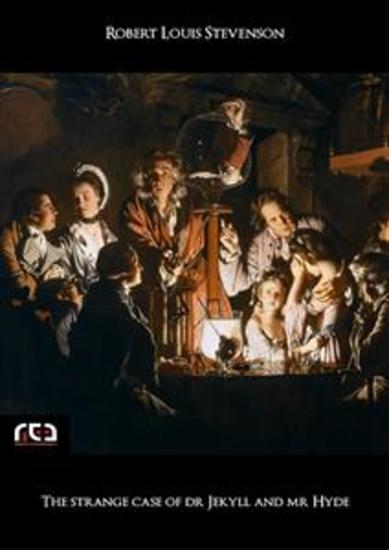
The strange case of Dr Jekyll and Mr Hyde - cover

The strange case of Dr Jekyll and Mr Hyde

Robert Louis Stevenson

Editorial: REA Multimedia

  • 0
  • 0
  • 0

Sinopsis

The Strange Case of Dr Jekyll and Mr Hyde is an 1886 Gothic novella by Scottish author Robert Louis Stevenson. It follows Gabriel John Utterson, a London-based legal practitioner who investigates a series of strange occurrences between his old friend Dr Henry Jekyll and a murderous criminal named Edward Hyde.
The Strange Case of Dr Jekyll and Mr Hyde is one of the most famous pieces of English literature, and is considered to be a defining book of the gothic horror genre. The novella has also had a sizable impact on popular culture, with the phrase "Jekyll and Hyde" being used in vernacular to refer to people with an outwardly good but sometimes shockingly evil nature.
Disponible desde: 02/08/2023.

Otros libros que te pueden interesar

  • Lily and the Lion - Story Time Episode 16 (Unabridged) - cover

    Lily and the Lion - Story Time...

    Brothers Grimm

    • 0
    • 0
    • 0
    "Lily and the Lion" There is a man with three daughters. One day, he must leave on a journey and asks each of his daughters what they would like him to bring back. The oldest wants diamonds, the second pearls, and the youngest a singing, springing lark. The man is able to find diamonds and pearls, but he fails to find a lark. On his journey home, the man sees a lark in a tall tree, and orders his servant to catch it.
    Ver libro
  • The Beautiful and Damned - cover

    The Beautiful and Damned

    F Scott itzgerald

    • 0
    • 0
    • 0
    First published in 1922, The Beautiful and the Damned followed Fitzgerald's impeccable debut, This Side of Paradise, thus securing his place in the tradition of great American novelists. Embellished with the author's lyrical prose, here is the story of Harvard-educated, aspiring aesthete Anthony Patch and his beautiful wife, Gloria. As they await the inheritance of his grandfather's fortune, their reckless marriage sways under the influence of alcohol and avarice. A devastating look at the nouveau riche, and the New York nightlife, as well as the ruinous effects of wild ambition, The Beautiful and the Damned achieved stature as one of Fitzgerald's most accomplished novels.
    Ver libro
  • History of Tom Jones a Foundling The - Book 10 (Unabridged) - cover

    History of Tom Jones a Foundling...

    Henry Fielding

    • 0
    • 0
    • 0
    A foundling of mysterious parentage brought up by Mr. Allworthy on his country estate, Tom Jones is deeply in love with the seemingly unattainable Sophia Western, the beautiful daughter of the neighboring squire though he sometimes succumbs to the charms of the local girls. When Tom is banished to make his own fortune and Sophia follows him to London to escape an arranged marriage, the adventure begins. A vivid Hogarthian panorama of eighteenth-century life, spiced with danger and intrigue, bawdy exuberance and good-natured authorial interjections, Tom Jones is one of the greatest and most ambitious comic novels in English literature.
    BOOK 10: Reader, it is impossible we should know what sort of person thou wilt be; for, perhaps, thou may'st be as learned in human nature as Shakespear himself was, and, perhaps, thou may'st be no wiser than some of his editors. Now, lest this latter should be the case, we think proper, before we go any farther together, to give thee a few wholesome admonitions; that thou may'st not as grossly misunderstand and misrepresent us, as some of the said editors have misunderstood and misrepresented their author.
    Ver libro
  • The Murderer - Bulgakov expertly explores life and death choices set on the backdrop of the Bolshevik Revolution - cover

    The Murderer - Bulgakov expertly...

    Mikhail Bulgakov

    • 0
    • 0
    • 0
    Mikhail Bulgakov was born on 15th May 1891 in Kiev, in the Kiev Governorate of the Russian Empire, into a Russian family.  He was one of seven children. 
     
    In 1901, Bulgakov attended the First Kiev Gymnasium, and developed a keen interest in Russian and European literature, theatre and opera.  After the death of his father in 1907, his mother assumed responsibility for his education.  After graduating Bulgakov entered the Medical Faculty of Kiev University and then took up a post as physician at the Kiev Military Hospital. 
     
    At the outbreak of the First World War, he volunteered as a doctor and was sent directly to the front, where he was badly injured at least twice.  To suppress chronic pain, especially in the abdomen, he injected morphine.  It took years to wean himself off. 
     
    He now took up medical posts in various towns and in 1919, he was mobilised by the Ukrainian People's Army and assigned to the Northern Caucasus.  There, he became seriously ill with typhus and barely survived.  
     
    After this illness, Bulgakov abandoned his medicine to pursue writing.  He moved to Vladikavkaz and had two plays staged there with great success.  He wrote too for various newspapers and other outlets, but his critics were many.  And growing. 
     
    When a Moscow's theatre director severely criticised Bulgakov, Stalin personally protected him, saying that a writer of Bulgakov's quality was above ‘party words’ like ‘left’ and ‘right’.   Indeed, it is said that Stalin watched ‘The Days of the Turbins’ at least 15 times. 
     
    It was not to last and by March 1929, Bulgakov's career was ruined when Government censorship stopped publication of any of his work and plays. 
     
    In despair, Bulgakov wrote a personal letter to Stalin.  He requested permission to emigrate.  He received a phone call from the Soviet leader, who asked the writer whether he really desired to leave. He replied that a Russian writer cannot live outside of his homeland.  Stalin thus gave him permission to continue working. In May 1930, he re-joined the theater, as stage director's assistant.  
     
    During the last stressful decade of his life, and in poor health, Bulgakov continued to work on ‘The Master and Margarita’, wrote plays, critical works, stories, and continued translations and dramatisations of novels.  Many of them were not published, others were derided by critics.  
     
    On 10th March 1940, Mikhail Afanasyevich Bulgakov died from nephrosclerosis.  He was 48. 
     
    ‘The Master and Margarita’ was not published in any form until the mid-1960’s 
     
    Here Bulgakov relates a story as told by a doctor describing the terrible things that humanity is capable of doing in times of war.
    Ver libro
  • The Europeans - cover

    The Europeans

    Henry James

    • 0
    • 0
    • 0
    "The Europeans" is a novel written by Henry James, first published in 1878. The story is set in the 19th century and revolves around the experiences of two European siblings, Eugenia and Felix Young, who visit their American relatives in New England. The novel explores themes of cultural clash, social expectations, and the differences between European and American values.
    Ver libro
  • Don Quixote - cover

    Don Quixote

    Miguel de Cervantes

    • 0
    • 0
    • 0
    Don Quixote is a Spanish novel by Miguel de Cervantes. It was originally published in two parts, in 1605 and 1615. Considered a founding work of Western literature, it is often labelled as the first modern novel. Don Quixote is also one of the most-translated books in the world and one of the best-selling novels of all time.The plot revolves around the adventures of a member of the lowest nobility, an hidalgo[d] from La Mancha named Alonso Quijano, who reads so many chivalric romances that he loses his mind and decides to become a knight-errant (caballero andante) to revive chivalry and serve his nation, under the name Don Quixote de la Mancha. He recruits as his squire a simple farm labourer, Sancho Panza, who brings a unique, earthy wit to Don Quixote's lofty rhetoric. In the first part of the book, Don Quixote does not see the world for what it is and prefers to imagine that he is living out a knightly story meant for the annals of all time. However, as Salvador de Madariaga pointed out in his Guía del lector del Quijote (1972 [1926]), referring to "the Sanchification of Don Quixote and the Quixotization of Sancho", as "Sancho's spirit ascends from reality to illusion, Don Quixote's declines from illusion to reality".
    Ver libro