

¡Acompáñanos a viajar por el mundo de los libros!
Añadir este libro a la estantería
Grey
Escribe un nuevo comentario Default profile 50px
Grey
Suscríbete para leer el libro completo o lee las primeras páginas gratis.
All characters reduced
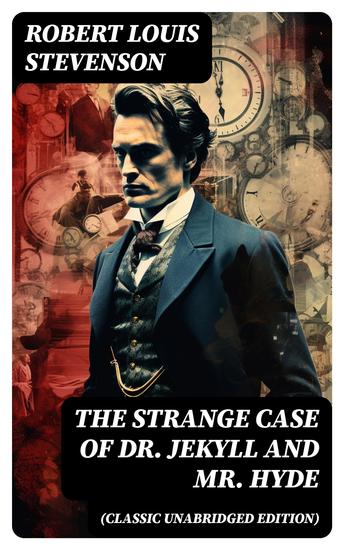
The Strange Case of Dr Jekyll and Mr Hyde (Classic Unabridged Edition) - cover

The Strange Case of Dr Jekyll and Mr Hyde (Classic Unabridged Edition)

Robert Louis Stevenson

Editorial: DigiCat

  • 0
  • 0
  • 0

Sinopsis

In Robert Louis Stevenson's iconic novella, "The Strange Case of Dr. Jekyll and Mr. Hyde," readers are invited into the dark recesses of human nature, exploring themes of duality, morality, and the struggle between good and evil. Written in a vivid, atmospheric style characteristic of Victorian literature, the text weaves a gripping narrative through sharp dialogues and detailed characterizations, particularly focusing on the transformative experiments of the well-respected Dr. Jekyll and his sinister counterpart, Mr. Hyde. Set against the backdrop of Victorian London, Stevenson's work is both a compelling horror story and a profound psychological study, engaging with contemporary debates on identity and morality. Robert Louis Stevenson, a Scottish author born in 1850, crafted this chilling tale during a period of great interest in psychology and the emerging science of the human mind. Influenced by his own struggles with illness and a fascination with moral dilemmas, Stevenson sought to dissect the complexities of human behavior through his characters, allowing readers to confront their own internal conflicts. His experiences and cultural context profoundly informed the novella's enduring exploration of the dualities inherent in every individual. For those interested in the intricate dance of good versus evil within ourselves, Stevenson's "The Strange Case of Dr. Jekyll and Mr. Hyde" is a must-read. It offers profound insights into the human condition alongside a thrilling narrative that retains its power to intrigue and disturb. This classic unabridged edition is perfect for both new readers and those revisiting this timeless exploration of identity and morality.
Disponible desde: 03/12/2023.
Longitud de impresión: 256 páginas.

Otros libros que te pueden interesar

  • A Wireless Message - From their pens to your ears genius in every story - cover

    A Wireless Message - From their...

    Ambrose Bierce

    • 0
    • 0
    • 0
    Ambrose Gwinnett Bierce was born on 24th June 1842 at Horse Cave Creek in Meigs County, Ohio. His parents were poor but they introduced him to literature at an early age, instilling in him a deep appreciation of books, the written word and the elegance of language.  
    Growing up in Koscuisko County, Indiana poverty and religion were defining features of his childhood, and he would later describe his parents as “unwashed savages” and fanatically religious, showing him little affection but always quick to punish. He came to resent religion, and his introduction to literature appears to be their only positive effect. 
    At age 15 Bierce left home to become a printer’s devil, mixing ink and fetching type at The Northern Indian, a small Ohio paper. Falsely accused of theft he returned to his farm and spent time sending out work in the hopes of being published. 
    His Uncle Lucius advised he be sent to the Kentucky Military Institute. A year later he was commissioned as an Officer.  As the Civil War started Bierce enlisted in the 9th Indiana Infantry Regiment.  
    In April 1862 Bierce fought at the Battle of Shiloh, an experience which, though terrifying, became the source of several short stories. Two years later he sustained a serious head wound and was off duty for several months. He was discharged in early 1865.  
    A later expedition to inspect military outposts across the Great Plains took him all the way to San Francisco. He remained there to become involved with publishing and editing and to marry, Mary Ellen on Christmas Day 1871.  They had a child, Day, the following year.  
    In 1872 the family moved to England for 3 years where he wrote for Fun magazine. His son, Leigh, was born, and first book, ‘The Fiend’s Delight’, was published.  
    They returned to San Francisco and to work for a number of papers where he gained admiration for his crime reporting. In 1887 he began a column at the William Randolph Hearst’s San Francisco Examiner.  
    Bierce’s marriage fell apart when he discovered compromising letters to his wife from a secret admirer. The following year, 1889 his son Day committed suicide, depressed by romantic rejection. 
    In 1891 Bierce wrote and published the collection of 26 short stories which included ‘An Occurrence at Owl Creek Bridge’.  Success and further works including poetry followed.  
    Bierce with Hearst’s resources helped uncover a financial plot by a railroad to turn 130 million dollars of loans into a handout. Confronted by the railroad and asked to name his price Bierce answered “my price is $130 million dollars. If, when you are ready to pay, I happen to be out of town, you may hand it over to my friend, the Treasurer of the United States”.  
    He now began his first foray as a fabulist, publishing ‘Fantastic Fables’ in 1899.  But tragedy again struck two years later when his second son Leigh died of pneumonia relating to his alcoholism.  
    He continued to write short stories and poetry and also published ‘The Devil’s Dictionary’.  
    At the age of 71, in 1913 Bierce departed from Washington, D.C., for a tour of the battlefields where he had fought during the civil war. At the city of Chihuahua he wrote his last known communication, a letter to a friend. It’s closing words were “as to me, I leave here tomorrow for an unknown destination,” Ambrose Bierce then vanished without trace.
    Ver libro
  • A Wicked Woman - From their pens to your ears genius in every story - cover

    A Wicked Woman - From their pens...

    Jack London

    • 0
    • 0
    • 0
    John Griffith Chaney was born on January 12th, 1876 in San Francisco.   
    His father, William Chaney, was living with Flora Wellman when she became pregnant.  Chaney insisted she have an abortion.  Flora's response was to turn a gun on herself.  Although her wounds were not severe the trauma made her temporarily deranged. 
    In late 1876 his mother married John London and the young child was brought to live with them as they moved around the Bay area, eventually settling in Oakland where now, calling himself Jack, he completed grade school. 
    Jack worked hard at several jobs, sometimes 12-18 hours a day, but his dream was university.  He studied hard and borrowed the money to enrol in the summer of 1896 at the University of California in Berkeley. 
    In 1897, at 21, Jack searched out newspaper accounts of his mother's suicide attempt and for the name of his biological father. He wrote to Chaney, then living in Chicago, who claimed he could not be Jack’s father because he was impotent and casually asserted that London's mother had relations with other men.  Jack, devastated by the response, quit Berkeley and went to the Klondike. Other accounts suggest that his dire finances presented Jack with the excuse he needed to leave. 
    In the Klondike Jack began to gather material for his writing but also accumulated many health problems, including scurvy, which together with hip and leg problems he would carry for the rest of his life. 
    During the late 1890's Jack was regularly publishing short stories and by the turn of the century full blown novels. 
    By 1904 Jack had married, fathered two children and was now in the process of divorcing.  A stint as a reporter on the Russo-Japanese war of 1904 was equal amounts trouble and experience. But that experience was always put to good use in a continuing and remarkable output of work. 
    In 1905 he married Charmian Kittredge who at last was a soul and companion who brought him some semblance of peace despite his advancing alcoholism and his incurable wanderlust. 
    Twelve years later Jack had amassed both wealth and a literary reputation through such classics as ‘The Call of the Wild’, ‘White Fang’ and many others. He had a reputation as a social activist and was a tireless friend of the workers.   
    Jack London died suffering from dysentery, late-stage alcoholism and uremia, aged only 40, on November 22nd 1916 at his property in Glen Elen in California.
    Ver libro
  • The Awakening - cover

    The Awakening

    Kate Chopin

    • 0
    • 0
    • 0
    This wonderful novella, first published in 1899, has been described as a case study of 19th-century feminism. Kate Chopin began writing the novel in 1897 and, after its publication, it was heavily criticized as "not wholesome", "vulgar" and even "poison" by the press of the time. The novella received such a wave of disdain that the once-popular author was forced into literary obscurity. The Awakening went out of print for more than 50 years. When it was rediscovered in the 1950s, critics were in wonder at its modern sensibility. A second edition was published in 1964. Now widely read, The Awakening is critically acclaimed and it is an absolute must-read for feminists everywhere, not only for its beautiful pros but as an acknowledgment of how far we have come, albeit far more slowly than some might have hoped.
    Ver libro
  • A Country Doctor - cover

    A Country Doctor

    Franz Kafka

    • 0
    • 0
    • 0
    "A Country Doctor"  is a short story written in 1917 by Franz Kafka. It was first published in the collection of short stories of the same title. In the story, a country doctor makes an emergency visit to a sick patient on a winter night. The doctor faces absurd, surreal predicaments that pull him along and finally doom him.A Country Doctor is perhaps Kafka's most fantastical or surreal work. It takes its cue from Gothic literature – it has echoes of Edgar Allan Poe and Nathaniel Hawthorne – and analysing and identifying the core 'meaning' of the story has proved tricky. Even when set aside Kafka's other work, 'A Country Doctor' remains particularly cryptic and opaque.
    Ver libro
  • So Big - cover

    So Big

    Edna Ferber

    • 0
    • 0
    • 0
    After losing her father and her husband, Selina Peake is left to raise her only son on the farm that was left to her. Dirk Peake, a tenacious boy who grows up to be a successful bond salesman, must come to terms with his own regrets later in life after he decides not to pursue architecture, a passion that both he and his mother shared. This classic novel about family, immigration, and the role of art and culture in society asks an age-old question: Can money really buy happiness?
    Ver libro
  • Cabbages and Kings - cover

    Cabbages and Kings

    O. Henry

    • 0
    • 0
    • 0
    "Cabbages and Kings" by O. Henry is a collection of short stories set in the fictional country of Anchuria, reflecting on human nature, love, and life's unpredictability. Through vivid characters and witty narratives, it explores themes of ambition, romance, and societal contrasts with O. Henry's signature twist endings.
    Ver libro
