¡Acompáñanos a viajar por el mundo de los libros!
Añadir este libro a la estantería
Grey
Escribe un nuevo comentario Default profile 50px
Grey
Suscríbete para leer el libro completo o lee las primeras páginas gratis.
All characters reduced
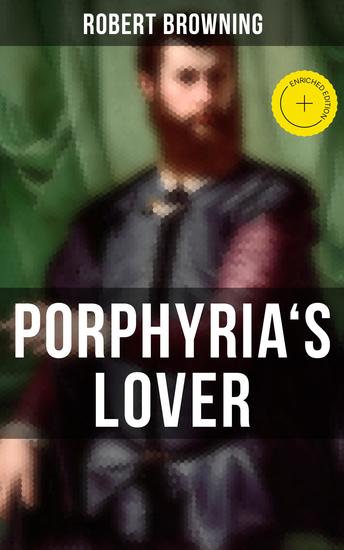
PORPHYRIA'S LOVER - Enriched edition A Psychological Poem - cover

PORPHYRIA'S LOVER - Enriched edition A Psychological Poem

Robert Browning

Editorial: Musaicum Books

  • 0
  • 0
  • 0

Sinopsis

Robert Browning's 'Porphyria's Lover' is a dramatic monologue that delves into the depths of human psychology and the complexities of love and possession. Written in a dramatic and evocative style, the poem explores themes of power dynamics, obsession, and madness. The chilling narrative unfolds through the voice of the narrator, who reveals his twisted emotions and justifies his heinous actions in a startling confession. Browning's use of imagery and language creates a haunting atmosphere that lingers with the reader long after the poem's conclusion, showcasing his mastery of poetic craft. Robert Browning, a prominent Victorian poet, was known for his exploration of the human psyche and themes of love and morality. His own life experiences and keen observations of human behavior provided fertile ground for his literary endeavors, including 'Porphyria's Lover'. Browning's skillful portrayal of the darker aspects of the human soul resonates with readers to this day, making his work timeless and thought-provoking. I highly recommend 'Porphyria's Lover' to readers interested in psychological thrillers and poetic explorations of the human condition. Browning's masterful craftsmanship and insightful exploration of complex emotions make this poem a compelling and unforgettable read.

In this enriched edition, we have carefully created added value for your reading experience:
- A succinct Introduction situates the work's timeless appeal and themes.
- The Synopsis outlines the central plot, highlighting key developments without spoiling critical twists.
- A detailed Historical Context immerses you in the era's events and influences that shaped the writing.
- An Author Biography reveals milestones in the author's life, illuminating the personal insights behind the text.
- A thorough Analysis dissects symbols, motifs, and character arcs to unearth underlying meanings.
- Reflection questions prompt you to engage personally with the work's messages, connecting them to modern life.
- Hand‐picked Memorable Quotes shine a spotlight on moments of literary brilliance.
- Interactive footnotes clarify unusual references, historical allusions, and archaic phrases for an effortless, more informed read.
Disponible desde: 07/08/2017.
Longitud de impresión: 85 páginas.
Otros libros que te pueden interesar

  • Poetics - cover

    Poetics

    Aristotle

    • 0
    • 0
    • 0
    Aristotle's Poetics (Greek: Περὶ ποιητικῆς; Latin: De Poetica) is the earliest surviving work of dramatic theory and first extant philosophical treatise to focus on literary theory. In it, Aristotle offers an account of what he calls "poetry" (a term that derives from a classical Greek term, ποιητής, that means "poet; author; maker" and in this context includes verse drama – comedy, tragedy, and the satyr play – as well as lyric poetry and epic poetry). They are similar in the fact that they are all imitations but different in the three ways that Aristotle describes: Differences in music rhythm, harmony, meter and melody. Difference of goodness in the characters.Difference in how the narrative is presented: telling a story or acting it out. In examining its "first principles", Aristotle finds two: 1) imitation and 2) genres and other concepts by which that of truth is applied/revealed in the poesis. His analysis of tragedy constitutes the core of the discussion. Although Aristotle's Poetics is universally acknowledged in the Western critical tradition, "almost every detail about his seminal work has aroused divergent opinions". The work was lost to the Western world for a long time. It was available in the Middle Ages and early Renaissance only through a Latin translation of an Arabic version written by Averroes.Aristotle's work on aesthetics consists of the Poetics, Politics and Rhetoric. The Poetics is specifically concerned with drama. At some point, Aristotle's original work was divided in two, each "book" written on a separate roll of papyrus.
    Ver libro
  • Time Is The Essence Of Grace - cover

    Time Is The Essence Of Grace

    Sonita Fryman

    • 0
    • 0
    • 0
    When the Father asked, ‘Do you want to write?’ the invitation was presented, and the response was a resounding ‘Yes!’ This book offers a unique opportunity to glimpse into the Father’s heart, as the author put pen to paper, often unsure of what would come forth. Within these pages, you will find solace for the lonely, hope for the longing, and comfort for those who feel forgotten. You may even discover your own story woven into the lines. At times, you will find yourself choking back tears, while at others, smiling at the victories. Yet, you will never be left without hope, just as the Father intended. 
     
    Each poem takes you on a soul-stirring journey, opening up your imagination. Much like the man in the hospital who found his Savior at the very end, or the woman in the park who discovers the answer she desperately seeks, these poems offer connection and guidance. The young teenager, unsure of her path, finds the courage to step out and embrace Hope. The poems in this collection are both inspiring and encouraging. Each one is unique and timely, serving as a gentle reminder of the deep love and care the Creator has for every human being. As you spend time meditating on the lines penned herein, you will undoubtedly find yourself uplifted and enriched.
    Ver libro
  • The House Party - cover

    The House Party

    Laura Lomas

    • 0
    • 0
    • 0
    A wild party. A friendship. A cherished pet. And a night that changes everything.
    It's Julie's eighteenth birthday, and she's throwing a party in her father's extravagant townhouse. Her boyfriend has just dumped her and her long-suffering best friend Christine is trying to pick up the pieces. As the revellers pile into the booze, down in the kitchen Christine and her boyfriend Jon – son of Julie's cleaner – clear up and dare to dream of the future.
    But as the volume goes up and the shots go down, Julie concocts a twisted cocktail of privilege, desire and destruction.
    Laura Lomas's play The House Party spins Strindberg's classic play Miss Julie into intense, fizzing life for today's generation. It was first performed at the Minerva Theatre, Chichester, in 2024, co-produced with Headlong in association with Frantic Assembly, and directed by Holly Race Roughan.
    Ver libro
  • My Land of Freedom - A poem of war and freedom - cover

    My Land of Freedom - A poem of...

    Ifeanyi Njoku

    • 0
    • 0
    • 0
    This poem is a powerful reflection on war, displacement, and the struggle for freedom. It tells the tragic story of a people who fought for liberation but were met with violence, loss, and eventual surrender. Likely referencing the Igbo experience during the Nigerian Civil War, it captures the pain of oppression and the resilience of those who endured it. 
    The poem begins with a contradiction: "In my land of freedom, I walked with fear." This highlights the irony of living in a place meant to be free but being consumed by anxiety. The people demand justice, yet their cries are silenced by violence. The line "Killing our brothers, and leaving us undone" conveys both physical loss and emotional devastation. 
    The imagery of "scorching soil" and "separated from families" paints a picture of suffering and displacement. War does not just take lives—it tears families apart and leaves hearts unable to thrive. The mention of "refugee camps" emphasizes how many were forced from their homes, left to question their identity: "Are we unlucky, to be Igbo?" This speaks to a deep sense of abandonment and injustice. 
    The poem also highlights betrayal, as leaders fail to protect their people. "Everyone was a soldier, in this war we couldn't win." This line captures the grim reality of a war where survival itself was a battle. Despite their bravery, they were up against overwhelming forces. 
    The final lines are heartbreaking: "We had to surrender, and say goodbye to our pride." This is not just a loss of battle but a loss of dignity. Yet, even in surrender, their story lives on. This poem is a tribute to resilience, a reminder of suffering, and a call to remember those who fought, even when the world turned away.
    Ver libro
  • Ever Dark: The Vampire King's Promise - Volume 4 A M M Vampire Romance - cover

    Ever Dark: The Vampire King's...

    X. Aratare

    • 0
    • 0
    • 0
    While Julian and Christian have been struggling to understand what their new Vampire lives will be going forward, they haven’t counted on their prior human lives being much more complicated. But that’s exactly the case as Christian’s parents come to dinner at Ravenscroft Manor. 
    But the boys are not the only ones finding out that their pasts are going to interfere with their presents. Balthazar is struggling to accept that he is the Immortal Eyros reborn. But he may not be the only other Immortal that is back… or maybe never left. 
    This is a FULL CAST audio drama with 12 actors, and all 9 books are complete.
    Ver libro
  • The Tragedy of Timon of Athens - cover

    The Tragedy of Timon of Athens

    William Shakespeare

    • 0
    • 0
    • 0
    The Tragedy of Timon of Athens (The Life of Tymon of Athens) is a play by William Shakespeare, probably written in collaboration with Thomas Middleton in about 1605–1606, which was published in the First Folio in 1623. It is about the fortunes of an Athenian named Timon. The central character is a beloved citizen of Athens who through tremendous generosity spends his entire fortune on corrupt hangers-on only interested in getting the next payout.
    The earliest-known production of the play was in 1674, when Thomas Shadwell wrote an adaptation under the title The History of Timon of Athens, The Man-hater. Multiple other adaptations followed over the next century, by writers such as Thomas Hull, James Love and Richard Cumberland. The straight Shakespearean text was performed at Smock Alley in Dublin in 1761, but adaptations continued to dominate the stage until well into the 20th century.
    ... Flavius arrives. He wants the money as well, but he also wants Timon to come back into society. Timon acknowledges that he has had one true friend in Flavius, a shining example of an otherwise diseased and impure race, but laments that this man is a mere servant. He invites the last envoys from Athens, who hoped Timon might placate Alcibiades, to go hang themselves, and then dies in the wilderness. Alcibiades, marching on Athens, then throws down his glove, and ends the play reading the bitter epitaph Timon wrote for himself, part of which was composed by Callimachus:
    "Here lies a wretched corpse of wretched soul bereft:
    Seek not my name: a plague consume you wicked caitiffs left!"
    Here lie I, Timon, who alive, all living men did hate,
    Pass by, and curse thy fill, but pass and stay not here thy gait...
    Among the most significant works William Shakespeare: Hamlet, Othello, King Lear, Macbeth, Orpheus, Romeo and Juliet, Julius Caesar, Troilus and Cressida, The Tempest, Venus and Adonis, Antony and Cleopatra, Measure for Measure, The Winter's Tale and many more.
    Ver libro