Rejoignez-nous pour un voyage dans le monde des livres!
Ajouter ce livre à l'électronique
Grey
Ecrivez un nouveau commentaire Default profile 50px
Grey
Abonnez-vous pour lire le livre complet ou lisez les premières pages gratuitement!
All characters reduced
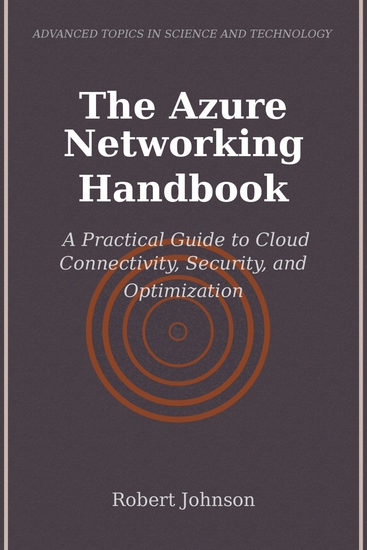
The Azure Networking Handbook - A Practical Guide to Cloud Connectivity Security and Optimization - cover

The Azure Networking Handbook - A Practical Guide to Cloud Connectivity Security and Optimization

Robert A. Johnson

Maison d'édition: HiTeX Press

  • 0
  • 0
  • 0

Synopsis

Unlock the potential of cloud connectivity with "The Azure Networking Handbook: A Practical Guide to Cloud Connectivity, Security, and Optimization." This comprehensive volume serves as your go-to resource for mastering the intricate world of Azure networking. Whether you're a beginner eager to understand the foundational concepts or an experienced professional seeking to refine your skills, this book delivers clear, concise insights into building and managing efficient, secure Azure network environments.Dive into expertly crafted chapters that unravel the complexities of network security, hybrid networking solutions, load balancing, traffic management, and more. Gain deep understanding and practical knowledge, from setting up virtual networks and implementing high-availability architectures to optimizing network performance and ensuring disaster recovery. Each chapter is designed to build your confidence in deploying scalable, robust cloud solutions tailored to your organizational needs."The Azure Networking Handbook" not only elucidates technical concepts but also shares best practices for network design, performance optimization, and governance. Immerse yourself in strategic guidance and step-by-step instructions that empower you to utilize Azure’s capabilities effectively. With this indispensable guide, transform your approach to cloud networking and ensure your infrastructure is equipped to meet the demands of a dynamic IT landscape.
Disponible depuis: 13/02/2025.
Longueur d'impression: 331 pages.

D'autres livres qui pourraient vous intéresser

  • Soil Health - Building and Maintaining Fertile Ground - cover

    Soil Health - Building and...

    Gertrude Harris

    • 0
    • 0
    • 0
    Soil structure is the physical arrangement of particles and aggregates that form the soil matrix, affecting everything from root growth to water retention and air circulation. The fundamental components of soil include sand, silt, and clay, each contributing unique properties that define the texture and function of the soil. Understanding soil structure is crucial for anyone looking to improve or maintain soil health, as it directly influences the soil’s ability to support plant life. 
    The size of soil particles determines its texture, which in turn affects its drainage and nutrient-holding capacity. Sand particles are the largest, with relatively little ability to retain nutrients or water, but they allow for excellent drainage. Silt particles are smaller and retain water better, though they may also become compacted more easily. Clay, the smallest of the soil particles, holds both water and nutrients but can create a dense, heavy structure that may not drain well, especially when wet. 
    Soil texture influences its ability to hold nutrients and support plant growth. A balanced mixture of sand, silt, and clay—known as loam—is ideal for most plants, as it combines the drainage properties of sand with the nutrient and water retention capabilities of silt and clay. Loam provides the necessary balance of aeration, moisture, and nutrient availability for healthy root systems. 
    The way these particles aggregate into clusters—known as soil structure—is just as important as texture. Soil aggregates, or clumps of soil particles bound together by organic matter, create small spaces for air and water to flow through. This porosity is essential for maintaining soil health. Well-aggregated soil has good permeability and
    Voir livre
  • When the Ice is Gone - What a Greenland Ice Core Reveals About Earth's Tumultuous History and Perilous Future - cover

    When the Ice is Gone - What a...

    Paul Bierman

    • 0
    • 0
    • 0
    In 2018, lumps of frozen soil, collected from the bottom of the world's first deep ice core and lost for decades, reappeared in Denmark. When geologist Paul Bierman and his team first melted a piece of this unique material, they were shocked to find perfectly preserved leaves, twigs, and moss. That observation led them to a startling discovery: Greenland's ice sheet had melted naturally before, about 400,000 years ago. 


    In When the Ice Is Gone, Bierman traces the story of this extraordinary finding, revealing how it radically changes our understanding of the Earth and its climate. A longtime researcher in Greenland, he begins with a brief history of the island, both human and geological. For the origins of ice coring, Bierman brings us to Camp Century, a US military base built inside Greenland's ice sheet, where engineers first drilled through mile-thick ice and into the frozen soil beneath. Decades later, a few feet of that long-frozen earth would reveal its secrets—ancient warmth and melted ice. 


    Changes in Greenland reverberate around the world, with ice melting high in the arctic affecting people everywhere. Bierman explores how losing Greenland's ice will catalyze devastating events if we don't change course and address climate change now.
    Voir livre
  • Drift Into Failure - From Hunting Broken Components to Understanding Complex Systems - cover

    Drift Into Failure - From...

    Sidney Dekker

    • 0
    • 0
    • 0
    What does the collapse of sub-prime lending have in common with a broken jackscrew in an airliner’s tailplane? Or the oil spill disaster in the Gulf of Mexico with the burn-up of Space Shuttle Columbia? These were systems that drifted into failure. While pursuing success in a dynamic, complex environment with limited resources and multiple goal conflicts, a succession of small, everyday decisions eventually produced breakdowns on a massive scale. We have trouble grasping the complexity and normality that gives rise to such large events. We hunt for broken parts, fixable properties, people we can hold accountable. Our analyses of complex system breakdowns remain depressingly linear, depressingly componential - imprisoned in the space of ideas once defined by Newton and Descartes. The growth of complexity in society has outpaced our understanding of how complex systems work and fail. Our technologies have gotten ahead of our theories. We are able to build things - deep-sea oil rigs, jackscrews, collateralized debt obligations - whose properties we understand in isolation. But in competitive, regulated societies, their connections proliferate, their interactions and interdependencies multiply, their complexities mushroom. This book explores complexity theory and systems thinking to understand better how complex systems drift into failure. It studies sensitive dependence on initial conditions, unruly technology, tipping points, diversity - and finds that failure emerges opportunistically, non-randomly, from the very webs of relationships that breed success and that are supposed to protect organizations from disaster. It develops a vocabulary that allows us to harness complexity and find new ways of managing drift.
    Voir livre
  • The Ultimate Guide to Launching Your Podcast - cover

    The Ultimate Guide to Launching...

    Stan Peters

    • 0
    • 0
    • 0
    The podcasting has become one of the most influential platforms with ideas, sharing stories, and connecting with a worldwide audience. The Ultimate Guide to Launching Your Podcast can help you pursue setting up your own podcast without breaking your bank account. Also, if you're a storyteller, an expert in a specific field, social influencer or simply someone with a passion to share, this book gives you the opportunity and tools to create your own podcast for free.
    Voir livre
  • Ultimate SQL Server and Azure SQL for Data Management and Modernization - Full Spectrum Expert Solutions for Deploying Securing and Optimizing SQL Server in Linux Cloud and Hybrid Environments with Performance Tuning Strategies - cover

    Ultimate SQL Server and Azure...

    Amit Khandelwal

    • 0
    • 0
    • 0
    An Encyclopedic Guide to Data Management and Modernization with SQL Server
    Book Description
    SQL Server 2022 marks a major advancement in data management technology, offering features that empower organizations to harness their data like never before. Ultimate SQL Server 2022 Data Management and Modernization is your comprehensive guide to mastering this powerful tool. 
    You will explore SQL Server 2022’s latest features, including support for Linux, containerization, and Kubernetes deployments—skills essential in today’s evolving data landscape. As you navigate these innovations, you will examine critical areas like security, business continuity, performance tuning, and optimization. Each chapter is crafted to illustrate practical applications in both on-premises and cloud environments, ensuring you grasp their significance. 
    Building on this foundation, you will uncover best practices and modernization techniques tailored for Windows and Linux systems. The book also includes insights from the authors' extensive experience with the Microsoft SQL Server support team, equipping you with effective troubleshooting methods to address performance challenges directly. 
    By the end of this book, you will have a thorough understanding of SQL Server deployments, empowering you to make strategic decisions and maximize its capabilities. 
    Table of Contents
    
    1. SQL Server – The Fundamentals
    2. Realms of SQL – Part 1
    3. Realms of SQL - Part 2
    4. SQL Server and Security Hand in Glove
    5. Business Continuity Strategies for SQL Offerings
    6. Accelerate SQL Server Modernization
    7. Achieving SQL Brilliance Through Best Practices
    8. Monitoring, Performance Tuning, and Optimization  
    Index
    Voir livre
  • Changing Our System Of Land Ownership - cover

    Changing Our System Of Land...

    Martin Adams

    • 0
    • 0
    • 0
    Most people aspire to become property owners and view real estate investments as an important way to build wealth and security. Mortgages are the norm. But does this system truly serve the well-being of either the economy or the individual? Martin Adams shares a view that profiting from land ownership causes social and cultural decline as well as environmental devastation. He introduces a radically new economic model that points to a more fair and abundant reality for everyone. He says this about mortgages, “As long as it remains an ongoing reality for the majority of human beings to have to pay other human beings for the land that they’re standing on, the economic system will forever cause wealth inequality at a core level.” Tune into this dynamic dialogue in order to fully understand his vision of a more equitable economic system that takes banks out of the picture and puts community in the center of economic of wealth and prosperity. (hosted by Molly Rowan Leach)
    Voir livre