¡Acompáñanos a viajar por el mundo de los libros!
Añadir este libro a la estantería
Grey
Escribe un nuevo comentario Default profile 50px
Grey
Suscríbete para leer el libro completo o lee las primeras páginas gratis.
All characters reduced
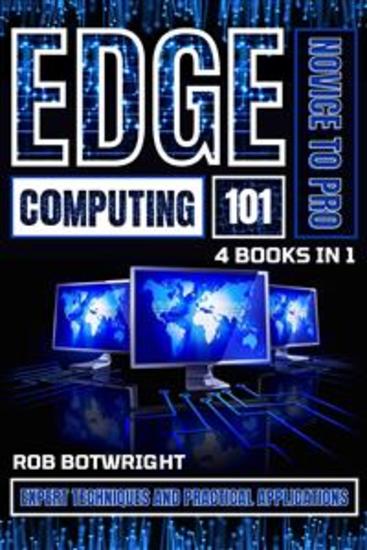
Edge Computing 101: Novice To Pro - Expert Techniques And Practical Applications - cover

Edge Computing 101: Novice To Pro - Expert Techniques And Practical Applications

Rob Botwright

Editorial: Rob Botwright

  • 0
  • 0
  • 0

Sinopsis

Introducing "Edge Computing 101: Novice to Pro" - your ultimate guide to mastering edge computing from beginner to expert level. This comprehensive book bundle includes four essential volumes packed with expert techniques and practical applications to propel your understanding and proficiency in edge computing.
Book 1, "Edge Computing Fundamentals: A Beginner's Guide to Distributed Systems," provides a solid foundation for understanding the core principles of distributed systems. Whether you're new to the field or seeking to reinforce your knowledge, this book equips you with the fundamental concepts necessary to embark on your journey into the world of edge computing.
In Book 2, "Edge Computing Architectures: Design Principles and Best Practices," you'll delve deeper into the intricacies of designing effective edge computing architectures. From deployment models to optimization techniques, this volume offers invaluable insights and best practices to help you build robust and scalable edge systems.
For those looking to advance their skills, Book 3, "Advanced Edge Computing: Scalability, Security, and Optimization Strategies," explores advanced techniques and strategies for overcoming scalability challenges, enhancing security measures, and optimizing performance in edge environments. With real-world examples and case studies, you'll gain practical expertise to tackle complex issues and achieve optimal outcomes.
Finally, Book 4, "Edge Computing in Industry 4.0: Practical Applications and Future Trends," focuses on the practical applications of edge computing across various industries, with a special emphasis on Industry 4.0. Discover how edge computing is transforming manufacturing, healthcare, smart cities, and more, and gain insights into future trends shaping the industry.
Whether you're a novice looking to build a strong foundation or a seasoned professional aiming to stay ahead of the curve, "Edge Computing 101: Novice to Pro" has you covered. With its comprehensive coverage, expert guidance, and practical insights, this book bundle is your essential companion for mastering the dynamic world of edge computing. Get your copy today and take your edge computing skills to the next level!
Disponible desde: 08/02/2024.
Otros libros que te pueden interesar

  • The Physics of Sound - Understanding the Science of Sound Waves - cover

    The Physics of Sound -...

    Mark Hedges

    • 0
    • 0
    • 0
    Sound waves are a fundamental aspect of physics, representing mechanical vibrations that travel through a medium. Unlike electromagnetic waves, which can propagate through the vacuum of space, sound waves require a material medium such as air, water, or solid substances. These waves are generated when an object vibrates, causing nearby particles in the medium to oscillate. As these particles move back and forth, they transfer energy to adjacent particles, creating a propagating wave of compression and rarefaction. This process continues outward from the source, allowing sound to travel over distances. 
    The two primary types of waves in physics are transverse and longitudinal waves. Sound waves fall into the category of longitudinal waves, meaning that the oscillations of the particles occur parallel to the direction of wave propagation. In contrast, transverse waves, such as water waves and electromagnetic waves, involve oscillations perpendicular to their direction of movement. In a sound wave, regions of compression correspond to areas where particles are densely packed together, while regions of rarefaction represent areas where the particles are spread apart. This alternating pattern of compression and rarefaction allows the wave to carry energy without transporting matter itself.
    Ver libro
  • Crypto Assets Unleashed: A Comprehensive Guide to Investing in Cryptocurrencies - Navigating Opportunities Risks and Strategies for Success - cover

    Crypto Assets Unleashed: A...

    Jonathan Richards

    • 0
    • 0
    • 0
    "Crypto Assets Unleashed" is the best resource for learning about and making investments in the financial market in the rapidly evolving world of cryptocurrencies. This book will give you the basic knowledge and strategies you need to successfully negotiate the complexities of the cryptocurrency market, regardless of your level of expertise as an investor or your level of inexperience with digital assets. 
    This book covers everything from the principles of blockchain technology and the major cryptocurrencies to risk management approaches and investing strategies that are suited for success. It does so by providing clear explanations and insights that can be put into action. In this course, you will investigate the possibilities offered by decentralized finance (DeFi), non-fungible tokens (NFTs), and rising trends that are responsible for transforming the future of global finance. 
    This book's goal is to give you the information and resources you need to capitalize on the potential that cryptocurrencies offer while safeguarding your funds from the dangers that come with investing in such a volatile market. You will be able to make decisions in the constantly evolving world of digital assets with confidence and knowledge of the pertinent facts if you can grasp the basic concepts, develop the abilities required to successfully manage risks, and create long-term success strategies.
    Ver libro
  • Trafficking Data - How China is Winning the Battle for Digital Sovereignty - cover

    Trafficking Data - How China is...

    Aynne Kokas

    • 0
    • 0
    • 0
    From TikTok and Fortnite to Grindr and Facebook, Aynne Kokas delivers an urgent look into the technology firms that gather our data, and how the Chinese government is capitalizing on this data flow for political gain. 


    In Trafficking Data, Aynne Kokas looks at how technology firms in the two largest economies in the world, the United States and China, have exploited government policy (and the lack thereof) to gather information on citizens, putting US national security at risk. Kokas argues that US government leadership failures, Silicon Valley's disruption fetish, and Wall Street's addiction to growth have fueled China's technological goldrush. In turn, American complacency yields an unprecedented opportunity for Chinese firms to gather data in the United States and quietly send it back to China, and by extension, to the Chinese government. Drawing on years of fieldwork in the US and China and a large trove of corporate and policy documents, Trafficking Data explains how China is fast becoming the global leader in internet governance and policy, and thus of the data that defines our public and private lives.
    Ver libro
  • Biodiversity Conservation - A Very Short Introduction - cover

    Biodiversity Conservation - A...

    David W. Macdonald

    • 0
    • 0
    • 0
    Extinction is a natural process. In geological time there have been several periods of mass extinction. One of these periods is unfolding right now but all the evidence suggests that current extinction rates are between a hundred and a thousand times greater than the background rate. To put this in to context, a quarter of all known mammalian species is at risk. The current extinction crisis is unique, because it is caused by the impact of one species, humans, on all others. This acceleration of species loss, and the much more widespread reductions in the populations of many species, is not merely a tragedy in aesthetics, it is also a threat to the quality of human life, indeed to the entire human enterprise. 


    Biodiversity, the diversity of life, is not only fascinating and beautiful, it is the engine of all the world's natural cycles, and the source of many of the resources on which humanity depends. Concern about biodiversity conservation is, therefore, not merely the preoccupation of a few enthusiastic naturalists—it is the lifeline business of everybody. 


    David Macdonald introduces the concept of biodiversity and the basic biological processes that it involves—evolutionary, ecological, and behavioral. He considers the various threats to biodiversity, their impacts, and some of the solutions to the problems.
    Ver libro
  • Space's Hidden Forces - How Dark Matter Holds Galaxies Together - cover

    Space's Hidden Forces - How Dark...

    Dirk Fallon

    • 0
    • 0
    • 0
    For centuries, humans have gazed up at the night sky in awe, wondering what lies beyond the stars. With the invention of powerful telescopes, astronomers began mapping galaxies, studying their motion, and uncovering patterns in how they moved through space. But something strange started to appear in the data. Galaxies were spinning in ways that defied the known laws of gravity. Based on what could be seen—the stars, dust, and gas—the galaxies should have been flying apart. The visible mass simply wasn’t enough to account for the gravitational pull holding everything together. This marked the beginning of a great cosmic mystery. 
    In the 1930s, Swiss-American astronomer Fritz Zwicky made one of the first observations that hinted at this invisible force. He studied a cluster of galaxies and noticed that they were moving too fast to be held together by the visible matter alone. He proposed the existence of “dunkle Materie,” or dark matter—an unknown substance that made up the missing mass. At the time, his ideas were largely ignored or dismissed as speculative. But in the decades that followed, more evidence began to emerge, and dark matter slowly gained credibility within the scientific community. 
    Fast forward to the 1970s, astronomer Vera Rubin provided some of the most convincing evidence that dark matter was real. By analyzing the rotation curves of spiral galaxies, she showed that stars far from the center of galaxies were moving just as quickly as those near the core. According to Newtonian physics, the stars on the edges should move slower, as the gravitational pull should weaken with distance from the center. But that wasn’t happening. Something unseen was holding these stars in orbit, acting like a glue that bound the galaxies together. This unseen substance, which does not emit, absorb, or reflect light, became known as dark matter.
    Ver libro
  • The Art Of Conjuring Alternate Realities - How Information Warfare Shapes Your World - cover

    The Art Of Conjuring Alternate...

    Sumit Kaul, Shivam Shankar...

    • 0
    • 0
    • 0
    'Shivam Shankar Singh and Anand Venkatanarayanan's stellar examination of how modern conjurers apply the art of perception management to shape reality uses wonderful Indian epics and pop culture stories to convey complex information-warfare concepts like reflexive control, cybercriminal psychology, and how authoritarians exploit the information environment to solidify power. A breath of fresh air showcasing information operations topics outside typical Western case studies, their work has pressing relevance to a global audience of laypersons and experts alike. I am excited to recommend this book to friends and colleagues.'  
    - Cody Gentry Barrow, information warfare expert, former senior intelligence officer, The Pentagon 
    'This is a beguiling and fascinating story of the worlds we have created and now live in. It sees WhatsApp and Facebook as imagined communities no more or less than nation states and religious groups, bonded and sustained by ritual and story-telling, novelty and community. Uniquely Indian, drawing on ancient myth and religious traditions, yet universal. The authors show us why we should fear the power of the gods that rule these new worlds no less than those that ruled the heavens and earth in centuries past. Their ability to shape our reality is perhaps greater than any more earthly, geographical and physical power. Nation states and political parties are both threatened by this new source of power, and ruthlessly exploiting it. Perhaps the most important battle of the century ahead will be the one for people's minds, the victor the one best able to conjure a reality people want to believe in, real or not.'  
    - Group Captain Keith Dear, former intelligence officer, Royal Air Force, former advisor to the Prime Minister (UK) on defence modernisation, science, technology and the Integrated Review 
    'As societal interactions get digitized, a crucial bastion of human agency-the ability to interpret reality via information-comes under attack. The sacred spaces of truth and objectivity are encroached upon by parasitic ideologies, beliefs and dogma. Increasingly sophisticated methods are utilized to influence the thoughts of people, and nation states turn into forces trying to shape the information environment. The machinery of a state is repurposed to target its own citizenry and create alternate realities. This book is a critical re-evaluation of the cognitive forces shaping our country and its digital architecture of information.'  
    - Pukhraj Singh, cyber intelligence analyst, former cyber operator, Government of India 
     
    HOW DO POLITICIANS IN TODAY'S world attain power? How do nations become powerful? Why do human beings follow others unquestioningly, even if it is to their own detriment? What factors determine which politicians, nations and organizations will dominate the modern world? 
    Through much of human history, societal control was determined by militaristic strength. Individuals and tribes fought to control vital resources and land. In the next part of evolution marked by colonialism and the emergence of mega-corporations, money determined power. In the recent decade, the key to supremacy has shifted again. The power and control individuals, leaders and nations have is now determined by their ability to mould the information environment. 
    In The Art of Conjuring Alternate Realities, Shivam Shankar Singh and Anand Venkatanarayanan dive into the operations of political parties, cyber criminals, godmen, nation states and intelligence agencies from around the world to explain how the power to manipulate your thoughts is being harnessed, and how information warfare is shaping your life and world.
    Ver libro