¡Acompáñanos a viajar por el mundo de los libros!
Añadir este libro a la estantería
Grey
Escribe un nuevo comentario Default profile 50px
Grey
Suscríbete para leer el libro completo o lee las primeras páginas gratis.
All characters reduced
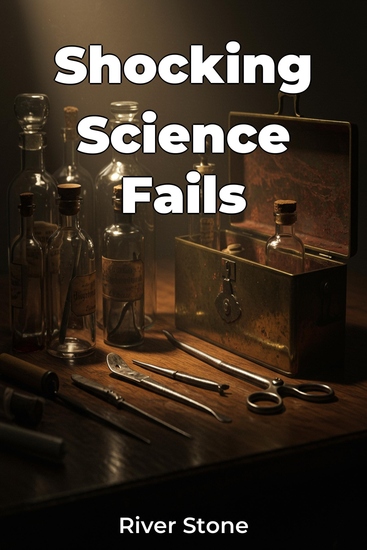
Shocking Science Fails - cover

Shocking Science Fails

River Stone

Traductor A AI

Editorial: Publifye

  • 0
  • 0
  • 0

Sinopsis

Shocking Science Fails explores the crucial role of failure in scientific progress. It highlights how scientific endeavors that went awry, debunked theories, and failed experiments have shaped our understanding of the world. Instead of portraying science as a linear path of successes, the book examines the iterative process punctuated by errors, and how these missteps contribute to refining methodologies. For instance, early anesthesia development involved scientists experimenting on themselves, sometimes with fatal results, illustrating the high stakes and unpredictable nature of scientific exploration.

 
The book adopts a historical perspective, examining experiments and theories within their specific contexts, making it accessible to a general audience interested in science history. A key argument is that scientific failures aren't mere setbacks but are integral to advancing knowledge. By analyzing these missteps, we can identify flaws in reasoning and arrive at a more accurate understanding.

 
The book progresses by first introducing the concept of "failure" in science, then exploring case studies of experiments with unexpected results, and finally examining theories that were widely accepted but later proven incorrect, such as the phlogiston theory of combustion. By focusing on the human stories behind scientific failures, the book humanizes science and emphasizes the importance of critical thinking.
Disponible desde: 03/04/2025.
Longitud de impresión: 65 páginas.
Otros libros que te pueden interesar

  • Constantinople - History of the Byzantine Empire’s Gigantic Capital - cover

    Constantinople - History of the...

    Kelly Mass

    • 0
    • 0
    • 0
    Constantinople, a city that witnessed the rise and fall of empires, served as the capital for three significant civilizations: the Roman/Byzantine Empire (330–1204 and 1261–1453), the Latin Empire (1204–1261), and the Ottoman Empire (1453–1922). Following the Turkish War of Independence, the capital was moved to Ankara, marking a new chapter in Turkish history. In 1930, the city was officially renamed Istanbul, which remains the Republic of Turkey’s largest city and financial center today. It is also the largest city in Europe. 
    In 324 AD, Emperor Constantine the Great made the fateful decision to transform the old city of Byzantium into a grand new capital, naming it "New Rome" and consecrating it on May 11, 330 AD. This strategic move solidified the city’s place in history, becoming the heart of the Eastern Roman Empire, later known as the Byzantine Empire. 
    Constantinople became a symbol of Orthodox Christianity, often referred to as the "cradle of Orthodox Christian civilization." The city's religious and cultural significance cannot be overstated; it was home to some of the most iconic architectural and religious sites in the Christian world. From the mid-fifth to the early-thirteenth century, Constantinople was Europe's largest, most affluent metropolis, a center of commerce, culture, and intellectual activity.
    Ver libro
  • Stone Breaker - The Poet James Gates Percival and the Beginning of Geology in New England - cover

    Stone Breaker - The Poet James...

    Kathleen L. Housley

    • 0
    • 0
    • 0
    Stone Breaker is an in-depth, accessible biography of a true American polymath, James Gates Percival. A poet, linguist, and unstable savant Percival was also a brilliant geologist who walked thousands of miles crisscrossing first Connecticut and then Wisconsin to lay the foundation for the work of generations of Earth scientists. Exploring the confluences of literature, art, and geology, Kathleen L. Housley reveals how one of most famous poets of the 1820's became a renowned geologist with his groundbreaking 1843 work Report on the Geology of the State of Connecticut. The book includes historic photographs and paintings of the Connecticut landscape.Publication of this book is funded by the Beatrice Fox Auerbach Foundation Fund at the Hartford Foundation for Public Giving.
    Ver libro
  • Pieces of Mee - cover

    Pieces of Mee

    Anexis Matos

    • 0
    • 0
    • 0
    Unleash your inner teen, fangirl, and your best and worse parts in this debut poetry collection. 
    The cringe of being a teenage girl. Blindness in all its glory and challenge. The fantastic parts of fandom. The power of stories. From reflections to a tragic love story of Death and their priestess, a poem is waiting to become your favorite.
    Ver libro
  • Pain Bleeds Crime - cover

    Pain Bleeds Crime

    Pamela Nathan

    • 0
    • 0
    • 0
    True stories from a forensic psychologist in prisons and out.  
     
     
    ‘The most dangerous people I met weren’t monsters. They were broken children wearing adult faces.’ 
     
    Pamela Nathan, clinical and forensic psychologist and psychoanalytic psychotherapist, uncovers the inner worlds of society’s most dangerous and broken—whether behind bars or hidden in plain sight. 
     
    In Pain Bleeds Crime, she shares twenty-three gripping true stories from her decades working in maximum-security prisons, courts, and forensic hospitals. The crimes are shocking—murder, rape, paedophilia, assault, fetishism, bestiality, and more—but what lies beneath is often even more confronting. 
     
    Each offender, whether male, female or transgender, reveals a hidden world shaped by trauma, pain, and silence. Pamela enters these inner worlds to feel and then to have revealed the internal crime scenes, to see what made them break—mentally, emotionally, morally. These aren’t excuses. They’re revelations. 
     
    You’ll come face-to-face with people whose crimes horrified the public—people who insist they’re not violent, or that “it just happened”—and come face-to-face with the dark truth: the past never really goes away. With unflinching honesty and rare insight, Pamela shows how the past never really stays buried—and how behind every act of violence, there’s a story waiting to be told. 
     
    Brutally honest, deeply unsettling, and impossible to forget, Pain Bleeds Crime is a journey into the darkest parts of humanity. 
     
     
    ‘Mad, bad, or sad—when we listen to the story, we see the person.’ 
     
     
    ‘A chilling exploration of the trauma and pain behind the most heinous crimes.’
    Ver libro
  • A Rare Recording of President John F Kennedy’s Last Speech Before His Assassination - cover

    A Rare Recording of President...

    President John Fitzgerald Kennedy

    • 0
    • 0
    • 0
    On November 22, 1963, President John F. Kennedy made a speech to the Fort Worth, Texas, Chamber of Commerce; he was assassinated later that afternoon. Kennedy had traveled to the state to unite Texas Democrats where party leaders were feuding and extremists were contributing to political tensions. Kennedy knew an intra-party feud in Texas could jeopardize his chances of carrying the state for his 1964 re-election campaign.
    Ver libro
  • This is Europe - The Way We Live Now - cover

    This is Europe - The Way We Live...

    Ben Judah

    • 0
    • 0
    • 0
    A Times, Financial Times and Telegraph Book of the Year 2023'Illuminates some of the great trends of our time' - Gideon Rachman, Financial Times'Vivid, urgent and unsettling' - Tom Holland, author of Dominion_____What does it now mean to call yourself European? Who makes up this population of some 750 million, sprawled from Ireland to Ukraine, from Sweden to Turkey? Who has always called it home, and who has newly arrived from elsewhere? Who are the people who drive our long-distance lorries, steward our criss-crossing planes, lovingly craft our legacy wines, fish our depleted waters, and risk life itself in search of safety and a new start?In a series of vivid but always empathetic portraits of other people’s lives, journalist Ben Judah invites us to meet them. Drawn from hours of painstaking interviews, these vital stories reveal a vibrant continent which has been transformed by diversity, migration, the internet, climate change, Covid, war and the quest for freedom.Laid dramatically bare, it may not always be a Europe we recognize – but this is Europe._____'An astonishing achievement' - Evening Standard'Brilliantly told . . . highly readable' - The Times
    Ver libro