¡Acompáñanos a viajar por el mundo de los libros!
Añadir este libro a la estantería
Grey
Escribe un nuevo comentario Default profile 50px
Grey
Suscríbete para leer el libro completo o lee las primeras páginas gratis.
All characters reduced
Art Inclusion - cover

Art Inclusion

River Stone

Traductor A AI

Editorial: Publifye

  • 0
  • 0
  • 0

Sinopsis

"Art Inclusion" explores the historical underrepresentation of women artists in major art institutions, revealing the systemic biases that have long shaped the art world. Challenging traditional perspectives, the book argues that a lack of talent isn't the cause; deeply ingrained social, economic, and institutional barriers have limited women's access to art education, exhibition opportunities, and lasting recognition. For instance, historically, women faced significant obstacles in accessing formal art training, impacting their artistic development and career trajectories. The book meticulously examines these barriers, tracing the evolution of women's roles in art from the Renaissance to today. It investigates curatorial biases in galleries and museums, uncovering how these biases perpetuate a skewed representation of artistic talent. Furthermore, "Art Inclusion" dedicates significant attention to feminist art movements and activism, highlighting the strategies employed to challenge the status quo. By analyzing these themes through historical context, case studies, and feminist theory, the book offers a comprehensive understanding of gender inequality in art.
Disponible desde: 06/05/2025.
Longitud de impresión: 60 páginas.

Otros libros que te pueden interesar

  • Voyagers - The Settlement of the Pacific - cover

    Voyagers - The Settlement of the...

    Nicholas Thomas

    • 0
    • 0
    • 0
    An award-winning scholar explores the sixty-thousand-year history of the Pacific islands in this dazzling, deeply researched account.One of the Best Books of 2021 — Wall Street JournalThe islands of Polynesia, Melanesia, and Micronesia stretch across a huge expanse of ocean and encompass a multitude of different peoples. Starting with Captain James Cook, the earliest European explorers to visit the Pacific were astounded and perplexed to find populations thriving thousands of miles from continents. Who were these people? From where did they come? And how were they able to reach islands dispersed over such vast tracts of ocean?  In Voyagers, the distinguished anthropologist Nicholas Thomas charts the course of the seaborne migrations that populated the islands between Asia and the Americas from late prehistory onward. Drawing on the latest research, including insights gained from genetics, linguistics, and archaeology, Thomas provides a dazzling account of these long-distance migrations, the seagoing technologies that enabled them, and the societies they left in their wake.
    Ver libro
  • England’s Entry into North America: The History of the First English Expeditions and Settlements in the Western Hemisphere - cover

    England’s Entry into North...

    Editors Charles River

    • 0
    • 0
    • 0
    Nearly 20 years before Jamestown was settled, the English established one of the earliest colonies in North America around the Chesapeake Bay region, until the colony had over 100 inhabitants. Like other early settlements, Roanoke struggled to survive in its infancy, to the extent that the colony’s leader, John White, sailed back to England in 1587 in an effort to bring more supplies and help. However, the attempts to bring back supplies were thwarted by the Spanish in the midst of the Anglo-Spanish War going on at the time, and it was not until 1590 that White reached Roanoke again. What White found when he came back to Roanoke led to one of the most enduring mysteries in American history. Despite the fact he had left over 100 people in Roanoke in 1587, White returned to literally nothing. 
    	Jamestown is fondly remembered today for being the first permanent English settlement in the colonies, but it was not fondly remembered by those who lived and died there. The English quickly learned it would be difficult to establish a permanent settlement because of the poor weather, the swampy terrain, the hostile natives living nearby, and the general inexperience and ineptitude of the English settlers. During their first winter, everyone nearly starved, and more than half of the settlers died. By the end of the winter of 1609-1610, known as the “starving time”, barely 10% of the settlers were still alive.  
    	Though the Virginian colonists had difficulty in the beginning, by the late 1620s the Chesapeake area was thriving, having become a haven for those seeking economic opportunity in the new world. Pressures in England were growing as King Charles I was on the throne. Though Charles I himself was an Anglican, many suspected him of Catholic sympathies, a suspicion not alleviated by Charles I marriage to a French Catholic princess.
    Ver libro
  • Alexander the Great in India: The History and Legacy of the Macedonian King’s Final Campaign - cover

    Alexander the Great in India:...

    Charles River Editors

    • 0
    • 0
    • 0
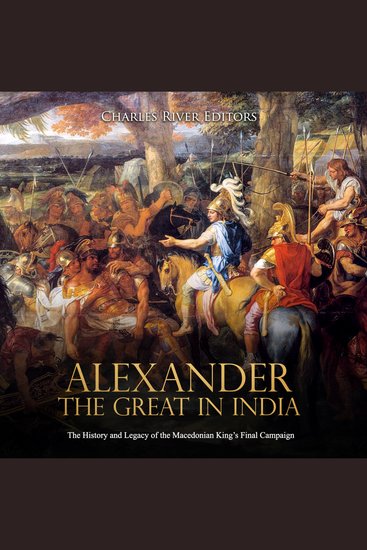
    After he had finished off the Persian Empire, Alexander must have been glad to leave Persia and its adjoining provinces at his back. Alexander was planning to march onwards, into India, and had made overtures to the wild tribesmen that inhabited the region that is now Pakistan, but he had been abruptly refused. The chieftains of the hill clans who guarded the passes of the mighty Hindu Kush mountains were determined to make a fight of it, secure in the knowledge that the high passes of their domains were virtually unconquerable. Alexander, never one to accept defiance, made his preparations and, in midwinter, a season traditionally reserved for rearmament and regrouping, he began his campaign. The Aspasioi, the Guraeans and the Assakenoi, inhabitants of the rocky valleys of north-western Pakistan, all opposed him, so Alexander destroyed their fortresses one by one, determined to extinguish them. The hill clans were fierce fighters, and each fortress, small though they generally were, was only carried by storm after days of vicious fighting which resulted in grievous losses among the Macedonian ranks. To give an idea of the brutality of this conflict, Alexander himself was seriously wounded twice during two separate sieges, taking a javelin through the shoulder fighting the Aspasioi and then a spear-thrust to the ankle in the assault against the Assakenoi fortress of Massaga. His reprisal was fierce: every fortress of the hill clans that did not surrender him was razed to the ground, and its inhabitants put to the sword, to the last man. 
    Despite the war-weariness of his veterans and many of his generals, after having vanquished the hill tribes Alexander pressed south and east into the Punjab. There he clashed with the most powerful enemy he had encountered since he had vanquished Darius at Gaugamela, the great Indian ruler Rajah Porus, whose domains included virtually the whole Punjab and who commanded an army tens of thousands strong.
    Ver libro
  • The Chaos of Me - cover

    The Chaos of Me

    Patrick S. Smith

    • 0
    • 0
    • 0
    Chaos. 
    The disrupotor of the plans of our lives. It can destroy us, only to rebuild us into something else. 
    In the Chaos of Me, Patrick S. Smith explains, in verse, the events that have shaped his life and his philosophy. From the highs of adopting a child, celebrating events, and the pain of September 11, 2001, he puts his feelings into words. Mixed in are his self-reflections and his wit, which can be chaotic.
    Ver libro
  • Salton Sea The: The History of America’s Most Unique Lake - cover

    Salton Sea The: The History of...

    Editors Charles River

    • 0
    • 0
    • 0
    In the list of popular American geological oddities and attractions, one sizeable phenomenon remains surprisingly unfamiliar to the average citizen. This may be due in part to its remote desert location, but perception of the Salton Sea in southern California is also laden with environmental concerns and is in a constant state of flux. The extensive body of inland saltwater hides a glorious commercial past and has served as an important wildlife preserve but approaches a seemingly inevitable crisis in the coming decade. 
    	The Salton Sea in not directly “on the way” to anything substantial or iconic, and is situated one hour’s drive from Palm Springs, 30 miles to the south of Indio, California on Highway 111. Its distance from Los Angeles and San Diego is approximately three hours driving time. The most recognizable natural phenomenon of Imperial and Riverside counties, it is surrounded by a rural area comprised of predominantly migrant farm workers and located in the southern Colorado desert area known as the Salton Trough, or Salton Sink. 
    	Despite being a natural occurrence filling and emptying intermittingly throughout history, the current presence of this large inland sea surrounded by sand was created accidentally in the early 20th century. First formed around 700 CE, the original and much larger version of the great inland lake was called Lake Cahuilla, connected to the Sea of Cortez. By the time the first Europeans arrived in the 16th century, the basin was completely dry as Don Juan Bautista led the first party across the basin’s expanse.  
    	The “accidental” creation of the lake’s modern version was a product of the rising Colorado that destroyed a crucial section of the canal system designed to help farmers. Millions of gallons of water were forced into the lowland area. Beyond the one breach, the entire volume of the river flowed into the Salton lowlands for nearly two years before engineers finally stopped it.
    Ver libro
  • Broken to Brave - Your Courageous Act of Healing After Intimate Betrayal - cover

    Broken to Brave - Your...

    MA Tammy Gustafson, Michelle Mays

    • 0
    • 0
    • 0
    Intimate betrayal shatters you. Everything you thought was true suddenly seems like a lie. It feels like you are falling through a black hole, unsure if it's possible to get to the other side. But there is a way through. It is possible to heal, grow stronger, and reclaim yourself.With deep compassion and expert advice, this book helps you· identify where you are in the healing journey· avoid getting stuck in the process· move forward with strength, courage, and deeper self-worth· navigate decisions about your relationshipBroken to Brave offers the guidance, encouragement, and empowerment you need to pick up the pieces of your life and create a brave, beautiful future--whether the relationship makes it or not.
    Ver libro