Junte-se a nós em uma viagem ao mundo dos livros!
Adicionar este livro à prateleira
Grey
Deixe um novo comentário Default profile 50px
Grey
Assine para ler o livro completo ou leia as primeiras páginas de graça!
All characters reduced
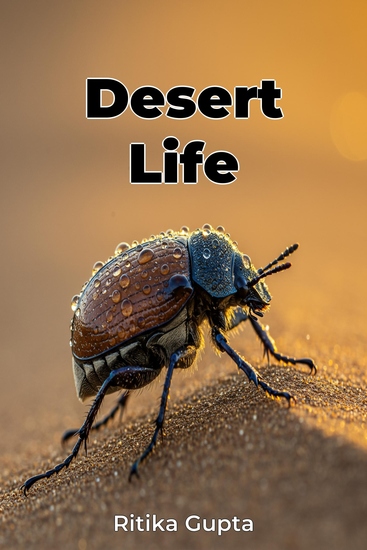
Desert Life - cover
LER

Desert Life

Ritika Gupta

Tradutor A AI

Editora: Publifye

  • 0
  • 0
  • 0

Sinopse

Desert Life unveils the remarkable strategies organisms employ to survive in arid ecosystems. Exploring the adaptations of desert plants and animals, the book highlights how life persists where water is scarce and temperatures fluctuate dramatically. A key focus is on water conservation, with examples like the deep taproots of mesquite trees and the fog-basking behavior of Namib Desert beetles, showcasing nature's ingenuity.

 
The book progresses logically, starting with an overview of major deserts and their characteristics, then diving into the diverse flora and fauna. It emphasizes thermoregulation, exploring how nocturnal habits and reflective surfaces help organisms cope with extreme heat.

 
Desert Life stands out by connecting scientific analysis with accessible writing, emphasizing adaptation and conservation principles while avoiding technical jargon. Ultimately, the book argues that understanding desert survival strategies offers valuable insights into resource management and ecological interconnectedness. These insights can then inform conservation efforts and inspire sustainable practices in an era of increasing global aridification. The book's approach blends field studies, physiological experiments, and ecological data to support its explanations.
Disponível desde: 06/03/2025.
Comprimento de impressão: 66 páginas.

Outros livros que poderiam interessá-lo

  • How Far the Light Reaches - A Life in Ten Sea Creatures - cover

    How Far the Light Reaches - A...

    Sabrina Imbler

    • 0
    • 0
    • 0
    A fascinating tour of creatures from the surface to the deepest ocean floor: this "miraculous, transcendental book" invites us to envision wilder, grander, and more abundant possibilities for the way we live (Ed Yong, author of An Immense World). A queer, mixed race writer working in a largely white, male field, science and conservation journalist Sabrina Imbler has always been drawn to the mystery of life in the sea, and particularly to creatures living in hostile or remote environments. Each essay in their debut collection profiles one such creature, including:     ·the mother octopus who starves herself while watching over her eggs,     ·the Chinese sturgeon whose migration route has been decimated by pollution and dams,     ·the bizarre, predatory Bobbitt worm (named after Lorena),     ·the common goldfish that flourishes in the wild,     ·and more.  Imbler discovers that some of the most radical models of family, community, and care can be found in the sea, from gelatinous chains that are both individual organisms and colonies of clones to deep-sea crabs that have no need for the sun, nourished instead by the chemicals and heat throbbing from the core of the Earth. Exploring themes of adaptation, survival, sexuality, and care, and weaving the wonders of marine biology with stories of their own family, relationships, and coming of age, How Far the Light Reaches is a shimmering, otherworldly debut that attunes us to new visions of our world and its miracles.    WINNER OF THE LOS ANGELES TIMES BOOK PRIZE in SCIENCE & TECHNOLOGY  Finalist for the Lambda Literary Award One of TIME’s 10 Best Nonfiction Books of the Year •  A PEOPLE Best New Book  •  A Barnes & Noble and SHELF AWARENESS Best Book of 2022  •  An Indie Next Pick  •  One of Winter’s Most Eagerly Anticipated Books: VANITY FAIR, VULTURE, BOOKRIOT
    Ver livro
  • Finding Genius: Understanding Cancer - 30 Questions 70 Geniuses 200+ Amazing Insights - cover

    Finding Genius: Understanding...

    Richard Jacobs

    • 0
    • 0
    • 0
    This book is for three kinds of audiences: 1) curious amateurs interested in science or overall wellness, 2) anyone who has been diagnosed with cancer or knows someone who has, and 3) medical, bioengineering, or other professionals who have a general knowledge of and curiosity about any or all aspects of cancer biology and treatment, but who are not experts in the field. 
    This book is the result of 70+ interviews of genius-level medical and science professionals, primarily in cancer biology, research, and medicine. They have all been asked the same set of questions, and have answered to the best of their ability and knowledge. 
    What you’re about to read is the answers to these questions, not from all the individuals, but from the most interesting 4 to 9 who answered each question. 
    At the start of my journey in science, I already had a B.S. in Chemical Engineering, but that was from 1998, certainly not 2016 when I started. Reading scientific papers was difficult at first – I understood about 10% of what I was reading. As I interviewed more scientists, researchers, clinicians and others, I started to pick up the vocabulary and thinking process needed to read scientific papers. 
    After a year of reading, my comprehension increased, and now stands at around 70%, typically. In the areas of physics or other sciences in which I’m not conversant, I understand about 30%. In advanced math, since it’s a language unto itself, especially at high levels, I am back to the 10% level. Apply yourself, and you’ll be surprised by what you can learn in a year’s time.
    Ver livro
  • The Seven Measures of the World - cover

    The Seven Measures of the World

    Piero Martin

    • 0
    • 0
    • 0
    From the beginning of history, measurement has been interwoven into the human experience, shaping our understanding of nature, personal relationships, and the supernatural. We measure the world to know our past, comprehend the present, and plan the future. 


    Renowned physicist Piero Martin explores how scientific knowledge is built around seven key pillars of measurement: the meter for length; the second for time; the kilogram for mass; the kelvin for temperature; the ampere for electricity; the mole for quantity of substance; and the candela for luminous intensity. Martin examines the history and function of these units and illustrates their applications in rich vignettes on a range of topics—from quarks to black holes, from a glass of wine to space exploration. He delves into not only the all-important numbers but also anecdotes that underline each unit's special quality. At the same time, he explains how each unit contributes to important aspects of science, from classical physics to quantum mechanics, from relativity to chemistry, from cosmology to elementary particle physics, and from medicine to modern technology. Martin eloquently shows how the entire universe can be measured and understood using just seven units.
    Ver livro
  • Generative AI in Practice - 100+ Amazing Ways Generative Artificial Intelligence Is Changing Business And Society - cover

    Generative AI in Practice - 100+...

    Bernard Marr

    • 0
    • 0
    • 0
    Generative AI is rewriting the rulebook with its seemingly endless capabilities, from crafting intricate industrial designs, writing computer code, and producing mesmerizing synthetic voices to composing enchanting music and innovating genetic breakthroughs. In Generative AI in Practice, renowned futurist Bernard Marr offers listeners a deep dive into the captivating universe of GenAI. This comprehensive guide introduces you to the basics of this groundbreaking technology and outlines the profound impact that GenAI will have on business and society. 


    In this book, Marr sheds light on the most innovative real-world GenAI applications through practical examples. You'll enjoy a captivating discussion of innovations in media and entertainment, seismic shifts in advertising, and the future trajectory of GenAI. You will: 


    ● Navigate the complex landscapes of risks and challenges posed by Generative AI 


    ● Delve into the revolutionary transformation of the job market in the age of GenAI 


    ● Understand AI's transformative impact on education, healthcare, and retail 


    ● And more 


    This audiobook includes a bonus afterword not included in the print edition.
    Ver livro
  • Rest Is Resistance - Group Discussion - cover

    Rest Is Resistance - Group...

    Vines Graener

    • 0
    • 0
    • 0
    The work we do doesn’t define our worth. Imagine a world where justice includes space for rest and leisure, away from the relentless grind created by capitalism, white supremacy, and other oppressive forces. For centuries, these systems have exploited bodies for production, leading to destruction and harm by denying the inherent divinity in every human being. But now, people are waking up to this manipulation, and they’re starting to prioritize rest and healing. 
    America was built on the labor of Black and Indigenous people, whose right to rest was denied. The capitalist system grew out of violence and the theft of labor on plantations. These oppressive systems view human bodies as property, not as divine beings. We've been conditioned to believe we must work endlessly or risk falling into poverty. But there’s more beyond this narrow view.
    Ver livro
  • The Theory That Would Not Die - How Bayes' Rule Cracked the Enigma Code Hunted Down Russian Submarines & Emerged Triumphant from Two Centuries of C - cover

    The Theory That Would Not Die -...

    Sharon Bertsch McGrayne

    • 0
    • 1
    • 0
    "This account of how a once reviled theory, Baye’s rule, came to underpin modern life is both approachable and engrossing" (Sunday Times).  A New York Times Book Review Editors’ Choice Bayes' rule appears to be a straightforward, one-line theorem: by updating our initial beliefs with objective new information, we get a new and improved belief. To its adherents, it is an elegant statement about learning from experience. To its opponents, it is subjectivity run amok. In the first-ever account of Bayes' rule for general readers, Sharon Bertsch McGrayne explores this controversial theorem and the generations-long human drama surrounding it.   McGrayne traces the rule’s discovery by an 18th century amateur mathematician through its development by French scientist Pierre Simon Laplace. She reveals why respected statisticians rendered it professionally taboo for 150 years—while practitioners relied on it to solve crises involving great uncertainty and scanty information, such as Alan Turing's work breaking Germany's Enigma code during World War II.   McGrayne also explains how the advent of computer technology in the 1980s proved to be a game-changer. Today, Bayes' rule is used everywhere from DNA de-coding to Homeland Security. Drawing on primary source material and interviews with statisticians and other scientists, The Theory That Would Not Die is the riveting account of how a seemingly simple theorem ignited one of the greatest controversies of all time.
    Ver livro