Junte-se a nós em uma viagem ao mundo dos livros!
Adicionar este livro à prateleira
Grey
Deixe um novo comentário Default profile 50px
Grey
Assine para ler o livro completo ou leia as primeiras páginas de graça!
All characters reduced
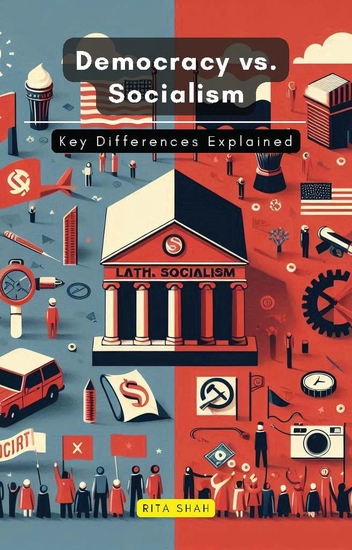
Democracy vs Socialism - Key Differences Explained - cover
LER

Democracy vs Socialism - Key Differences Explained

Rita Shah

Editora: Educohack Press

  • 0
  • 0
  • 0

Sinopse

The illustrations in this book are created by “Team Educohack”.
 
"Democracy vs. Socialism: Key Differences Explained" delves into the social, political, and economic struggles that shaped these two influential systems. We explore how democracy, embraced by the majority, rose to power and its inherent drawbacks. Similarly, we discuss socialism, its power struggles, philosophies, and devoted followers.
 
Our book summarizes democratic theory, its origins, and its impact on history, particularly in the 20th century. We examine the concept of equality, societal justifications, and unresolved issues within traditional democratic thought.
 
We also explore the functioning of contemporary democracies, introducing original views on popular sovereignty and the American constitutional system.
 
Understanding the past is crucial to predicting the future, and our book provides insights into the history, struggles, and future of both democracy and socialism.
Disponível desde: 03/01/2025.
Comprimento de impressão: 301 páginas.

Outros livros que poderiam interessá-lo

  • Unraveling the War on Expertise: Why We Must Care - "Discover the truth about expertise! Transform your mindset with our compelling audiobook on the War on Expertise" - cover

    Unraveling the War on Expertise:...

    Ronan Ashworthy

    • 0
    • 0
    • 0
    Unraveling the War on Expertise: Why We Must Care  
    Are you eager to advance in your career and deepen your knowledge in a world where expertise is often undervalued?   
    Are you in search of a thorough guide that highlights the importance of valuing authentic expertise and insight?   
    Your quest ends here!   
    This guide acts as your essential companion for enriching your understanding and engaging with practical exercises. With this resource, you are set up for success.   
    Updated for the evolving landscape of 2025.   
    Key features of this insightful guide:   
    - In-depth analysis of the significance of expertise in today’s society   
    - Comprehensive exploration of authentic insight and its benefits   
    - Effective strategies for applying knowledge and navigating challenges   
    Our guide stands out due to its thorough coverage, which is crucial for your understanding and mastery. Concepts are not just touched upon; they are comprehensively examined.   
    Please note, this guide operates independently and is not affiliated with any official organization, ensuring that it is purely a resource for your enrichment.   
    Crafted with a clear structure and accessible language, our guide ensures smooth transitions between topics. Say goodbye to convoluted jargon and embrace clear, precise, and technically accurate content.   
    So, why delay? Click the BUY NOW button, secure your guide, and embark on your journey toward valuing authentic expertise and insight!
    Ver livro
  • Fascism: What It Is And How To Fight It - cover

    Fascism: What It Is And How To...

    Leon Trotsky

    • 0
    • 0
    • 0
    Leon Trotsky (1879-1940) was a Bolshevik revolutionary and Marxist theorist. He was one of the leaders of the Russian October Revolution, second only to Vladimir Lenin. During the early days of the Soviet Union, he served first as People's Commissar for Foreign Affairs and later as the founder and commander of the Red Army and People's Commissar of War. He was also among the first members of the Politburo. 
    Why fascism was able to conquer only in those countries where social democratic or Stalinist parties blocked the workers and their allies from utilizing a revolutionary situation to remove the capitalists from power. There is a scientific analysis of fascism. It was made by the exiled Bolshevik revolutionary Leon Trotsky not as a postmortem, but during the rise of fascism. This was — along with his analysis of the nature of Stalinism — Trotsky's greatest contribution to Marxist theory. He began the task after Mussolini's victory in Italy in 1922 and brought itto ahigh pointin the years preceding Hitler'striumphin Germany in 1933.
    Ver livro
  • Disrupting the university - The stifling of academic freedom in Germany Austria and Switzerland - cover

    Disrupting the university - The...

    Heike Egner, Anke Uhlenwinkel

    • 0
    • 0
    • 0
    At universities, professors are increasingly being dismissed or demoted from high positions for allegedly disruptive behaviors. But when is a professor disruptive? In the media, you read about unpopular statements, false attitudes, bullying or abuse of power. But that is only part of the story. This book looks at the structures behind the cases and shows that the dismissals repeatedly affect certain groups of people. Instead of performance orientation, a 'right to certification' is gaining ground. Instead of academic freedom, there is increasing pressure to conduct research only in line with certain political ideologies. Based on their empirical surveys, Heike Egner and Anke Uhlenwinkel present worrying findings and remind us of the once seemingly unshakeable principles of free research and free teaching at our universities.
    
    Among other things, the authors have examined the questions of which groups of people were primarily affected by the dismissals, what accusations were made against them, what the respective course of proceedings was, and what role the media played. The findings unearthed in the process are disturbing, for the facts suggest that not only has there been a sharp increase in the number of professors who have been prematurely removed from university service against their will, but that qualitatively questionable developments have also been observed. Those affected seem to belong particularly often to certain sociological groups whose members are presumed to have been able to pursue a career in academia only through extraordinary personal effort and talent, to feel committed to the ethos of achievement, and to be particularly attached to the traditional, Humboldtian understanding of academia.
    Ver livro
  • Who’s the Devil: the Other or the West? - cover

    Who’s the Devil: the Other or...

    Régis Le Sommier

    • 0
    • 0
    • 0
    “We’ve spent nine trillion dollars bombing the Middle East like mad. We’ve sown death there, including our own. And what has it gotten us? Nothing.” 
    Donald Trump, November 1, 2024. 
    
    The figure of the devil has haunted our collective consciousness since the dawn of time. He structures our societies, whether religious or secular. Sometimes, the devil has been a friend before being “demonized”. Sometimes, by force of circumstance, he has become an ally. And sometimes, the devil must be eliminated to mask or even justify the errors of our societies. 
    Thus, during the Second World War, we made a pact with Stalin to bring down a devil deemed more formidable: Hitler. In Northern Ireland, the British ended up talking with representatives of the IRA, just as the French did a few years earlier with the Algerian FLN. Recently, the Americans negotiated with the Taliban, another terrorist group, before handing over the keys to Afghanistan. Saddam Hussein, Muammar Gaddafi and Bashar al-Assad were friends of the West before the latter precipitated their downfall, even if it meant causing chaos in their countries.
    Régis Le Sommier has been a war reporter for 27 years, and has himself interviewed a number of infamous figures. His aim is to revisit the concept of the devil in the light of recent and current conflicts, in order to answer one question: shouldn’t the deleterious consequences of geopolitics conducted “in the name of good” lead us to doubt the validity of the actions taken by our governments, even today, against those they like to refer to as devils?
    Ver livro
  • Born This Way - Science Citizenship and Inequality in the American LGBTQ+ Movement - cover

    Born This Way - Science...

    Joanna Wuest

    • 0
    • 0
    • 0
    The story of how a biologically driven understanding of gender and sexuality became central to US LGBTQ+ political and legal advocacy. 
     
    Across protests and courtrooms, LGBTQ+ advocates argue that sexual and gender identities are innate. Oppositely, conservatives incite panic over “groomers” and a contagious “gender ideology” that corrupts susceptible children. Yet, as this debate rages on, the history of what first compelled the hunt for homosexuality’s biological origin story may hold answers for the queer rights movement’s future. 
    Born This Way tells the story of how a biologically based understanding of gender and sexuality became central to LGBTQ+ advocacy. Starting in the 1950s, activists sought out mental health experts to combat the pathologizing of homosexuality. As Joanna Wuest shows, these relationships were forged in subsequent decades alongside two broader, concurrent developments: the rise of an interest-group model of rights advocacy and an explosion of biogenetic and bio-based psychological research. The result is essential reading to fully understand LGBTQ+ activism today and how clashes over science remain crucial to equal rights struggles.
    Ver livro
  • Hate and Reconciliation - Approaches to Fostering Relationships between People and Peace - cover

    Hate and Reconciliation -...

    Guido Cuyvers

    • 0
    • 0
    • 0
    Hatred is human and current. It is an intrinsic part of what can happen between people. Personal experiences can lead people to hate someone. In society and even on a global level, hatred is again and again the motor of misunderstanding and often also of violence between people. Sometimes hate smolders almost unconsciously; at other times he is furious and serves as a flag for serious violence. 


    Hatred has many faces and seems omnipresent, that much is clear. The term "Erida complex," after the Greek goddess of hate, symbolizes the common and deeply rooted nature of hatred. After examining the nature of hate, this book focuses a wide-angle lens on its many faces, in individuals and groups as well as peoples. Facing the negativity of hatred, this book presents constructive approaches to fostering relationships between people and peace.
    Ver livro