¡Acompáñanos a viajar por el mundo de los libros!
Añadir este libro a la estantería
Grey
Escribe un nuevo comentario Default profile 50px
Grey
Suscríbete para leer el libro completo o lee las primeras páginas gratis.
All characters reduced
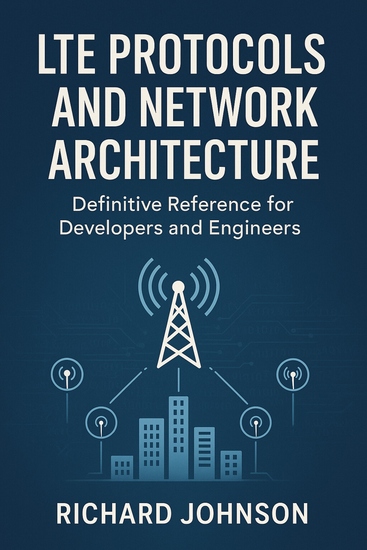
LTE Protocols and Network Architecture - Definitive Reference for Developers and Engineers - cover

LTE Protocols and Network Architecture - Definitive Reference for Developers and Engineers

Richard Johnson

Editorial: HiTeX Press

  • 0
  • 0
  • 0

Sinopsis

"LTE Protocols and Network Architecture""LTE Protocols and Network Architecture" offers an authoritative and comprehensive exploration of the LTE ecosystem, charting its evolution from legacy cellular systems to the robust, standards-driven networks of today. Beginning with the historical context and essential design motivations behind LTE, the book provides readers with a nuanced understanding of the technical, regulatory, and business factors shaping modern mobile broadband. In-depth comparisons to preceding and emerging technologies—including HSPA, WiMAX, and early 5G—contextualize LTE's pervasive role in the wireless landscape.The book delves into the architectural foundation of LTE, meticulously detailing core components, interfaces, and protocols that govern both user and control planes. Readers will gain insight into E-UTRAN and EPC elements, deployment strategies for small cells and heterogeneous networks, as well as state-of-the-art approaches such as network function virtualization and cloud-native architectures. Extensive focus is given to radio access procedures, security frameworks, and advanced mobility management, equipping practitioners with practical knowledge of bearer establishment, handover mechanisms, and resilience in failure scenarios.Beyond the protocol stack, "LTE Protocols and Network Architecture" addresses the full lifecycle of LTE network operations: from quality of service provision, resource allocation, and VoLTE integration, to comprehensive OAM (Operations, Administration, and Maintenance) practices and self-organizing network features. Readers are guided through strategies for performance measurement, troubleshooting, field validation, and future-facing enhancements including LTE-Advanced, IoT enablement, and the technology's seamless migration path toward 5G. With its blend of technical depth and real-world application, this book is an essential resource for engineers, network architects, and decision-makers seeking mastery in LTE networks.
Disponible desde: 28/05/2025.
Longitud de impresión: 250 páginas.
Otros libros que te pueden interesar

  • Theory of Computation - cover

    Theory of Computation

    Introbooks Team

    • 0
    • 0
    • 0
    Theory of computation is seen as a branch of both theoretical computer science and modern mathematics (however, it also contains some concepts from pure mathematics). Theory of computation shows how one can effectively solve a problem using a computational model. A number of computational models are described in theory of computation. Algorithm is most common format of computational model. Algorithm is a logical, systematic presentation of the process of problem solution. It theoretically represents the procedure of solving a particular problem. Flowchart is another form of such model of computation. Simply, flowchart is a graphical representation of any algorithm, using various symbols. Each symbol of flowchart represents a particular action. Algorithms and flowcharts possess a strong relation among each other. Yet, theory of computation talks more deeply and descriptively about algorithms and less about flowcharts. 
    Theories, which are too broad, are often divided into sub theories or branches. Such division allows one to approach and learn the theory efficiently. Theory of computation is divided into four main branches. Many people see these branches as individual sub theories (sub theories and branches are both different terms). These main branches/ sub theories are as following:Automata TheoryFormal Language TheoryComputability TheoryComputational Complexity Theory 
    Here, it should be noticed that many theories treat Automata Theory and Formal Language Theory as individual concepts. It is same for vice versa situation. Many treat them as a whole. In this book, they are described as individual concepts. However, you will find many connections between their concepts. The whole structure of computation theory is dedicated to describe the capabilities and limitations of modern computer system; in terms of solving a particular problem, (This process includes various steps and operations). 
    Model of computations are mathematical abstractions of computers and their functionality. These models are used to descriptive studies and researches related to computers and various functions provided by them (capabilities, limitations, etc). These computational models are divided in various types according to the characteristics and results they provide. Turning machine is one of these many models of computations. This model is being referred here since it is arguably the most reasonable and powerful model compared to other computational models. This model has a simple and straightforward structure that is easy to interpret and understand which makes the formulation and analyzing process much easier. Other models consider that infinite memory capacity is essential in order to provide results related to decidable problems. However, turning machine requires only a finite amount of memory in order to solve and provide results for a decidable problem. It means that if a turning model is capable of solving a problem; the very same problem can be solved using any other computer that has a finite amount of available memory. 
    However, some researchers denied the turning model being the most reliable model. They do not deny its functions or capabilities, but they do point out some limitations ignoring the fact that they are yet to be proven practically. 
    Ver libro
  • Fashion After Fifty - A Guide to Real Style - cover

    Fashion After Fifty - A Guide to...

    Kaaren Hale

    • 0
    • 0
    • 0
    The trouble with being over fifty is that everything starts to change. By sixty, gravity has started to pull hard and by seventy there is an urgent need to cover up some of the wobbly bits. The female ageing process has not been helped by society’s worship of youth and airbrushed beauty. Yet despite the youth-obsessed society of which the fashion industry is only one reflection, women continue to need to feel good about themselves, to nurture their self-confidence; to re-educate themselves about what works and why, to seek new doyennes of style and to retain beauty that is attainable past the first blush of youth.
    In this timely new edition of her tongue-in-cheek look at the fashion world, Kaaren Hale gives us her take on the industry and how to confidently find your own style in an ever-changing and confusing landscape.The women of her generation are the product of the conservative Fifties, the Swinging Sixties, the boom-boom Eighties and sober Nineties. They have enjoyed many heydays and aren’t ready to give up just yet. So why is it that the fashion industry, with few exceptions, directs all its ideas to the very young?
    Although the lack of style mentors and fashion choices is disheartening, women do not have to fill their wardrobes with dreary clothes, insensitive to the high-spirited girl inside them who still craves fashion adventure. They may not have Donna Karan to guide them personally through the minefield of middle age, but they can learn from their peers who already know how to do it – and enjoy the ride. This is a book for a generation of women that has done it all, seen it all and still wants to look – and feel – good.
    Ver libro
  • Night Night Sweet Child - Safe Blastoff to Anesthesia Dreamland - cover

    Night Night Sweet Child - Safe...

    CAA Kate Novinc

    • 0
    • 0
    • 0
    The book provides a comforting yet accurate overview of the anesthetic process for surgery, aimed at children who are injured and frightened about what to expect. It explains the journey from preoperative holding to the operating room and then to the post-anesthesia care unit. The narrative highlights the steps involved in anesthesia in a medically accurate yet fun and playful way, making the child feel as if they are embarking on a rocket ship ride under anesthesia. This process is portrayed as safe and guided by the anesthetist, who is depicted as a knowledgeable and compassionate guide. 
    The child is introduced to the medical equipment they will encounter, such as the face mask, reservoir bag, and vital sign monitors, making them appear approachable and less intimidating. Additionally, the anesthetist is portrayed as an "anesthesia angel" and a real-life superhero, alongside various other healthcare providers who are dedicated to helping and caring for the child. All medical personnel are in scrubs. Ultimately, the child undergoes an inhalational general anesthetic and emerges as their own "astronaut of anesthesia" superhero filled with pride and a beaming smile.
    Ver libro
  • Acres of Diamonds (Version 2) - cover

    Acres of Diamonds (Version 2)

    Russell Conwell

    • 0
    • 0
    • 0
    One of the most requested motivational lectures of all time.  "I say that you ought to get rich, and it is your duty to get rich ... The men who get rich may be the most honest men you find in the community. Let me say here clearly ... ninety-eight out of one hundred of the rich men of America are honest. That is why they are rich. That is why they are trusted with money. That is why they carry on great enterprises and find plenty of people to work with them. It is because they are honest men. ." The central idea of the work is that one need not look elsewhere for opportunity, achievement, or fortune—the resources to achieve all good things are present in one's own community; look in your own backyard for those acres of diamonds. This theme is developed by an introductory anecdote, credited by Conwell to an Arab guide, about a man who wanted to find diamonds so badly that he sold his property and went off in futile search for them. The new owner of his home discovered that a rich diamond mine was located right there on the property. Conwell elaborates on the theme through examples of success, genius, service, or other virtues involving ordinary Americans contemporary to his audience: "dig in your own backyard!". - Summary by the author
    Ver libro
  • Human Righats - cover

    Human Righats

    Ismail Serageldin

    • 0
    • 0
    • 0
    Ismail Serageldin is the Co-Chair of the Board of Trustees of the Nizami  Ganjavi International Center (NGIC).  He was the Founding Director of the Bibliotheca Alexandrina, the New Library of Alexandria in Egypt (2001-2017).  Before that he was the Vice-President of the World Bank (1993-2000) in charge of Environmentally Sustainable Development (ESD), and the Chairman of the Consultative Group for International Agricultural Research (CGIAR).  He served on many international committees and commissions, including serving as a member of the High Level group for the Alliance of Civilizations convened by the Secretary General of the United Nations (2006-2007).   He was also a distinguished professor at Wageningen University and the College de France. He is a member of many Academies and serves on many commissions, boards, and advisory committees for academic, research, and NGO institutions. He has lectured widely and published more than 100 books and 500 articles. He has received many awards from many countries and has received more than 40 honorary doctorates from all over the world.
    Ver libro
  • Rootabaga Stories - cover

    Rootabaga Stories

    Carl Sandburg

    • 0
    • 0
    • 0
    Carl Sandburg is beloved by generations of children for his Rootabaga Stories and Rootabaga Pigeons (which is not in the public domain), a series of whimsical, sometimes melancholy stories he originally created for his own daughters. The Rootabaga Stories were born of Sandburg's desire for "American fairy tales" to match American childhood. He felt that the European stories involving royalty and knights were inappropriate, and so populated his stories with animals, skyscrapers, trains, corn fairies, and other colorful characters. (Summary from Wikipedia)
    Ver libro