Junte-se a nós em uma viagem ao mundo dos livros!
Adicionar este livro à prateleira
Grey
Deixe um novo comentário Default profile 50px
Grey
Assine para ler o livro completo ou leia as primeiras páginas de graça!
All characters reduced
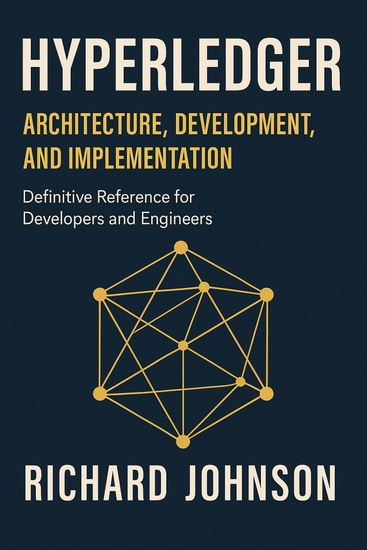
Hyperledger - Architecture Development and Implementation - cover
LER

Hyperledger - Architecture Development and Implementation

Richard Johnson

Editora: HiTeX Press

  • 0
  • 0
  • 0

Sinopse

"Hyperledger: Architecture, Development, and Implementation""Hyperledger: Architecture, Development, and Implementation" delivers a comprehensive examination of Hyperledger's pivotal role in the evolution of enterprise blockchain technologies. The book opens with an insightful journey through the transformation of distributed ledgers, guiding readers from the origins of blockchain to the robust ecosystem curated by the Hyperledger Foundation. By exploring the overarching project landscape—including Fabric, Sawtooth, Indy, Iroha, Besu, and Aries—the book expertly contrasts enterprise permissioned ledgers with public blockchain platforms. Readers gain a clear perspective on Hyperledger's practical adoption across industries such as finance, supply chain, healthcare, and government, with real-world case studies illustrating tangible business value.Diving into the technical core, this work systematically unpacks the architectural foundations and operational mechanisms underpinning the Hyperledger family of projects. Detailed chapters explore permissioned networking, consensus algorithms, smart contracts, privacy preservation, and modular design features that enable flexibility and scalability. Through a close examination of Hyperledger Fabric internals, readers discover the nuances of membership identity, state management, transaction lifecycles, channel configuration, and advanced data-handling capabilities, empowering professionals to architect and sustain resilient, secure distributed ledger solutions.Equipped with a strong practical orientation, the book delves into application development, DevOps best practices, security and compliance frameworks, and integration patterns crucial for real-world deployment. Guidance on chaincode development, client SDKs, performance tuning, interoperability, and cloud-native operation ensures that enterprise architects, developers, and decision-makers are prepared to navigate the rapidly advancing field of decentralized technology. Concluding with forward-looking discussions on privacy-enhancing innovations, decentralized identity, standardization initiatives, and the future trajectory of the Hyperledger community, this authoritative volume is an indispensable resource for anyone building, managing, or innovating with enterprise blockchain solutions.
Disponível desde: 06/06/2025.
Comprimento de impressão: 250 páginas.

Outros livros que poderiam interessá-lo

  • Global Disasters - The Escalating Crisis of Natural and Man-Made Calamities - cover

    Global Disasters - The...

    Marcus Kline

    • 0
    • 0
    • 0
    The world is increasingly vulnerable to a wide array of disasters, both natural and man-made, that threaten our lives, economies, and ecosystems. These crises, which range from catastrophic earthquakes to the far-reaching impacts of climate change, have become more frequent, intense, and interconnected. While the planet has always been subject to the forces of nature, human activity has amplified many of these events, while also introducing new, unprecedented risks. Natural disasters, like hurricanes, wildfires, and floods, have become an inevitable part of the global landscape, but they are now exacerbated by the ongoing environmental degradation we’ve caused. Likewise, man-made calamities, from industrial accidents to nuclear disasters, have demonstrated how human innovation can have disastrous consequences when not properly managed. 
      
    The interwoven nature of these crises has led to a compounded sense of urgency. Events like pandemics, which have a devastating impact on public health, can be worsened by the social and economic disarray that follows a natural or political disaster. The global interconnectivity in the age of globalization means that no disaster remains confined to one region; effects ripple across borders, affecting distant countries and societies. With climate change creating new uncertainties, the boundaries between natural and man-made disasters are becoming increasingly blurred. Rising temperatures contribute to more severe weather events, droughts, and wildfires, while deforestation, industrial pollution, and resource depletion are accelerating these destructive trends.
    Ver livro
  • Lost Towns of the Swift River Valley - Drowned by the Quabbin - cover

    Lost Towns of the Swift River...

    Elena Palladino

    • 0
    • 0
    • 0
    In April 1938, Swift River Valley residents held a farewell ball to mark the demise of the quintessential New England town of Enfield and its three smaller neighbors, Greenwich, Dana, and Prescott. 


    The Commonwealth of Massachusetts sacrificed these three towns to build the Quabbin, a massive reservoir of drinking water for residents of Boston. Three prominent residents attended the somber occasion. Marion Andrews Smith was the last surviving member of an important manufacturing family. Willard "Doc" Segur was the valley's beloved country doctor and town leader. And Edwin Henry Howe was Enfield's postmaster and general store proprietor. They helped build their beloved community for decades, only to watch grief-stricken as it was destroyed by 400 billion gallons of water. 


    Author and historian Elena Palladino recounts the story of these communities as seen through eyes of those who lived there until the end.
    Ver livro
  • Eye Movement Desensitization and Reprocessing (EMDR) - Processing Trauma through Eye Movement - cover

    Eye Movement Desensitization and...

    Vivian Westlake

    • 0
    • 0
    • 0
    Eye Movement Desensitization and Reprocessing (EMDR) is a therapeutic approach that has garnered widespread recognition for its effectiveness in treating trauma, particularly post-traumatic stress disorder (PTSD). Developed by Francine Shapiro in the late 1980s, EMDR is founded on the concept that distressing memories can become “stuck” in the brain, leading to emotional and psychological difficulties. By using bilateral stimulation—usually in the form of guided eye movements—EMDR aims to facilitate the processing of these memories, enabling individuals to integrate them in a way that reduces emotional distress. 
    At its core, EMDR is grounded in the understanding that trauma can impair the brain's natural processing abilities. When a traumatic event occurs, the brain’s memory systems may not fully encode the memory, leaving the experience fragmented and unresolved. As a result, individuals may experience intrusive thoughts, flashbacks, and heightened emotional responses associated with the unresolved trauma. EMDR aims to "unstick" these memories and allow the brain to reprocess them, turning them from vivid, emotionally charged experiences into less distressing memories that can be stored in a more adaptive manner. 
    The key to EMDR's effectiveness lies in its use of bilateral stimulation. During the therapy session, the client follows the therapist’s fingers or another form of rhythmic bilateral stimulation (e.g., auditory tones or tactile taps) while focusing on distressing memories. This process is thought to mimic the natural mechanisms the brain uses during REM sleep, a stage associated with memory consolidation and emotional processing. By engaging both hemispheres of the brain in this way, EMDR helps clients process traumatic memories, alleviating their emotional charge and reducing their impact on daily life.
    Ver livro
  • Original Works by Dr Buteyko and 1988 Buteyko Breathing Manual - cover

    Original Works by Dr Buteyko and...

    Artour Rakhimov

    • 0
    • 0
    • 0
    This thought-provoking collection of original material, translated from Russian includes interviews with Dr. Buteyko covering the development of his ideas from 1962 to 1998 and his main CEOB (Conscious Elimination of Deep Breathing) manual. It is important because it provides insight into the power of his method when used by trained practitioners, especially in a clinical setting. 
    He saw breathing as a fundamental measurable parameter in the treatment of 150 common diseases and because of his disciplined scientific research he never allowed it to be considered simply an alternative asthma treatment' as it is often now perceived in the West. With trained practitioners and Breathing clinics it would result in a profound improvement in the health of millions of people suffering from many different conditions throughout the world. 
    Here is a summary of the main chapters: 
    1. 1962 interview while he was Head of a functional Diagnostics laboratory within the Siberian branch of the USSR Academy of Science. 
    2. 1982 interview covers the development of his theoretical ideas and practical work in further detail. 
    3. Large practical guide (CEOB Breath Retraining Manual) showing his systematic approach to 'the Conscious Elimination of Deep Breathing' in sick patients in a clinical setting. 
    4. 1997 Buteyko answers questions by callers on a public radio program. 
    5. Interview with a Siberian newspaper in 1998 when he was 75 where he talks about his work and medical and spiritual perspective. 
    6. Interview on Ukrainian Television in the late 1980s with a detailed restating of his work where he advocates for breathing retraining centers in Ukraine and Russia. 
    The book's approximate length is 35,000 words.
    Ver livro
  • Environmental Science - Challenges and Solutions for a Healthier Planet - cover

    Environmental Science -...

    Jeron Iris

    • 0
    • 0
    • 0
    Environmental Science is an interdisciplinary field that integrates various scientific disciplines to study the natural world and the impact of human activities on it. This branch of science explores the complex interactions between living organisms, their physical surroundings, and the broader ecosystems they form. The primary goal of environmental science is to understand how natural systems function, identify environmental problems, and develop strategies for addressing these issues. 
      
    At its core, environmental science seeks to answer fundamental questions about the earth's resources, how they are used, and how human actions influence the balance of ecosystems. It draws from biology, chemistry, physics, geology, and social sciences to provide a comprehensive understanding of the environment. For example, ecology, the study of living organisms and their relationships to each other and their surroundings, is a central component of environmental science. By examining the dynamics of ecosystems, scientists can assess the health of the environment and predict the effects of human activities such as urbanization, deforestation, and pollution. 
    One of the primary focuses of environmental science is resource management. As the global population continues to grow, the demand for natural resources such as water, energy, and food increases. Environmental scientists work to ensure that these resources are used sustainably, balancing the needs of current populations with the preservation of resources for future generations. This includes studying renewable resources, such as solar and wind energy, and nonrenewable resources, like fossil fuels, to understand their availability and impact on the environment.
    Ver livro
  • Undammed - Freeing Rivers and Bringing Communities to Life - cover

    Undammed - Freeing Rivers and...

    Tara Lohan

    • 0
    • 0
    • 0
    Free-flowing rivers in the United States are an endangered species. With more than 500,000 dams in place, we've dammed and diverted almost every major river, straightening curves and blocking passage for fish and other aquatic animals, pushing many to the brink. Now a heartening new movement is helping to demolish harmful or obsolete structures and restore new life to rivers and the communities that depend on them. In doing so, it offers a pathway to undoing environmental harm to nature—and to ourselves.In Undammed, environmental journalist Tara Lohan takes a clear-eyed look at the unexpected benefits of dam removal after centuries of dam-building. In helping to restore rivers, she argues, we're protecting our own communities by improving water quality, enhancing public safety, and boosting fish populations that feed people and restore rights for Native American Tribes. In Europe, where river barriers occur almost every half-mile, the US movement is spurring a rival effort to restore natural flow to rivers degraded by obstructions.Undammed is an inspirational look at our changing relationship with the natural world, showing the cascade of benefits that come when we no longer turn our backs on rivers. And in helping to restore rivers, we're helping ourselves.
    Ver livro