Junte-se a nós em uma viagem ao mundo dos livros!
Adicionar este livro à prateleira
Grey
Deixe um novo comentário Default profile 50px
Grey
Assine para ler o livro completo ou leia as primeiras páginas de graça!
All characters reduced
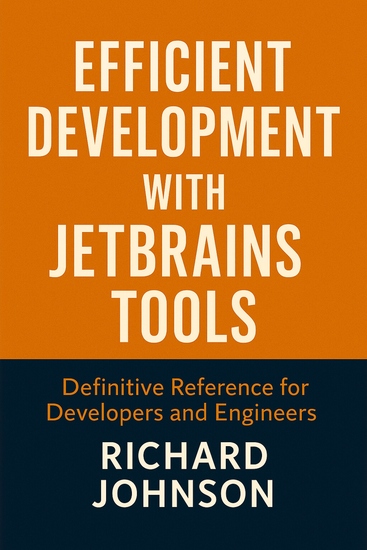
Efficient Development with JetBrains Tools - Definitive Reference for Developers and Engineers - cover
LER

Efficient Development with JetBrains Tools - Definitive Reference for Developers and Engineers

Richard Johnson

Editora: HiTeX Press

  • 0
  • 0
  • 0

Sinopse

"Efficient Development with JetBrains Tools""Efficient Development with JetBrains Tools" is an essential guide for software professionals seeking to master the rich and evolving JetBrains ecosystem. This comprehensive resource begins by delving into the architectural foundations of JetBrains IDEs, uncovering the extensible platform and plugin frameworks that empower seamless interoperability and tailored workflows. Through comparative analysis and a focus on security and privacy by design, the book equips readers with a nuanced understanding of both the strategic and practical dimensions of choosing JetBrains tools in modern development environments.The book proceeds with in-depth coverage of project structuring, advanced configuration, editing, and automation, bringing clarity to crucial practices such as multi-language support, code quality enforcement, and collaborative team workflows. With thorough chapters on version control integration, build management, and customization at scale, readers learn to streamline both individual productivity and enterprise consistency. Advanced sections offer insights into precision code navigation, intelligent editing, debugging, profiling, and continuous integration—empowering developers to optimize performance and minimize technical debt across complex, polyglot codebases.Finally, "Efficient Development with JetBrains Tools" explores contemporary paradigms in remote, distributed, and cloud-native development, as well as organizational concerns like enterprise deployments, compliance, and metrics-driven productivity. The closing chapters anticipate future trends, including the integration of AI-driven features, proactive troubleshooting, and community engagement—equipping teams and enterprises to not only keep pace with innovation but shape the future of intelligent software development. Whether you are aiming to elevate your personal workflow or scale productivity across large organizations, this book delivers actionable expertise for every phase of the software lifecycle.
Disponível desde: 03/06/2025.
Comprimento de impressão: 250 páginas.


Outros livros que poderiam interessá-lo

  • Of Ice and Men - How We've Used Cold to Transform Humanity - cover

    Of Ice and Men - How We've Used...

    Fred Hogge

    • 0
    • 0
    • 0
    An exploration of humanity’s relationship with ice since the dawn of civilization, Of Ice and Men reminds us that only by understanding this unique substance can we save the ice on our planet—and perhaps ourselves. 
     
    Ice tells a story. It writes it in rock. It lays it down, snowfall by snowfall at the ends of the earth where we may read it like the rings on a tree. It tells our planet’s geological and climatological tale. 
     
    Ice tells another story too: a story about us. It is a tale packed with swash-buckling adventure and improbable invention, peopled with driven, eccentric, often brilliant characters. It tells how our species has used ice to reshape the world according to our needs and our desires: how we have survived it, harvested it, traded it, bent science to our will to make it—and how in doing so we have created globe-spanning infrastructures that are entirely dependent upon it. 
     
    And even after we have done all that, we take ice so much for granted that we barely notice it. 
     
    Ice has supercharged the modern world. It has allowed us to feed ourselves and cure ourselves in ways unimaginable two hundred years ago. It has enabled the global population to rise from less than 1 billion to nearly 7½ billion—which just happens to cover the same period of time as humanity has harvested, manufactured, and distributed ice on an industrial scale. 
     
    And yet the roots of our fascination with ice and its properties run much deeper than the recent past.
    Ver livro
  • A Road Running Southward - Following John Muir's Journey through an Endangered Land - cover

    A Road Running Southward -...

    Dawn Chapman

    • 0
    • 0
    • 0
    In 1867, John Muir set out on foot to explore the botanical wonders of the South, keeping a detailed journal of his adventures as he traipsed from Kentucky southward to Florida. One hundred and fifty years later, on a similar whim, veteran Atlanta reporter Dan Chapman recreated Muir's journey to see for himself how nature has fared since Muir's time. Channeling Muir, he uses humor, keen observation, and a deep love of place to celebrate the South's natural riches. 


    Each chapter touches upon a local ecological problem—moving between John Muir's vivid descriptions of a lush botanical paradise and the myriad environmental problems facing the South today. Along the way he talks to locals with deep ties to the land—scientists, hunters, politicians, and even a Muir impersonator—who describe the changes they've witnessed and what it will take to accommodate a fast-growing population without destroying the natural beauty and a cherished connection to nature. 


    A Road Running Southward is part travelogue, part environmental cri de coeur, and paints a picture of a South under siege. It is a passionate appeal, a call to action to save one of the loveliest and most biodiverse regions of the world by understanding what we have to lose if we do nothing.
    Ver livro
  • Hindenburg - Thirty-Second Inferno - cover

    Hindenburg - Thirty-Second Inferno

    P Agrawal

    • 0
    • 0
    • 0
    This audiobook is narrated by an AI Voice.  
    Hindenburg: Thirty-Second Inferno is a clear, human-centered chronicle of the most famous airship in history and the half-minute of fire that ended an era. Spanning twenty immersive chapters, it traces the zeppelin dream from its hopeful beginnings through the Hindenburg’s majestic construction, serene ocean crossings, and refined life aboard—promenades of glass, piano in the lounge, disciplined crews, and a floating world of quiet elegance. With steady, simple prose, it opens the doors of the hangars at Friedrichshafen, walks the reader along duralumin ribs and gas cells, and reveals the teamwork, rituals, and pride that held a giant ship safely in the sky. 
    The narrative narrows to May 6, 1937: the gray New Jersey evening, the slow turn over Lakehurst, the dropped mooring lines, and then the sudden bloom of flame that raced the length of the hull. The book stays close to witnesses and survivors—rescuers running into heat and smoke, passengers finding seconds of courage, and the trembling voice of the famous broadcast that carried grief into homes around the world. It follows the night’s rescue efforts, the solemn roll of names, and the first careful questions asked among wreckage still warm with rain and ash. 
    Beyond the shock, the book examines investigations and debates with calm clarity: hydrogen’s lift against its peril, helium’s safety against its scarcity, static and weather, leak and spark, and the humble truth that complex failures are chains, not single breaks. It shows how the disaster reshaped trust and practice—longer checklists, better materials, clearer cockpit authority—and how airplanes quietly inherited the future as airships slipped into memory.
    Ver livro
  • The Knowledge Gene - cover

    The Knowledge Gene

    Lynne Kelly

    • 0
    • 0
    • 0
    Over 500,000 years ago, a single gene mutated. It spread over time, becoming critical in the journey transforming our earliest ancestors into fully modern humans, capable of navigating the entire planet and beyond. Then just a few thousand years ago, humans gradually outsourced knowledge to writing, and we displaced art and music from the heart of learning. 
     
    This is the extraordinary story of the discovery of a supergene that makes us uniquely human. Dr Lynne Kelly recounts how a widespread congenital disorder was the critical clue she and her collaborators needed to identify the gene that has long eluded researchers into human cognition. 
     
    The knowledge gene supercharged our ability to learn and share knowledge with others, explaining the prodigious memories of Indigenous people the world over. The discovery of the knowledge gene unlocks many other puzzles too. It explains for the first time why humans are the only species to make art, offers new insights into the earliest music and storytelling, and into the cognitive strengths of neurodivergent people. 
     
    The Knowledge Gene shows that we can all access the full power of our memories, without giving up any of the advantages of writing and technology. The implications for learning and creativity at any age are profound.
    Ver livro
  • Microservices with Spring Boot and Spring Cloud - Develop modern resilient scalable and highly available apps using microservices with Java Spring Boot 30 and Spring Cloud - cover

    Microservices with Spring Boot...

    Tejaswini Jog

    • 0
    • 0
    • 0
    Microservices has emerged as a powerful solution to build flexible, scalable, and resilient applications. This Book is the go-to-guide to understanding, designing, and implementing microservice architectures using Spring Boot. It takes you on a journey through the intricacies of microservices to create robust and efficient microservice-based applications.
    This book helps you to understand the motivations and the entire process behind migrating from monolithic to microservice architectures. It covers essentials like REST basics, advanced topics such as centralized configuration, inter-service communication, Eureka Server, resilience mechanisms, security, and Docker deployment.
    Readers will be equipped to effortlessly find and access instances within a microservice architecture without disrupting clients. You will delve into distributed tracing and its importance in monitoring the interactions among microservices. Finally, we will discuss strategies for ensuring the reliability of your microservices architecture.
    Whether you're new to microservices or seeking to enhance your existing expertise, this book is your comprehensive guide to navigating the intricacies of modern application development. Embark on your microservices journey today and unlock the potential of Spring Boot in crafting efficient, scalable, and resilient software solutions.
    Ver livro
  • A Brief History of the Countryside in 100 Objects - cover

    A Brief History of the...

    Sally Coulthard

    • 0
    • 0
    • 0
    A Waterstones Best Book of 2024: Nature Writing 
    The untold story of rural Britain revealed through its artefacts 
    'A really lovely, fascinating book. I dived straight into this clever, joyous, celebration of nature, history, and – of course – the countryside.' Charles Spencer, author of The White Ship 
    For most of human history, we were rural folk.  
    Our daily lives were bound up with working the land, living within the rhythm of the seasons. We poured our energies into growing food, tending to animals and watching the weather. Family, friends and neighbours were often one and the same. Life revolved around the village and its key spaces and places – the church, the green, the school and the marketplace. 
    And yet rural life is oddly invisible our historical records. The daily routine of the peasant, the farmer or the craftsperson could never compete with the glamour of city life, war and royal drama. Lives went unrecorded, stories untold. 
    There is, though, one way in which we can learn about our rural past. The things we have left behind provide a connection that no document can match; physical artefacts are touchstones that breathe life into its history. From farming tools to children’s toys, domestic objects and strange curios, the everyday items of the past reveal fascinating insights into an often-forgotten way of life. Birth, death, celebration, work, crime, play, medicine, beliefs, diet and our relationship with nature can all be read from these remnants of our past. 
    From ancient artefacts to modern-day memorabilia, this startling book weaves a rich tapestry from the fragments of our rural past. 
    In her non-fiction book A Brief History of the Countryside in 100 Objects, Sally Coulthard explores the social and cultural dynamics of rural life in Europe. The book, steeped in anthropology and environmental conservation, emphasises the importance of regional studies and the protection of our environment. 
    For fans of Jane Cooper (The Lost Flock), James Rebanks (The Shepherd's View), Clara Parkes (Vanishing Fleece), Robert Macfarlane (Underland), and Robin Wall Kimmerer (The Serviceberry). 
    HarperCollins 2024
    Ver livro