¡Acompáñanos a viajar por el mundo de los libros!
Añadir este libro a la estantería
Grey
Escribe un nuevo comentario Default profile 50px
Grey
Suscríbete para leer el libro completo o lee las primeras páginas gratis.
All characters reduced
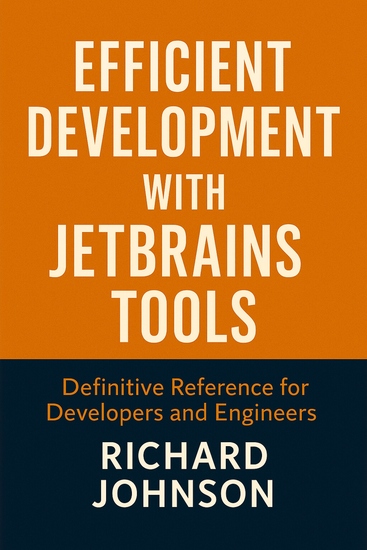
Efficient Development with JetBrains Tools - Definitive Reference for Developers and Engineers - cover

Efficient Development with JetBrains Tools - Definitive Reference for Developers and Engineers

Richard Johnson

Editorial: HiTeX Press

  • 0
  • 0
  • 0

Sinopsis

"Efficient Development with JetBrains Tools""Efficient Development with JetBrains Tools" is an essential guide for software professionals seeking to master the rich and evolving JetBrains ecosystem. This comprehensive resource begins by delving into the architectural foundations of JetBrains IDEs, uncovering the extensible platform and plugin frameworks that empower seamless interoperability and tailored workflows. Through comparative analysis and a focus on security and privacy by design, the book equips readers with a nuanced understanding of both the strategic and practical dimensions of choosing JetBrains tools in modern development environments.The book proceeds with in-depth coverage of project structuring, advanced configuration, editing, and automation, bringing clarity to crucial practices such as multi-language support, code quality enforcement, and collaborative team workflows. With thorough chapters on version control integration, build management, and customization at scale, readers learn to streamline both individual productivity and enterprise consistency. Advanced sections offer insights into precision code navigation, intelligent editing, debugging, profiling, and continuous integration—empowering developers to optimize performance and minimize technical debt across complex, polyglot codebases.Finally, "Efficient Development with JetBrains Tools" explores contemporary paradigms in remote, distributed, and cloud-native development, as well as organizational concerns like enterprise deployments, compliance, and metrics-driven productivity. The closing chapters anticipate future trends, including the integration of AI-driven features, proactive troubleshooting, and community engagement—equipping teams and enterprises to not only keep pace with innovation but shape the future of intelligent software development. Whether you are aiming to elevate your personal workflow or scale productivity across large organizations, this book delivers actionable expertise for every phase of the software lifecycle.
Disponible desde: 03/06/2025.
Longitud de impresión: 250 páginas.


Otros libros que te pueden interesar

  • Data Structures and Algorithms for Beginners - A Beginner's Guide to Essential Concepts and Techniques - cover

    Data Structures and Algorithms...

    Vincent Berry

    • 0
    • 0
    • 0
    "Data Structures and Algorithms for Beginners" demystifies complex topics with clear explanations, real-world examples, and practical exercises. Starting from the basics, you'll learn about different types of data structures, from simple arrays and linked lists to more intricate structures like trees and graphs. As you progress, you'll explore the mechanics and strategies of efficient algorithms, understanding how they manipulate and process data to solve problems. 
    This guide also dives into the critical aspect of algorithm analysis, teaching you how to evaluate the performance of an algorithm through concepts like time and space complexity. You'll gain hands-on experience with sorting and searching algorithms, discovering how they are applied in various applications and how they can be optimized for speed and efficiency. 
    Each chapter includes practical code examples in a beginner-friendly programming language, step-by-step walkthroughs, and illustrative diagrams to help solidify your understanding. By the end of this book, you will have a solid grasp of key concepts and be well-prepared to apply these techniques in practical scenarios, from software development to preparing for technical interviews. 
    Step into the world of computer science with confidence and curiosity! "Data Structures and Algorithms for Beginners" is your comprehensive guide to mastering these critical concepts, opening doors to a multitude of possibilities in technology and beyond.
    Ver libro
  • Forgiving Humanity - How the Most Innovative Species Became the Most Dangerous - The Curse of Exponential Change - cover

    Forgiving Humanity - How the...

    Peter Russell

    • 0
    • 0
    • 0
    Why has the most innovative of species become so dangerous? The answer, suggests Peter Russell, lies in humanity’s accelerating pace of development. He shows how innovation breeds further innovation—a positive feedback loop leading to exponential rates of change. But our minds cannot grasp the full implications of exponential growth. We think more in terms of linear change, leading to a blind spot on the future.  
    However fast the pace of change may be today, it will be even faster in the years to come, bringing ever more rapid scientific and technological advances. But ever-accelerating change also creates stress on the systems involved. The faster the change, the greater the stress, and the more likely systemic breakdown. We are heading into a future with technology beyond our dreams, but in a world that is breaking at the seams. 
    Russell argues there is no blame for this. Spiraling rates of development, with all their consequences, positive and negative, are the inevitable fate of any intelligent, technologically-empowered species.  
    How do we live with such unsettling conclusions? How can we prepare for a world that is becoming increasingly unpredictable? What does it mean for the future of humanity? 
    Peter Russell, the widely acclaimed author of The Global Brain and other pioneering works, earned an honors degree in theoretical physics and psychology —as well as a masters degree in computer science —at the University of Cambridge. He subsequently went to India where he explored meditation and Eastern philosophy, and was one of the first people to introduce personal development programs to corporations in the 1970s. His other books include The TM Technique, The Upanishads, Waking Up in Time, From Science to God, and Letting Go of Nothing.
    Ver libro
  • The Cognitive Amplification Engine - Learning to Think Better - cover

    The Cognitive Amplification...

    Martin K. Ettington

    • 0
    • 0
    • 0
    This book describes a way of thinking, not a tool. 
    It argues that artificial intelligence is not intelligent, that fluent output is not understanding, and that the real risk in human–machine interaction is not that machines will replace us—but that we will stop thinking clearly while using them. The central idea of the book is cognitive amplification: using tools to extend human reasoning while preserving human judgment, intent, and responsibility. 
    Methods like this, however, face a practical problem. They are easy to understand and difficult to apply consistently. 
    Most people already believe they think in stages. In practice, intent is vague, constraints are assumed rather than defined, options are prematurely narrowed, and conclusions are accepted because they sound coherent. Under time pressure or when interacting with persuasive systems, discipline collapses. 
    This is where the Cognitive Amplification Engine (CAE) enters—not as an authority, and not as an artificial mind, but as a structured environment. 
    This book is a companion for the CAE plugin for wordpress which helps automate this structured thinking process
    Ver libro
  • Shark: Why we need to save the world’s most misunderstood predator - cover

    Shark: Why we need to save the...

    Paul de Gelder

    • 0
    • 0
    • 0
    From shark attack survivor to the shark’s biggest advocate, Paul de Gelder tells us just why these majestic diverse animals need our help as much as we need them. 
    Something happens to you the first time you dive with sharks… 
    We have a perennial fascination with sharks. Portrayed in the media and popular culture as killing machines, we are awed by their power and strength. But the shark is so much more – a marvel of the sea, they have evolved over 450 million years into over 500 species, from the bioluminescent kitefin to the tiny dwarf lantern shark, the sociable lemon shark to the cow shark, which can birth up to 100 pups in one litter. Bringing balance to the ocean’s ecosystem, our planet is at serious risk when these amazing creatures are threatened. 
    Paul de Gelder, who lost two limbs in a shark attack during a mission as an elite Australian navy clearance diver, spent time as part of his recovery learning all about sharks. He became so obsessed that, despite what happened to him, he is now an expert and has dedicated his life to helping save them. Shark is his love-letter to these unfairly vilified animals, and his warning to the world about what will happen if we don’t look out for them. 
    In SHARK, Paul de Gelder, a shark attack survivor turned advocate, explores the intricate ecosystems of the seas and oceans. He emphasises the importance of marine conservation and the protection of the diverse habitats that these misunderstood creatures call home. 
    For fans of John A. Long (The Secret History of Sharks), Daniel C. Abel (The Lives of Sharks), David A. Ebert (A Pocket Guide to Sharks of the World), David Shiffman (Why Sharks Matter), and Philip V. Mladenov (Marine Biology). 
    HarperCollins 2022
    Ver libro
  • Introduction to Internet of Things - A Beginner’s Guide to Building Smart Solutions with Sensors Networks and Cloud-Driven Intelligence - cover

    Introduction to Internet of...

    Sam Miley

    • 0
    • 0
    • 0
    The Internet of Things (IoT) is transforming our world—connecting physical devices, enabling real-time decision-making, and opening new possibilities across industries. Whether you're an aspiring engineer, tech enthusiast, or business professional, Introduction to Internet of Things is your gateway to understanding how IoT works and how to build intelligent, connected solutions from the ground up. 
    This beginner-friendly guide breaks down the complex ecosystem of IoT into accessible concepts and hands-on knowledge. From basic sensors to cloud integration, it provides the foundational tools and techniques to design, deploy, and scale IoT systems that interact with the real world. 
    Inside, you’ll learn how to: 
    •	Understand key IoT components: sensors, actuators, connectivity protocols, and embedded systems 
    •	Connect devices using wireless communication technologies such as Wi-Fi, Bluetooth, Zigbee, and LoRaWAN 
    •	Process and analyze IoT data using edge computing and cloud services 
    •	Build simple yet functional projects with platforms like Arduino, Raspberry Pi, and ESP32 
    •	Explore IoT applications across industries—from smart homes and cities to agriculture, healthcare, and manufacturing 
    •	Address important considerations such as security, privacy, and scalability 
    Filled with real-world examples, illustrations, and step-by-step project guidance, Introduction to Internet of Things equips you with the knowledge and confidence to explore this exciting field and start building your own smart systems.
    Ver libro
  • Homewaters - A Human and Natural History of Puget Sound - cover

    Homewaters - A Human and Natural...

    David B. Williams

    • 0
    • 0
    • 0
    Not far from Seattle skyscrapers live 150-year-old clams, more than 250 species of fish, and underwater kelp forests as complex as any terrestrial ecosystem. For millennia, vibrant Coast Salish communities have lived beside these waters dense with nutrient-rich foods, with cultures intertwined through exchanges across the waterways. Transformed by settlement and resource extraction, Puget Sound and its future health now depend on a better understanding of the region's ecological complexities. 


    Focusing on the area south of Port Townsend and between the Cascade and Olympic mountains, Williams uncovers human and natural histories in, on, and around the Sound. In conversations with archaeologists, biologists, and tribal authorities, Williams traces how generations of humans have interacted with such species as geoducks, salmon, orcas, rockfish, and herring. He sheds light on how warfare shaped development and how people have moved across this maritime highway, in canoes, the mosquito fleet, and today's ferry system. The book also takes an unflinching look at how the Sound's ecosystems have suffered from human behavior, including pollution, habitat destruction, and the effects of climate change.
    Ver libro