Rejoignez-nous pour un voyage dans le monde des livres!
Ajouter ce livre à l'électronique
Grey
Ecrivez un nouveau commentaire Default profile 50px
Grey
Abonnez-vous pour lire le livre complet ou lisez les premières pages gratuitement!
All characters reduced
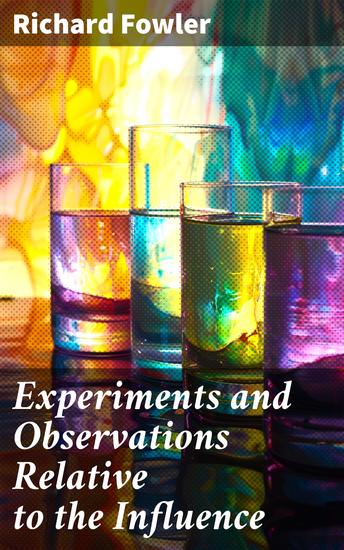
Experiments and Observations Relative to the Influence - Lately Discovered by M Galvani and Commonly Called Animal Electricity - cover

Experiments and Observations Relative to the Influence - Lately Discovered by M Galvani and Commonly Called Animal Electricity

Richard Fowler

Maison d'édition: Good Press

  • 0
  • 0
  • 0

Synopsis

In "Experiments and Observations Relative to the Influence," Richard Fowler delves into the intricate interplay between environmental factors and their effects on human health. Drawing on empirical data, Fowler combines scientific rigor and accessible prose to engage readers in the exploration of natural phenomena, presenting a systematic approach to observations that define the era's burgeoning interest in experimental science. Situated in the context of Enlightenment thought, Fowler's work embodies a shift towards reason and observation, emphasizing the importance of experimentation in understanding the natural world. Richard Fowler, a pivotal figure in early 19th-century scientific thought, was influenced by contemporaneous advancements in the fields of medicine and botany. His meticulous research and dedication to observational science are informed by his educational background and personal encounters with the limitations of traditional medical practices. Fowler's commitment to empirical investigation paved the way for more refined methodologies and encouraged a new generation of scientists to consider the significance of influences such as air, humidity, and temperature on physiological health. This provocative work is highly recommended for readers interested in the historical foundations of scientific inquiry, as well as for those looking to gain insight into how empirical observations shaped health and science in the Enlightenment. Fowler's compelling narrative invites readers to question and explore the delicate balance between humanity and its environment, making it a must-read for anyone fascinated by the evolution of scientific thought.
Disponible depuis: 12/10/2023.
Longueur d'impression: 68 pages.

D'autres livres qui pourraient vous intéresser

  • Thoughts for the Times of War and Death - cover

    Thoughts for the Times of War...

    Sigmund Freud

    • 0
    • 0
    • 0
    In this insightful essay Sigmund Freud delves into the psychological roots of war, the nature of human aggression, and the profound impact of death on society.
    
    Written during the tumultuous years of World War I, Freud explores how conflict shapes the psyche and why humanity is drawn to violence despite the consequences.
    Voir livre
  • The Tenderness of Silent Minds - Benjamin Britten and his War Requiem - cover

    The Tenderness of Silent Minds -...

    Martha C. Nussbaum

    • 0
    • 0
    • 0
    The human body is the primary instrument of war, yet those waging war often confront soldiers' bodies in a detached or merely intellectual way. In The Tenderness of Silent Minds, Martha C. Nussbaum, a leading thinker on emotion, morality, and justice, conducts a pioneering study of Benjamin Britten's musical representations of the tender male body amidst the brutality of war, and their ability to transform consciousness by evoking potent, non-personal emotions. 


    Offering a reading of Britten's views about the value and beauty of the body that situates these in the context of his thirty-nine year partnership with his lover, the singer Peter Pears, and also surveying pacifist themes in works written both before and after War Requiem, Nussbaum presents a compelling framework for critically assessing Britten's oeuvre. Nussbaum engages with a remarkably wide range of Britten's works, examining his treatment of aggression and its roots in his collaborations with the poet W. H. Auden, offering readings of the value placed on the body in early partnerships with Britten's beloved and singer Peter Pears, and surveying pacifist themes in Britten's earlier works. The analysis throughout is enriched with perspectives from Britten's personal letters and thoughtful study of the social and political backdrop of fear and homophobic disgust in mid-twentieth century Britain.
    Voir livre
  • Civilization's Collapse: Unmasking the Secrets of Humanity's Downfall - "Dive into humanity’s downfall! Access captivating audio lessons that unveil the secrets of civilization’s collapse" - cover

    Civilization's Collapse:...

    Harlan Berwick

    • 0
    • 0
    • 0
    Civilization's Collapse: Unmasking the Secrets of Humanity's Downfall 
    Are you eager to expand your career and deepen your understanding by mastering the lessons from history?  
    Searching for a thorough guide that includes everything you need to grasp the critical insights from our past to better navigate the future?  
    Your quest ends here! 
    This audiobook serves as your ultimate resource for enhancing your comprehension, applying your newfound knowledge, and engaging in practical exercises. With it, you are well-equipped for success. 
    Updated to reflect the latest insights and structure relevant to 2025. 
    Key Features of This Engaging Guide: 
    - In-depth analysis of civilization's collapse and the crucial lessons it offers 
    - Comprehensive explanations of historical events and their significance 
    - Effective strategies for understanding and applying these concepts in modern-day contexts 
    Our guide stands out with its thorough exploration, which is vital for your intellectual victory. Topics are not just touched upon; they are examined in detail. 
    Crafted with a clear structure and straightforward language, this guide ensures a seamless progression through topics. Say farewell to convoluted jargon and welcome clear, precise, and technically accurate content. 
    So, why wait? Click the BUY NOW button to secure your audiobook and start your enlightening journey through history to enhance your future! 
    Embark on this journey to uncover the secrets of civilization's downfall and learn how we can build a better future!
    Voir livre
  • Give It A Home - cover

    Give It A Home

    Lizzy Co

    • 0
    • 0
    • 0
    What happens when a woman's life falls apart? 
    She builds a new one. 
    Take the journey, one sonnet at a time. 
    - 
    When she was 35, Lizzy Co lost everything that filled her heart. This is the story of how she filled it back up. 
    Give It A Home is a journey through a year of recovery, told through 100 sonnets. 
    Walk with Lizzy as she navigates the daily experience of grieving the loss of her father, her relationship, her job, and her sense of self. 
    (Spoiler alert: there's a happy ending.)
    Voir livre
  • Right This Way - A History of the Audience - cover

    Right This Way - A History of...

    Robert Viagas

    • 0
    • 0
    • 0
    When you sit down at a play, movie, or concert—or even in front of the TV or scrolling on your phone—you are taking part in one of the oldest and most mysterious forms of human behavior. Being part of an audience is an age-old experience that we all crave, one that has evolved from amphitheaters to screens. Right This Way is a pop history of audiences through the ages. Playbill editor Robert Viagas unfolds the unique aspects of what he calls “audiencing” with stories from the age of the Greeks to the world of Zoom. He walks through the different types of audiences and the history of their responses, what science has to say about how our brains respond to what they see and the reactions of the people around them, and why, during COVID-19, people risked a deadly virus to be part of a crowd. Right This Way explores what the audience experience brings us and how it may evolve in the 21st century.
    Voir livre
  • Project MK-Ultra: The History of the CIA’s Controversial Human Experimentation Program - cover

    Project MK-Ultra: The History of...

    Editors Charles River

    • 0
    • 0
    • 0
    Since the early days of human warfare, which may date back to the Stone Age, combatants have sought to gain an advantage through the acquisition of secret information. With the growth of technology, a parallel advantage was sought through the application of numerous types of torture. In the 19th century, the concept of manipulation was added to military tactics, an attempt to influence the minds of assassins, double agents, and world leaders alike to act against their natures. Given the incredible advances in technology brought about by global warfare, the years immediately after World War II would bring about the most extensive formal study of the many procedures by which this effect could be accomplished. 
    The push to develop torture and manipulation techniques was driven by an “exaggerated fear”[1] propagated by the American military and national press of “mind-control.” American officials believed that Soviet, Chinese, and North Korean communists had reached the “Holy Grail”[2] of mental warfare, and that the United States must follow suit or be left behind. In time, the “transformation of brainwashing from a system of coercive propaganda to a secret program of human enslavement”[3] reflected cultural demands placed on the idea by the Korean War and was preceded by interest in electromagnetics. To the embarrassment of many Americans, 5,000 of the 7,200 American POWs in North Korea signed confessions and petitions to end the war. Most recanted their actions once free, but many did not, and some refused to return to their homeland. 
    In the end, the peak of the American experimental regimen on unwitting humans grew to vast proportions and splintered into a myriad of disciplines by the mid-20th century. The program came to be known as MK-Ultra after several early incarnations, and to this day, the name has become synonymous with controversy, even as the program’s experiments and results remain relatively mysterious.
    Voir livre