Junte-se a nós em uma viagem ao mundo dos livros!
Adicionar este livro à prateleira
Grey
Deixe um novo comentário Default profile 50px
Grey
Assine para ler o livro completo ou leia as primeiras páginas de graça!
All characters reduced
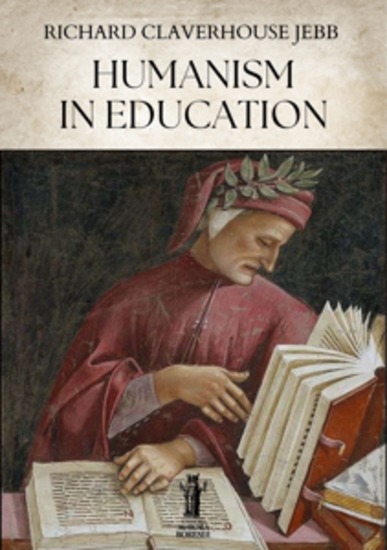
Humanism in Education - cover
LER

Humanism in Education

Richard Claverhouse Jebb

Editora: Edizioni Aurora Boreale

  • 0
  • 0
  • 0

Sinopse

Sir Richard Claverhouse Jebb (1841-1905) was a British classical scholar and Member of Parliament for Cambridge University. He was acknowledged to be one of the most brilliant classical scholars of his time, a humanist and an unsurpassed translator from and into the classical languages.
The Jebb’s essay Humanism in Education, which we propose to our readers today, is based on a Romanes Lecture, delivered by the scholar in the Sheldonian Theatre at Oxford on June 7, 1899. It was included in 1907 in the collection Essays and Addresses, published by the Cambridge University Press.
Renaissance humanism is a worldview centered on the nature and importance of humanity that emerged from the study of Classical antiquity.
Renaissance humanists sought to create a citizenry able to speak and write with eloquence and clarity, and thus capable of engaging in the civic life of their communities and persuading others to virtuous and prudent actions. Humanism, while set up by a small elite who had access to books and education, was intended as a cultural movement to influence all of society. It was a program to revive the cultural heritage, literary legacy, and moral philosophy of the Greco-Roman civilization. It first began in Italy and then spread across Western Europe in the 14th, 15th, and 16th centuries.
Disponível desde: 01/02/2025.
Outros livros que poderiam interessá-lo

  • On Writing and Failure - Or the Peculiar Perseverance Required to Endure the Life of a Writer - cover

    On Writing and Failure - Or the...

    Stephen Marche

    • 0
    • 0
    • 0
    Writing is, and always will be, an act defined by failure. The best plan is to just get used to it.
    		 
    Failure is a topic discussed in every creative writing department in the world, but this is the book every beginning writer should have on their shelf to prepare them. Less a guide to writing and more a guide to what you need to continue existing as a writer, On Writing and Failure: Or, On the Peculiar Perseverance Required to Endure the Life of a Writer describes the defining role played by rejection in literary endeavors and contemplates failure as the essence of the writer’s life. Along with his own history of rejection, Marche offers stories from the history of writerly failure, from Ovid’s exile and Dostoevsky’s mock execution to James Baldwin's advice just to endure, where living with the struggle and the pointlessness of writing is the point.
    Ver livro
  • 21 Things You Need to Know About Indigenous Self-Government - A Conversation About Dismantling the Indian Act - cover

    21 Things You Need to Know About...

    Bob Joseph

    • 0
    • 0
    • 0
    From the bestselling author of 21 Things™ You May Not Know About the Indian Act comes a powerful new book on dismantling the Indian Act and advancing Indigenous self-governance.Bob Joseph’s 21 Things™ You May Not Know About the Indian Act captured the attention of hundreds of thousands of Canadians by shining a light on the Indian Act and the problems associated with it. In that book, readers learned that the Consolidated Indian Act of 1876 has controlled the lives of Indigenous Peoples in Canada for generations, and despite its objective to assimilate Indians into the economic and political mainstream, it has had the opposite effect: segregation. They live under different laws and on different lands.People came away from that book with questions such as "Can we get rid of the Indian Act?" and "What would that look like? Would self-government work?" These are timely questions, given that 2026 will mark 150 years since the Consolidated Indian Act of 1876. The short answer to these questions is, yes, we can dismantle the Act, and there are current examples of self-government arrangements that are working.With his trademark wisdom, humility, and deep understanding, Bob Joseph shows us the path forward in 21 Things™ You Need to Know About Indigenous Self-Government: A Conversation About Dismantling the Indian Act, in which Indigenous self-governance is already happening and not to be feared—and negotiating more such arrangements, sooner rather than later, is an absolute necessity.21 Things™ You Need to Know About Indigenous Self-Government: A Conversation About Dismantling the Indian Act is a call to action. Join the conversation now.
    Ver livro
  • An Infinite Fountain of Light - Jonathan Edwards for the Twenty-First Century - cover

    An Infinite Fountain of Light -...

    George M. Marsden

    • 0
    • 0
    • 0
    Christians need to pause once in a while to get their bearings. For perspective on our own times and how we got here, it helps to listen to wise guides from other eras. In An Infinite Fountain of Light, the renowned American historian George Marsden illuminates the landscape with wisdom from one such mentor: Jonathan Edwards.
    Drawing on his deep expertise on Edwards and American culture, Marsden explains where Edwards stood within his historical context and sets forth key points of his complex thought. By also considering Benjamin Franklin and George Whitefield, two of Edwards's most influential contemporaries, Marsden unpacks the competing cultural and religious impulses that have shaped our times. In contrast, Edwards offered us an exhilarating view of the centrality of God's beauty and love. Christians' love for God, he taught, can be the guiding love of our lives, opening us to transformative joy and orienting all our lesser loves.
    "There is an infinite fullness of all possible good in God, a fullness of every perfection, of all excellency and beauty, and of infinite happiness," wrote Edwards. "This infinite fountain of light should, diffusing its excellent fullness, pour forth light all around."
    With Marsden's guidance, readers will discover how Edwards's insights can renew our own vision of the divine, of creation, and of ourselves.
    Ver livro
  • Responsible and Responsive Parenting in Autism - Between Now and Dreams - cover

    Responsible and Responsive...

    Shahla Ala'i-Rosales, Peggy...

    • 0
    • 0
    • 0
    Parents of children with autism have so much to learn and to manage, it’s easy for them to feel alone and become emotionally drained. But there is a framework for making progress, whether the child is newly diagnosed or an adult. Now available in audiobook, reviewers call Responsible and Responsive Parenting in Autism: Between Now and Dreams a first-stop, must-read for parents, family members and caregivers, one that is also eloquent and engaging. The essence of any parenting journey relies on learning, connecting and loving. Each power informs the other. Each amplifies the other. Each power is essential for meaningful, courageous parenting. Writing with compassion and empathy, Shahla Ala’i-Rosales, a professor and clinician who’s worked with hundreds of autism families, and Peggy Heinkel-Wolfe, a science writer and parent of an adult with autism, teamed up to offer effective, practical suggestions. Learn how to harness your parenting powers to tailor both scientific information and cultural wisdom to your family’s needs. “Five out of five stars for structure, content and practical advice.” – Adam Hockman, learning architect at the Heifetz Institute and ABA Technologies
    Ver livro
  • Salvador Dalì: A short biography - 5 Minutes: Short on time - long on info! - cover

    Salvador Dalì: A short biography...

    5 Minutes, 5 Minute Biographies,...

    • 0
    • 0
    • 0
    Salvador Dalì, Spanish painter and surrealist: Life and work in a short biography! Everything you need to know, brief and concise. Infotainment, education and entertainment at its best!
    Ver livro
  • The Self - A Very Short Introduction - cover

    The Self - A Very Short...

    Marya Schechtman

    • 0
    • 0
    • 0
    'Know thyself' is said to have been one of the maxims carved into the Temple of Apollo at Delphi. On the face of it, this does not seem like a very difficult task. My self is with me at every moment of every day, I have access to its inner thoughts and feelings, and I am hardly liable to mistake someone else for me. At the same time, however, the self is surprisingly elusive and opaque. Our understanding of the self is replete with puzzles and paradoxes: I cannot be anyone but who I am, and yet everyone will acknowledge that there are circumstances in which being oneself is a difficult task. If I change enough, I can be said to have become a different person. I cannot get away from myself, and yet I can find and lose myself. 


    In this Very Short Introduction, Marya Schechtman uses insights from philosophy, psychology, psychiatry, sociology, and popular thought to consider some of the most compelling and puzzling questions about the self, including questions about what kind of object a self is if it is an object at all, what it means to be oneself and why it is important, what kinds of changes the self can and cannot survive, whether a self can be separated from its body, whether more than one self can exist in a single body, and what role engagement with the environment and with other selves plays in constituting and maintaining the self.
    Ver livro