Junte-se a nós em uma viagem ao mundo dos livros!
Adicionar este livro à prateleira
Grey
Deixe um novo comentário Default profile 50px
Grey
Assine para ler o livro completo ou leia as primeiras páginas de graça!
All characters reduced
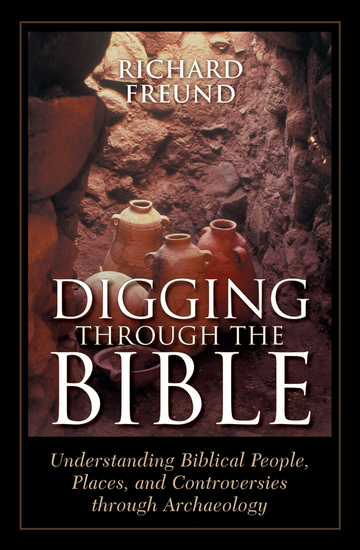
Digging Through the Bible - Understanding Biblical People Places and Controversies through Archaeology - cover
LER

Digging Through the Bible - Understanding Biblical People Places and Controversies through Archaeology

Richard A Freund

Editora: Rowman & Littlefield Publishers

  • 0
  • 0
  • 0

Sinopse

A “masterful and eminently readable” journey through the fascinating insights and revelations of Biblical archeology (Publishers Weekly, starred review). Many of our religious beliefs are based on faith alone, but archaeology gives us the opportunity to find evidence about what really happened in the distant past—evidence that can have a dramatic impact on what and how we believe. In Digging Through the Bible, archaeologist and rabbi Richard Freund takes readers through digs he has led in the Holy Land, searching for evidence about key biblical characters and events.  Digging Through the Bible presents overviews of the evidence surrounding figures such as Moses, Kings David and Solomon, and Mary the mother of Jesus, as well as new information that can help us more fully understand the life and times in which these people would have lived. Freund also presents new evidence about finding the grave of the Teacher of Righteousness mentioned in the Dead Sea Scrolls, and gives a compelling argument about how the Exodus of the Israelites may have taken place in three separate waves over time, rather than in a single event as presented in the Bible.
Disponível desde: 14/06/2023.
Comprimento de impressão: 394 páginas.

Outros livros que poderiam interessá-lo

  • Unraveling Faculty Burnout - Pathways to Reckoning and Renewal - cover

    Unraveling Faculty Burnout -...

    Rebecca Pope-Ruark

    • 0
    • 0
    • 0
    Faculty often talk about how busy, overwhelmed, and stressed they are. These qualities are seen as badges of honor in a capitalist culture that values productivity above all else. But for many women in higher education, exhaustion and stress go far deeper than end-of-the-semester malaise. Burnout, a mental health syndrome caused by chronic workplace stress, is endemic to higher education in a patriarchal, productivity-obsessed culture. In this unique book for women in higher education, Rebecca Pope-Ruark, PhD, draws from her own burnout experience, as well as collected stories of faculty in various roles and career stages, interviews with coaches and educational developers, and extensive secondary research to address and mitigate burnout. Pope-Ruark lays out four pillars of burnout resilience for faculty members: purpose, compassion, connection, and balance. Each chapter contains relatable stories, reflective opportunities and exercises, and advice from women in higher education.Blending memoir, key research, and reflection opportunities, Pope-Ruark helps faculty not only address burnout personally but also use the tools in this book to eradicate the systemic conditions that cause it in the first place. As burnout becomes more visible, we can destigmatize it by acknowledging that women are not unraveling; instead, women in higher education are reckoning with the productivity cult embedded in our institutions, recognizing how it shapes their understanding and approach to faculty work, and learning how they can remedy it for themselves, their peers, and women faculty in the future.
    Ver livro
  • Matisse at War - cover

    Matisse at War

    Christopher C. Gorham

    • 0
    • 0
    • 0
    In 1940, with the Nazis sweeping through France, Henri Matisse found himself at a personal and artistic crossroads. His marriage had ended, he was gravely ill, and after decades at the forefront of modern art, he was beset by doubt. As scores of famous figures escaped the country, Matisse took refuge in Nice, with his companion, Lydia. By defiantly remaining, Matisse was a source of inspiration for his nation. 


    While enemy agents and Resistance fighters played cat-and-mouse in the alleyways of Nice, Matisse's son, Jean, engaged in sabotage efforts with the Allies. In Paris, under the swastika, Matisse's estranged wife worked for the Communist underground. His daughter, Marguerite, active in the French Resistance, was arrested and tortured by the Gestapo, sentenced to Ravensbruck concentration camp—and miraculously escaped when her train was halted by Allied bombs. His younger son, Pierre helped Jewish artists escape to New York; even his grandson risked his life by defying the Germans and their Vichy collaborators. Amidst this chaos, Matisse responded to the dark days of war by inventing a dazzling new paper technique that led to some of his most iconic pieces, including The Fall of Icarus, his profile of Charles De Gaulle, Monsieur Loyal, and his groundbreaking cut-out book, Jazz. His wartime works were acts of resistance, subtly patriotic, and daringly new.
    Ver livro
  • The Soviet Army's High Commands in War and Peace 1941–1992 - cover

    The Soviet Army's High Commands...

    Richard W. Harrison

    • 0
    • 0
    • 0
    The first full history of the Soviet Army’s High Commands during World War II and the Cold War—“Provides valuable and original research that reveals a great deal about the Soviet Union’s military command structure during World War II, with a few important insights into the almost fifty years that followed” (Journal of Military History).The war on the Eastern Front during 1941–45 was an immense struggle, running from the Barents Sea to the Caucasus Mountains. The vast distances involved forced the Soviet political-military leadership to resort to new organizational expedients in order to control operations along the extended front. These were the high commands of the directions, which were responsible for two or more fronts (army groups) and, along maritime axes, one or more fleets.In all, five high commands were created along the northwestern, western, southwestern, and North Caucasus strategic directions during 1941–42. However, the highly unfavorable strategic situation during the first year of the war, as well as interference in day-to-day operations by Stalin, severely limited the high commands' effectiveness. As a consequence, the high commands were abolished in mid-1942 and replaced by the more flexible system of supreme command representatives at the front. A High Command of Soviet Forces in the Far East was established in 1945 and oversaw the Red Army's highly effective campaign against Japanese forces in Manchuria.The Far Eastern High Command was briefly resurrected in 1947 as a response to the tense situation along the Korean peninsula and the ongoing civil war in China, but was abolished in 1953, soon after Stalin's death. Growing tensions with China brought about the recreation of the Far Eastern High Command in 1979, followed a few years later by the appearance of new high commands in Europe and South Asia. However, these new high commands did not long survive the collapse of the Soviet Union in 1991 and were abolished a year later.The book relies almost exclusively on Soviet and post-communist archival and other sources and is the first unclassified treatment of this subject in any country, East or West.
    Ver livro
  • The 7 Deadly Sins - Understanding and Repenting from the 7 Worst Vices - cover

    The 7 Deadly Sins -...

    Christian Vandergroot

    • 0
    • 0
    • 0
    Seven titles in one book. All the seven deadly sins explained and analyzed. 
    Book 1: Envy 
    Envy is often something we point out in others, but if we face the facts and admit to being imperfect, finding it in ourselves can actually improve our lives, our attitude, and our happiness. When we figure out where our feelings are wrong, we can take action and change our mindset. So many people think of envy as a sin against others, but actually, we are doing this to ourselves. We create our own misery by looking at others and comparing ourselves to them. 
    Book 2: Gluttony 
    Gluttony has been mistaken for many things in the past. Some people judge others for being fat. Some are confused as to how far to go when indulging themselves in delicious foods. And others wonder if self-discipline in general is the underlying commandment that is related to the sin of gluttony. Understanding the sin, and the essence of it, can be life changing. It can mean the difference between a constant nagging feeling or urge to have more, and on the other hand, a divine feeling of contentment and a smile on your face. 
    Book 3: Greed 
    We’ve heard it before: The love of money is the root of all evil. Greed, or avarice, has caused many to “err from the faith” according to Paul, who wrote to Timothy. “Flee these things,” he said, urging him—and all of us—to concentrate on Christlike qualities instead of worldly possessions, and on treasures in heaven, not on earth. Greed is everywhere. It is almost unavoidable. If we let go of the possessions that so easily possess us, we can focus more on God and His purposes. 
      
    Other vices include lust, sloth, wrath, and pride. Listen to this eye-opening audiobook now! 
     
    Ver livro
  • The Scheme - How the Right Wing Used Dark Money to Capture the Supreme Court - cover

    The Scheme - How the Right Wing...

    Senator Sheldon Whitehouse,...

    • 0
    • 0
    • 0
    Following his book Captured on corporate capture of regulatory and government agencies, and his years of experience as a prosecutor, Senator Sheldon Whitehouse here turns his attention to the right-wing scheme to capture the courts, and how it influenced the Trump administration's appointment of over 230 "business-friendly" judges, including the last three justices of the United States Supreme Court. 


    Whitehouse traces the motive to control the court system back to Lewis Powell's notorious memo, which gave a road map for corporate influence to target the judiciary, and chronicles a hidden-money campaign using an armada of front groups and helped by the infamous Citizens United Supreme Court decision. The scheme utilized the Federalist Society as an appointments turnstile, spent secret millions to support the nominees, orchestrated an "amicus brief" signaling apparatus, and propped up front-group litigants to "fast-lane" strategic test cases to the friendly justices. 


    Whitehouse finds the same small handful of right-wing billionaires and corporations running operations that he likens to "covert ops," ultimately enticing the Senate to break rules, norms, and precedents to confirm wildly inappropriate nominees who would advance the anti-government agenda of a small number of corporate oligarchs.
    Ver livro
  • On Liberty - cover

    On Liberty

    John Stuart Mill

    • 0
    • 0
    • 0
    On Liberty by John Stuart Mill is a powerful and enduring philosophical essay that explores the nature and boundaries of individual freedom in society. Written in 1859 during a period of political and intellectual upheaval, Mill makes an impassioned case for the sanctity of personal liberty—arguing that individuals should be free to act, think, and express themselves as they choose, so long as they do not harm others. 
    Mill’s central thesis, often referred to as the "harm principle," remains one of the cornerstones of liberal political thought: that the only justification for societal or governmental interference in a person’s life is to prevent harm to others. With remarkable clarity, he examines the relationship between authority and autonomy, tackling issues like free speech, individuality, moral policing, and the role of dissent in democratic society. 
    Narrated with depth and thoughtfulness by Luke Oldham, this audiobook brings to life one of the most influential works in political philosophy—a timeless defense of freedom and a clarion call for the courage to think for oneself.
    Ver livro