¡Acompáñanos a viajar por el mundo de los libros!
Añadir este libro a la estantería
Grey
Escribe un nuevo comentario Default profile 50px
Grey
Suscríbete para leer el libro completo o lee las primeras páginas gratis.
All characters reduced
Following the Color Line - cover

Following the Color Line

Ray Stannard Baker

Editorial: DigiCat

  • 0
  • 0
  • 0

Sinopsis

In "Following the Color Line," Ray Stannard Baker embarks on an incisive exploration of race relations in the United States during the early 20th century. The book, rich in journalistic integrity and narrative drive, combines personal anecdotes, investigations, and a call to social consciousness, reflecting the fervors of the Progressive Era. Baker employs a journalistic yet literary style, intertwining factual reporting with compelling narratives that highlight the systemic injustices faced by African Americans, making a formidable contribution to American literature and social criticism. His work serves as both a documentary and a poignant critique of the sociopolitical landscape at the time, examining the intersections of race, class, and policy across various states. Baker, an esteemed journalist and reformer, was instrumental in advocating for social justice issues, and his own experiences as a white man witnessing the pervasive inequalities deeply informed his writing. His commitment to racial equity is evident throughout his career, which encompassed reporting from diverse communities and engaging with the unfolding dynamics of race. Inspired by the potent changes of his time, Baker enables readers to confront the delicate and often painful realities surrounding race in America. "Following the Color Line" is essential reading for those seeking a deeper understanding of the historical context of race relations in the U.S. This profound work not only resonates with ongoing conversations about race but also serves as a pivotal reminder of the struggle for equality. Baker's insightful analysis and passionate prose make this a timeless contribution to both American literature and social advocacy, inviting modern readers to reflect on the enduring implications of his findings.
Disponible desde: 16/11/2023.
Longitud de impresión: 278 páginas.

Otros libros que te pueden interesar

  • The Rory's Stories Lockdown Lookback - cover

    The Rory's Stories Lockdown...

    Rory O'Conor

    • 0
    • 0
    • 0
    From dodgy home haircuts and Tiktok dance crazes to banana-bread baking and checkpoint cheek, even in lockdown social media star and comedian Rory O'Connor found plenty of opportunities to keep everyone laughing.
    Filled with Rory's trademark banter and observational gems, this hilarious and infectious (!) lockdown lookback will make you nostalgic for outdoor dining in the rain and loo roll shortages!
    Ver libro
  • Rumbles - A Curious History of the Gut: The Secret Story of the Body’s Most Fascinating Organ - cover

    Rumbles - A Curious History of...

    Elsa Richardson

    • 0
    • 0
    • 0
    The fascinating—and often secret—history of the body's most fascinating system: the gut. 


    The stomach is notoriously outspoken. It growls, gurgles, and grumbles while other organs remain silent, inconspicuous, and content. For centuries humans have puzzled over this rowdy organ, deliberating on the extent of its influence over cognition, mental wellbeing, and emotions, and wondering how the gut became so central to our sense of self. 


    Traveling from ancient Greece to Victorian England, eighteenth-century France to modern America, historian Elsa Richardson leads us on a tour of the gut, exploring all the ways that we have imagined, theorized, and probed the mysteries of the gastroenterological system. We'll meet a diverse cast of characters including Edwardian body builders, hunger-striking suffragettes, demons, medieval alchemists, and one poor teenage girl plagued by a remarkably vocal gut, all united by this singular organ. 


    Engaging, eye-opening, and thought-provoking, Rumbles leaves no stone unturned, scrutinizing religious tracts and etiquette guides, satirical cartoons and political pamphlets, in its quest to answer the millennia-old question: Are we really ruled by our stomachs?
    Ver libro
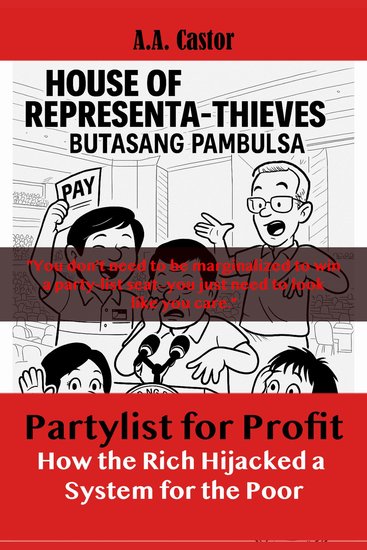
  • Partylist for Profit: How the Rich Hijacked a System for the Poor - cover

    Partylist for Profit: How the...

    A.A. Castor

    • 0
    • 0
    • 0
    Once designed to amplify the voices of farmers, laborers, and the underrepresented, the Philippine party-list system has now become the ultimate low-risk, high-reward investment for the well-connected. In Partylist for Profit: How the Rich Hijacked a System for the Poor, A.A. Castor peels back the glossy surface of legislative charity to expose the machinery of legalized profiteering, dynastic expansion, and quiet political laundering. 
    With deadpan seriousness and a dose of dark humor, this book walks readers through the insider's playbook of how to build, fund, and quietly control a party-list with as little accountability—and as much profit—as possible. From choosing a vague advocacy ("OFWs" or "transport workers," anyone?) to securing alphabet-friendly names for ballot advantage, to recycling nominees across election cycles and repackaging greed as governance, this is not a how-to—this is a how-it's-done. 
    Perfect for political junkies, aspiring operators, or just disillusioned citizens looking to finally understand why nothing ever changes, Partylist for Profit isn't just a book—it's a public service announcement disguised as satire. 
    Learn how power is bought, maintained, and quietly passed down—not through revolution, but registration. After all, in today's politics, you don't need a platform. You just need a seat.
    Ver libro
  • Dark Psychology - Toxic Minds and Difficult People who Manipulate and Control - cover

    Dark Psychology - Toxic Minds...

    Wesley Felt

    • 0
    • 0
    • 0
    This book consists of three titles, which are the following: 
    Dark Psychology: Influencing Others and Avoiding Manipulation and Blackmail 
    Dark Psychology: Detecting Lies, Spotting Manipulators, and Seeing through People 
    Dark Psychology: Dealing with Difficult People, Abuse, Liars, and Manipulators 
    These titles discuss topics such as leadership, deception, Cognitive Behavioral Therapy, jealous, emotions, trauma, manipulation, and emotional intelligence.
    Ver libro
  • The Norman Sicily - A Crossroads of Cultures - cover

    The Norman Sicily - A Crossroads...

    Harris Ropes

    • 0
    • 0
    • 0
    The Norman conquest of Sicily was a transformative period that reshaped the island’s political, social, and cultural landscape. The Normans, originally of Viking descent, had settled in northern France and became known for their military prowess and adaptability. By the 11th century, ambitious Norman adventurers turned their attention to southern Italy, seeking wealth and power. Among them, the Hauteville family played a crucial role in the conquest of Sicily, led by Robert Guiscard and his younger brother Roger.  
    The campaign to seize Sicily from Muslim control began in 1061, as the Normans took advantage of internal divisions among the island’s Muslim rulers. At the time, Sicily was a prosperous and diverse society, ruled by various Arab and Berber factions who had governed the island for over two centuries. Despite their dominance, infighting among the Muslim emirs weakened their hold, providing the Normans with an opportunity to launch a well-planned invasion. Robert Guiscard and Roger initially captured the strategic town of Messina, using it as a foothold for further expansion. Over the next three decades, the Normans steadily advanced across the island, engaging in fierce battles and sieges. 
    One of the most significant victories came in 1072 when the Normans captured the capital city of Palermo, a major cultural and economic center. Palermo’s fall marked a turning point in the conquest, as it solidified Norman authority in the region. However, complete control of Sicily was not achieved until 1091 when Roger seized Noto, the last stronghold of Muslim resistance. With this final victory, the Normans established their rule over the entire island, bringing an end to Muslim governance while incorporating many aspects of its administrative and cultural systems.
    Ver libro
  • Reforms at Risk - What Happens After Major Policy Changes Are Enacted - cover

    Reforms at Risk - What Happens...

    Eric M. Patashnik

    • 0
    • 0
    • 0
     “A fascinating account of why some general-interest policy reforms stick and others fall apart . . .  This is political science at its best.” —Julian Zelizer, Princeton UniversityWinner of the Louis Brownlow Book Award, National Academy of Public Administration Reforms at Risk is the first book to closely examine what happens to sweeping and seemingly successful policy reforms after they are passed. Most books focus on the politics of reform adoption, yet as Eric Patashnik shows here, the political struggle does not end when major reforms become enacted. Why do certain highly praised policy reforms endure while others are quietly reversed or eroded away?Patashnik peers into some of the most critical arenas of domestic-policy reform—including taxes, agricultural subsidies, airline deregulation, emissions trading, welfare state reform, and reform of government procurement—to identify the factors that enable reform measures to survive. He argues that the reforms that stick destroy an existing policy subsystem and reconfigure the political dynamic. Patashnik demonstrates that sustainable reforms create positive policy feedbacks, transform institutions, and often unleash the “creative destructiveness” of market forces.Reforms at Risk debunks the argument that reforms inevitably fail because Congress is prey to special interests, and the book provides a more realistic portrait of the possibilities and limits of positive change in American government. It is essential reading for scholars and practitioners of U.S. politics and public policy, offering practical lessons for anyone who wants to ensure that hard-fought reform victories survive.“In this penetrating and important book, Eric Patashnik explores the political circumstances that enable reforms to endure.” —Paul J. Quirk, University of British Columbia
    Ver libro