¡Acompáñanos a viajar por el mundo de los libros!
Añadir este libro a la estantería
Grey
Escribe un nuevo comentario Default profile 50px
Grey
Suscríbete para leer el libro completo o lee las primeras páginas gratis.
All characters reduced
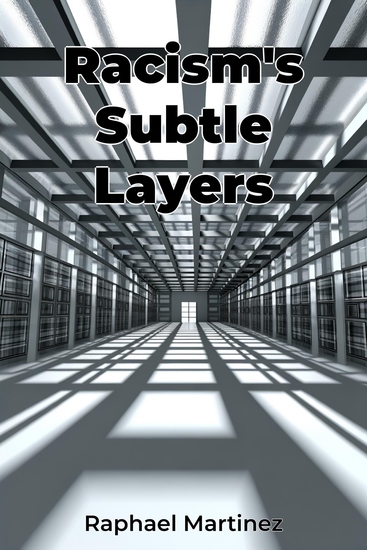
Racism's Subtle Layers - cover

Racism's Subtle Layers

Raphael Martinez

Traductor A AI

Editorial: Publifye

  • 0
  • 0
  • 0

Sinopsis

"Racism's Subtle Layers" offers a compelling exploration of how seemingly neutral social systems perpetuate racial inequities in modern society. Moving beyond obvious forms of discrimination, this comprehensive analysis reveals the hidden mechanisms that maintain racial hierarchies across education, healthcare, criminal justice, and employment sectors.

 
Through a carefully structured examination, the book demonstrates how racist practices have evolved from overt expressions to more subtle, systemic forms that operate without conscious intent. The work stands out for its innovative focus on process rather than intent, drawing from five decades of longitudinal studies and cross-country data to illustrate how routine organizational procedures can produce discriminatory outcomes.

 
Particularly fascinating is the book's revelation of how accumulated disadvantages create persistent barriers, even in systems that appear colorblind on the surface. The analysis combines quantitative data on wealth disparities and educational outcomes with qualitative studies of lived experiences, creating a comprehensive picture of modern systemic racism.

 
The book progresses logically through three major sections, beginning with historical context, moving through current mechanisms of systemic racism, and concluding with practical frameworks for institutional reform. Written for policymakers, educators, and organizational leaders, it provides concrete tools for identifying and addressing racial inequities while maintaining scientific objectivity. This approach makes complex sociological concepts accessible without sacrificing academic rigor, offering readers both theoretical understanding and practical applications for implementing equitable practices in organizational settings.
Disponible desde: 08/01/2025.
Longitud de impresión: 116 páginas.
Otros libros que te pueden interesar

  • Theoretical Knowledge and Inductive Inference - cover

    Theoretical Knowledge and...

    J.-M. Kuczynski

    • 0
    • 0
    • 0
    According to David Hume, the concept of causation and probability are to be understood in terms of the concepts of similarity and repetition. In this book, it is shown that they are to be understood in terms of the concept of continuity. One corollary is that there is no legitimate basis for skepticism concerning the legitimacy of inductive inference. Another is that anti-realism about theoretical entities is misconceived.
    Ver libro
  • The Maxims of Ptahhotep - The Oldest Book in the World - cover

    The Maxims of Ptahhotep - The...

    Ptahhotep

    • 0
    • 0
    • 0
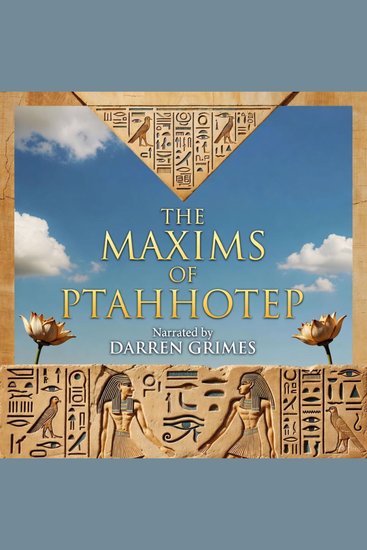
    Dive into the timeless wisdom of ancient Egypt with The Maxims of Ptahhotep: The Oldest Book in the World, now available as an captivating audiobook narrated by Darren Grimes. 
    Dating back to around 2400 BCE, this profound collection of teachings from the vizier Ptahhotep offers invaluable insights on ethics, leadership, family life, and personal conduct. Often hailed as one of the earliest surviving works of literature, these maxims provide a blueprint for living a balanced, honorable life—lessons that resonate just as powerfully today as they did in the courts of the pharaohs. From advice on humility and justice to the art of wise speech and self-control, Ptahhotep’s words guide listeners toward moral excellence and practical success. 
    Brought to life by the dynamic narration of Darren Grimes, whose clear, engaging voice captures the depth and gravity of this ancient text, this audiobook makes these eternal principles accessible and inspiring for modern audiences. Whether you’re a history enthusiast, a seeker of self-improvement, or simply curious about the roots of human wisdom, Grimes’ delivery ensures every maxim lands with impact, blending reverence for the past with relevance for the present. 
    Perfect for commutes, workouts, or quiet reflection, this audiobook is more than a listen—it’s a journey through history that could transform your perspective on life. Unlock the secrets of the ancients today. Available now—don’t miss your chance to own a piece of eternity!
    Ver libro
  • Eastern Han Dynasty The: A History of China - cover

    Eastern Han Dynasty The: A...

    Hui Wang

    • 0
    • 0
    • 0
    The Eastern Han Dynasty: A History of China, PART TWO takes you on a thrilling ride through one of China's most dramatic and chaotic eras. This book pulls you right into the palace, where figures like Empress Dou plot and scheme to secure power, even using poison and false charges to remove rivals. You'll watch the rise and fall of powerful families like the Dous and the Liang clan, who used their ties to the throne to control the empire — but always at a heavy cost. 
    You'll follow brave officials like Yuan An, Yue Hui, and Cai Yong, who risked everything to speak the truth and challenge corruption. These weren't dry, stiff scholars — they were real people caught in a deadly game of politics, facing off against terrifying figures like Liang Ji and the infamous Ten Regular Attendants, the emperor's most corrupt and dangerous eunuchs. 
    This book doesn't just tell you about emperors and generals; it shines a light on the students, rebels, and farmers, too. You'll see how the National Academy students stood up to the powerful, how the Yellow Turban Rebellion shook the empire, and how even everyday folk got tangled in the madness, whether they were sucked into fake "filial" shows or forced to pay crushing taxes to fund the emperor's endless luxuries. 
    You'll walk through lavish palace gardens, secret court meetings, bloody battlefields, and fake street markets set up inside the palace for the emperor's entertainment. From wild feasts to puppet rulers, from political assassinations to daring military campaigns, the Eastern Han was packed with stories that read like the best kind of historical drama — because they were real.
    Ver libro
  • Ethical Theory - 50 Puzzles Paradoxes and Thought Experiments (Puzzles Paradoxes and Thought Experiments in Philosophy) - cover

    Ethical Theory - 50 Puzzles...

    Sarah Stroud, Daniel Muñoz

    • 0
    • 0
    • 0
    In this new kind of introduction to ethical theory, Daniel Muñoz and Sarah Stroud present fifty of the field's most exciting puzzles, paradoxes, and thought experiments. Over the course of eleven chapters, the authors cover a huge variety of topics, starting with the classic debate between utilitarians and deontologists and ending on existential questions about the future of humanity. 


    Every chapter begins with a helpful introduction, and each of the fifty entries includes references for further reading and questions for reflection. Among the entries are such classics as the Ring of Gyges, Jim and the Villagers, the Repugnant Conclusion, JoJo, "One Thought Too Many," the Miners Puzzle, the Gentle Murder Paradox, Nowheresville, the Experience Machine, and the Trolley Problem. The book also explores several more recent topics of interest, such as doxastic wronging and the ethics of AI, so that even advanced students are likely to discover something new. Each entry can be read on its own, and the writing is accessible and conversational throughout, making this an ideal resource for undergraduate teaching. Listeners at any level can pick up this book and see for themselves how fascinating—and puzzling—ethical theory can be.
    Ver libro
  • The Monadology - cover

    The Monadology

    Gottfried Wilhelm Leibniz

    • 0
    • 0
    • 0
    The Monadology (La Monadologie, 1714) is one of Gottfried Leibniz’s best known works representing his later philosophy. It is a short text which sketches in some 90 paragraphs a metaphysics of simple substances, or monads. What he proposed can be seen as a modification of occasionalism developed by latter-day Cartesians. Leibniz surmised that there are indefinitely many substances individually 'programmed' to act in a predetermined way, each program being coordinated with all the others. This is the pre-established harmony which solved the mind body problem at the cost of declaring any interaction between substances a mere appearance, something which Leibniz accepted. Indeed it was space itself which became an appearance as in his system there was no need for distinguishing inside from outside. True substances were explained as metaphysical points which, Leibniz asserted, are both real and exact - mathematical points being exact but not real and physical ones being real but not exact.  
    (Summary from Wikipedia)
    Ver libro
  • 1811 German Coast Uprising and Nat Turner’s Rebellion The: The History and Legacy of America’s Most Famous Slave Revolts - cover

    1811 German Coast Uprising and...

    Editors Charles River

    • 0
    • 0
    • 0
    As the issue of slavery roiled the country, few people became as controversial or consequential as Nat Turner, who was one of millions of slaves in the South before the Civil War but ultimately led the nation’s most notorious slave uprising. In August 1831, Turner led a rebellion that terrorized Virginia for several days, killing dozens of whites and freeing slaves as his band moved from plantation to plantation. The Richmond Enquirer reported, “A fanatic preacher by the name of Nat Turner (Gen. Nat Turner) who had been taught to read and write, and permitted to go about preaching in the country, was at the bottom of this infernal brigandage. He was artful, impudent and vindicative, without any cause or provocation, that could be assigned.” Even after the uprising was put down, Turner evaded capture for a few months, and after he was captured, his “confessions” were taken down and published before he was executed. Virginia would put a total of 56 slaves to death for the uprising. 
    	While Turner’s rebellion remains famous today, a far larger uprising took place a generation earlier. In January 1811, hundreds of slaves in Louisiana attempted to make a new beginning for themselves or die trying. Armed with muskets, cane knives, and axes, and wearing stolen United States militia uniforms, they set out to conquer the city of New Orleans. The goal was to establish a free republic where slavery was outlawed and blacks had control over their own lives. Understandably discontented with their status and no longer willing to accept it, they were ready to engage in extreme violence to win their freedom. Despite being unsuccessful in overthrowing the system, the German Coast Uprising showed a level of organization, leadership, and coordination unseen before by slaves in America, and it was totally unexpected by white owners and officials, which made it a precursor to its much more famous successor. 
    Ver libro