Rejoignez-nous pour un voyage dans le monde des livres!
Ajouter ce livre à l'électronique
Grey
Ecrivez un nouveau commentaire Default profile 50px
Grey
Abonnez-vous pour lire le livre complet ou lisez les premières pages gratuitement!
All characters reduced
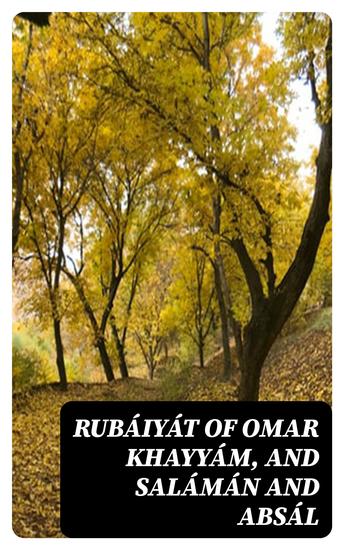
Rubáiyát of Omar Khayyám and Salámán and Absál - Together with a Life of Edward Fitzgerald and an Essay on Persian Poetry by Ralph Waldo Emerson - cover

Rubáiyát of Omar Khayyám and Salámán and Absál - Together with a Life of Edward Fitzgerald and an Essay on Persian Poetry by Ralph Waldo Emerson

Omar Khayyam, Ralph Waldo Emerson, Jami

Traducteur Edward FitzGerald

Maison d'édition: DigiCat

  • 0
  • 0
  • 0

Synopsis

The anthology 'Rubáiyát of Omar Khayyám, and Salámán and Absál' serves as a bridge connecting the timeless wisdom of Persian and Western literature, embracing a rich tapestry of philosophical musings and poetic innovation. This collection, bound by the threads of existential wonder and romantic exploration, showcases a variety of literary styles, from the evocative quatrains of the Rubáiyát to the allegorical prose of Salámán and Absál. Each work illuminates profound questions regarding life, destiny, and love, offering readers an introspective journey through both classical and symbolic narratives. Bringing together the illustrious voices of Omar Khayyám, Ralph Waldo Emerson, and Jami, this anthology stands as a testament to the enduring exchange of ideas across cultures and eras. Each contributor draws from a rich historical and cultural heritage—Khayyám's Persian roots meet Emerson's transcendental reflections and Jami's mystical insights. Their collective works substantiate a dialogue that enriches the thematic depth of the anthology, reflecting the intersections of Persian philosophy with Western thought and embodying the spirit of intellectual and cultural symbiosis. Recommended for its introspective depth and its celebration of cross-cultural dialogue, this anthology invites readers to indulge in a kaleidoscope of perspectives and literary styles. It offers an educational odyssey into the philosophical terrains of East and West, cultivating a nuanced appreciation for diverse narratives. As readers traverse this collection, they engage with an illuminating discourse that showcases the timeless relevance and literary allure of these distinguished authors.
Disponible depuis: 15/08/2022.
Longueur d'impression: 56 pages.

D'autres livres qui pourraient vous intéresser

  • The Odes of Anacreon - cover

    The Odes of Anacreon

    Anacreon

    • 0
    • 0
    • 0
    Anacreon (582 BCE–485 BCE) was a Greek lyric poet born in Teos, an Ionian city on the coast of Asia Minor. He likely moved to Thrace in 545 BCE with others from his city when it was attacked by Persians. He then moved to Samos, to Athens, and possibly again to Thessaly, seeking a safe place to write his poems as his patrons (including Polycrates, tyrant of Samos, and Hipparchus, brother of Athenian tyrant Hippias) kept being murdered. It is unknown where Anacreon died, though he lived to the unusually advanced age of 85. 
    Few of Anacreon's works survive, but those that do focus on wine, love (homosexual and heterosexual), and the overall pleasures of the legendary Roman symposium. Anacreon used various techniques in his writings, including self-deprecation and irony. The collection of miscellaneous Greek poems from the Hellenistic Age and beyond known as the Anacreontea was "mistakenly labeled" with Anacreon's name. Despite later appreciation for Anacreon's true poems, his works were not appreciated during his lifetime.
    This work is a collection of the Odes of Anacreon, translated into English by Thomas Moore.
    Voir livre
  • The Book of Jonah - cover

    The Book of Jonah

    Luke Kennard

    • 0
    • 0
    • 0
    Read by the author, Luke Kennard‘Kennard’s distinctive voice – surreal, funny, anxious, always overthinking, and cringingly self-deprecating – has made him one of the most widely liked and imitated British poets’ – Tristram Fane Saunders, TLSNone of the Old Testament prophets were especially happy or confident in their calling, but Jonah was the only one who rejected it outright, disobeying direct instruction from God and literally running away. In The Book of Jonah, Luke Kennard transforms the unique and awkward position Jonah’s story occupies in scripture – part dream, part joke, part provocation – into a madcap picaresque which marries the sacred and the absurd.Though Jonah’s encounter with the whale is most commonly interpreted as the story of a reluctant prophet being punished by his maker, Kennard’s Jonah is more wily business traveller than seer. Taking his instruction instead from non-governmental organizations, arts development agencies and public-relations gurus, this Jonah keeps relentlessly busy, accepting any assignment that will take him further away from Nineveh and drown out the word of God in his ears. On his travels he meets errant writers, fixers, artists and consultants, but nobody who can give him a sense of what his work might be beyond a five-star capitalist purgatory in a series of exotic locations. What would it mean to be a prophet – or even a false prophet – in this milieu?Taking on the decimation of funding for the arts, the emptiness of the hero’s journey and a literary culture regarded by wider society with cynicism, ignorance and apathy, The Book of Jonah is a blistering poetry collection from the Forward Prize-winning author of Notes on the Sonnets.
    Voir livre
  • Bully King - cover

    Bully King

    Andi Jaxon

    • 0
    • 0
    • 0
    BULLY KING IS A BRILLIANTLY WRITTEN TALE OF INTOLERANCE, PREJUDICE, SOCIAL INJUSTICE, ACCEPTANCE & UNCONDITIONAL LOVE. 5-STARS! 
     
    I'm the pastor's son. 
    He's the star quarterback for a small Kentucky high school. 
    While the town worships him, I pray for God to take my life. 
    He makes my life a living hell by making me his victim. 
    This perverse game we play could end us both. 
    How can something that feels so right be so wrong? 
    The price if the truth is discovered is death, but I can't stop. 
    Neither can he. No one can know. 
    Can I risk it? Is Roman King worth dying for? 
     
    This story is a bully romance. Trigger Warnings: 
    By main characters: Bullying, non-con, dub-con, homophobia, assault 
    By side character: domestic violence, alcohol abuse, suicide attempt, abuse, bullying, car accident, death, homophobia, violence
    Voir livre
  • Top 10 Poets The - Died in World War I - Five poems each from some of the best poets that tragically died in WW1 - cover

    Top 10 Poets The - Died in World...

    Wilfred Owen

    • 0
    • 0
    • 0
    The language of Poetry is an art that most of us attempt at some point in our lives.  Although its commonplace exposure has been somewhat marginalised in today’s often fast-paced lives we all recognise good verse that can empathise with our thoughts or open us up to experience new things in new ways, to better understand and to enjoy the many strands of our lives. 
     
    But finding a starting point can be overwhelming, even off-putting, so in this series we offer up our Top 10 classic poets, who brim with talent and verse, on a range of subjects and themes that we can all enjoy. 
     
    It is at first difficult to comprehend that the carnage and slaughter of War could yield some of our greatest poetry.  Harder still that in four years of horror humanity was able to destroy and create on such a scale.  These 10 poets and their verses speak for everyone. 
    1 - The Top 10 Poets - Died in WWI - An Introduction 
    2 - From My Diary July 1914 by Wilfred Owen 
    3 - Strange Meeting by Wilfred Owen 
    4 - Soldier's Dream by Wilfred Owen 
    5 - Dulce et Decorum Est by Wilfred Owen 
    6 - Anthem For Doomed Youth by Wilfred Owen 
    7 - 1914 by Rupert Brooke - Peace, Safety, The Dead,  The Dead & The Soldier 
    8 - The Night Journey by Rupert Brooke 
    9 - The Old Vicarage of Grantchester by Rupert Brooke 
    10 - Libido by Rupert Brooke 
    11 - Desertion by Rupert Brooke 
    12 - No One Cares Less Than I (Bugle Call) by Edward Thomas 
    13 - A Private by Edward Thomas 
    14 - This Is No Case of Petty Right or Wrong by Edward Thomas 
    15 - These Things That Poets Said by Edward Thomas 
    16 - Adlestrop by Edward Thomas 
    17 - God by Isaac Rosenberg 
    18 - Break of Day in the Trenches by Isaac Rosenberg 
    19 - In the Trenches by Isaac Rosenberg 
    20 - Spring 1916 by Isaac Rosenberg 
    21 - Daughters of War by Isaac Rosenberg 
    22 - The Dying Patriot by James Elroy Flecker 
    23 - I Rose From Dreamless Hours by James Elroy Flecker 
    24 - No Coward's Song by James Elroy Flecker 
    25 - Destroyer of Ships, Men, Cities by James Elroy Flecker 
    26 - Don Juan in Hell by James Elroy Flecker  
    27 - Such Such Is Death by Charles Sorley 
    28 - A Call to Action by Charles Sorley 
    29 - When You See Millions Of The Mouthless Dead By Charles Sorley 
    30 - To Germany by Charles Sorley 
    31 - East Kennet Church At Evening by Charles Sorley 
    32 - An Attempt at a City Sunset by Francis Ledwidge 
    33 - Ireland by Francis Ledwidge 
    34 - Lament for the Poets, 1916 by Francis Ledwidge 
    35 - Growing Old by Francis Ledwidge 
    36 - A Soldier's Grave by Francis Ledwidge 
    37 - In Flanders Fields by John McCrae 
    38 - Disarmament by John McCrae 
    39 - Anarchy by John McCrae 
    40 - The Pilgrims by John McCrae 
    41 - A Song of Comfort by John McCrae 
    42 - Champagne 1914-1915 by Alan Seeger 
    43 - Paris by Alan Seeger 
    44 - Sonnet 14 by Alan Seeger 
    45 - Ode in Memory of the American Volunteers Fallen for France by Alan Seeger 
    46 - I Have a Rendezvous with Death by Alan Seeger 
    47 - The Battle at Saarburg by Alfred Lichtenstein 
    48 - Prayer Before Battle by Alfred Lichtenstein 
    49 - The Trip to the Mental Hospital by Alfred Lichtenstein 
    50 - Moonscape by Alfred Lichtenstein 
    51 - Soldiers' Songs by Alfred Lichtenstein
    Voir livre
  • Impossible Heat - cover

    Impossible Heat

    Ciara Maguire

    • 0
    • 0
    • 0
    'these basements that taught me to breathe;my body happening in the space between moonlight &the leather straps wrapped round an old dyke's wristgender split open like a crass piñata on the sticky floor'
    Ciara Maguire's poems explore the bright fields and dark corners of love. They are heartbreaking, sexy and addictive.
    'Impossible Heat is a work of claustrophobia, heat, and longing. Sexual ideation extends from the mind of the speaker to colour and consume everything. Long lines and rich cadences hold the reader in a vice, just as the speaker is offered no reprieve from her own intensity of feeling. Amidst the erotic, there is a profound hopelessness that doesn't stop the poems being witty and manic, as the speaker struggles with privacy and performance, with a
    fear of perception but a desperate need to be perceived. The emotional incisiveness of this work is stark, its euphony sumptuous.' Susannah Dickey
    'A nest-making of threads and mirrors, sapphic rorschachs revealing everything and nothing that might be told in the salt content of sweat and the tonguing indent of lyric. These generous poems drift through the gap someone left in your bedroom window. Here are dreams, tragedies of homosexuality, domestic horror shows, a cascade of utopian performatives, moonlight, a summer that may or may not ever end. What innocence is lost or won in love is felt in the sensory plenitude of our speaker's imagination. Maguire is a master of anaphora, list and simile. Impossible Heat surrenders to its own melting, poems yielding
    magical hyperobjects which metabolise into tender adhesives, binding us irresistibly to this book. This is a work of devotion, connection, eclipse, desire and discovery. Its charm is quietly devastating.' Maria Sledmere
    Voir livre
  • The Rubaiyat of Omar Khayyam - cover

    The Rubaiyat of Omar Khayyam

    Omar Khayyam, Edward FitzGerald

    • 0
    • 0
    • 0
    The Rubaiyat of Omar Khayyam is a collection of quatrains (four-line verses) attributed to the 12th-century Persian poet, mathematician, and astronomer, Omar Khayyam. While the original Persian text is complex and open to interpretation, it is the English translation by Edward Fitzgerald that popularized the work in the Western world. 
    Fitzgerald's translation portrays a world view that is often characterized as: 
    Carpe Diem: Seize the day, emphasizing the fleeting nature of life and the importance of enjoying the present moment. 
    Skepticism: Questioning traditional beliefs and religious dogma, particularly in relation to the afterlife. 
    Epicureanism: Focusing on pleasure and the senses as the primary goods in life. 
    Fatalism: Accepting one's fate and the inherent unpredictability of existence.
    Voir livre