¡Acompáñanos a viajar por el mundo de los libros!
Añadir este libro a la estantería
Grey
Escribe un nuevo comentario Default profile 50px
Grey
Suscríbete para leer el libro completo o lee las primeras páginas gratis.
All characters reduced
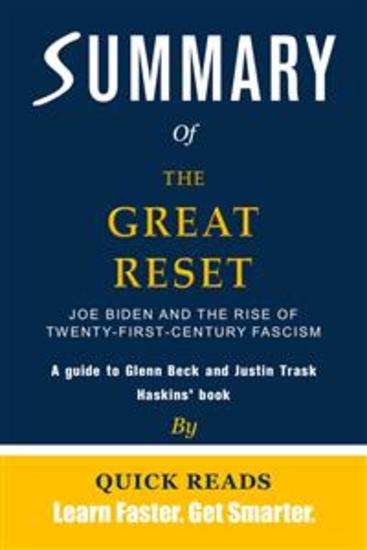
Summary of The Great Reset - Joe Biden and the Rise of Twenty-First-Century Fascism by Glenn Beck and Justin Trask Haskins - cover

Summary of The Great Reset - Joe Biden and the Rise of Twenty-First-Century Fascism by Glenn Beck and Justin Trask Haskins

Quick Reads

Editorial: Quick Reads

  • 0
  • 0
  • 0

Sinopsis

The Great Reset is about a powerful effort among the world's elite to use banks, government services, and environmental, social, as well as governance parameters to reset the global economy.

If they succeed and the Great Reset is completed, huge firms, international organizations, banks, and government officials, including Joe Biden, the United Nations, and many World Economic Forum participants, will have far more economic and social influence.

It's a 320-page book published by Glenn Beck, a talk radio broadcaster and long-time media presence, and Justin Haskins, head of the Heartland Institute's Stopping Socialism Center, an Illinois-based free-market think tank.

According to the author, the "Great Reset" is "the single most significant issue I have covered in my career and the movement that might eventually extinguish the spark of liberty in America," according to the author.

This is the SUMMARY of the book, The Great Reset: Joe Biden and the Rise of Twenty-First-Century Fascism by Glenn Beck and Justin Trask Haskins which in no way intends to displace the original work but offers the following:

* An in-depth analysis of the book

* An efficiently written work that conveys the authors' message in a user friendly manner.

* A sufficient synopsis of the authors' main ideas.

These and many more can be found in this little book of immeasurable value!

To get a copy of this quick-read summary, click on the Buy Now button for instant access!

---------
DISCLAIMER

This book is an unofficial summary and analysis of Glenn Beck and Justin Trask Haskins' book, The Great Reset: Joe Biden and the Rise of Twenty-First-Century Fascism, which should be read in conjunction with the original work, not as a substitute. This content is solely the responsibility of Quick Reads, which is not affiliated with the original author in any way.
Disponible desde: 10/01/2023.


Otros libros que te pueden interesar

  • Internet for the People - The Fight for Our Digital Future - cover

    Internet for the People - The...

    Ben Tarnoff

    • 0
    • 0
    • 0
    Why is the internet so broken, and what could ever possibly fix it? 


    In Internet for the People, leading tech writer Ben Tarnoff offers an answer. The internet is broken, he argues, because it is owned by private firms and run for profit. Google annihilates your privacy and Facebook amplifies right-wing propaganda because it is profitable to do so. But the internet wasn't always like this. Tarnoff tells the story of the privatization that made the modern internet, and which set in motion the crises that consume it today. 


    The solution to those crises is straightforward: deprivatize the internet. Deprivatization aims at creating an internet where people, and not profit, rule. It calls for shrinking the space of the market and diminishing the power of the profit motive. It calls for abolishing the walled gardens of Google, Facebook, and the other giants that dominate our digital lives and developing publicly and cooperatively owned alternatives that encode real democratic control. To build a better internet, we need to change how it is owned and organized. Otherwise, a small number of executives and investors will continue to make choices on everyone's behalf, and these choices will remain tightly bound by the demands of the market. It's time to demand an internet by, and for, the people now.
    Ver libro
  • Editorial Wild Oats - cover

    Editorial Wild Oats

    Mark Twain

    • 0
    • 0
    • 0
    Editorial Wild Oats is a classic collection of non-fiction, journalistic essays from Mark Twain. It contains:My First Literary VentureMy First Literary VentureJournalism in TennesseeNicodemus Dodge PrinterMr. Bloke's ItemHow I Edited an Agricultural PaperThe Killing of Julius Caesar 'Localized'
    Ver libro
  • Coronavirus Oppression - cover

    Coronavirus Oppression

    Raphael Terra

    • 0
    • 0
    • 0
    This audiobook has been recorded using Text to speech (TTS). 
     
    We have been terrified into submission. Words like pandemic and images of horror have been thrust upon us. It is all a scam. A lie. It is part of a long-term plot to control, manipulate and enslave mankind. 
     
    A divided world has been brought together under a common threat and it is just the beginning. 
     
    There are massive, global revolutions being created and fostered by a powerful, dark and sinister group that have directed the sheep for countless generations. Very soon you will be asked to do things you would never have contemplated before and you will do them gladly. 
     
    This is the story of how your freedoms and liberties are being taken away from you without you even caring. In fact you will be happy to lose them. And all because of a small virus created by that same elite group and let loose upon mankind for a very malevolent end. 
     
    George Orwell said: "Political language is designed to make lies sound truthful and murder respectable, and to give an appearance of solidity to pure wind." This book will prove that he was right all along...
    Ver libro
  • Capitalism - The Story behind the Word - cover

    Capitalism - The Story behind...

    Michael Sonenscher

    • 0
    • 0
    • 0
    What exactly is capitalism? How has the meaning of capitalism changed over time? And what's at stake in our understanding or misunderstanding of it? In Capitalism, Michael Sonenscher examines the history behind the concept and pieces together the range of subjects bound up with the word. Sonenscher shows that many of our received ideas fail to pick up the work that the idea of capitalism is doing for us, without us even realizing it. 


    "Capitalism" was first coined in France in the early nineteenth century. It began as a fusion of two distinct sets of ideas. The first involved thinking about public debt and war finance. The second involved thinking about the division of labor. Sonenscher shows that thinking about the first has changed radically over time. Funding welfare has been added to funding warfare, bringing many new questions in its wake. Thinking about the second set of ideas has offered far less room for maneuver. The division of labor is still the division of labor and the debates and discussions that it once generated have now been largely forgotten. By exploring what lay behind the earlier distinction before it collapsed and was eroded by the passage of time, Sonenscher shows why the present range of received ideas limits our political options and the types of reform we might wish for.
    Ver libro
  • NAZI MOVIES AS PROPAGANDA MACHINE - How Goebbels Changed the German Film Industry Into an Ideological Weapon - cover

    NAZI MOVIES AS PROPAGANDA...

    Davis Truman

    • 0
    • 0
    • 0
    The German film industry transformed from a collection of independent studios into a division of the Nazi Party between 1933 and 1945. German film became a crucial component of the Nazi campaign to ideologically indoctrinate the German populace as part of the Ministry for Popular Enlightenment and Propaganda, led by Joseph Goebbels. However, the business kept up its prior commercial practices and made movies aimed at paying German consumers. Even though Goebbels worked hard to turn German cinema into an ideological weapon, the theater served as a popular consumer marketplace, and the various film tastes of German moviegoers continued to affect the kinds of films made. Therefore, filmmaking in Nazi Germany was influenced by popular taste and Goebbels' ideological objectives. 
    This book will look at several movies that demonstrate Goebbel's evolving propaganda objectives and the changing preferences of the German audience for movies during the Nazi era. Box office statistics from the years before and after the start of World War II offer unique insight into German film consumption and serve to highlight the extent to which the general public supported the war in Germany.
    Ver libro
  • To Catch a Dictator - The Pursuit and Trial of Hissène Habré - cover

    To Catch a Dictator - The...

    Reed Brody

    • 0
    • 0
    • 0
    What does it take to make a dictator answer for his crimes? Hissène Habré, the former despot of Chad, terrorized, tortured, and killed on a horrific scale over eight years in power—while enjoying full American and Western support. After Habré’s overthrow, his victims and their supporters were determined to see him held responsible for his atrocities. Their quest for justice would be long, tense, and unnerving, but they would not back down. 


    To Catch a Dictator is an insider's account of the hunt for Habré and his momentous trial. The human rights lawyer Reed Brody recounts how he and an international team of investigators, legal experts, and victims worked across three continents to unearth evidence and witnesses, petition courts and skeptical governments, and rally public opinion. They faced many obstacles and constant threats. Habré fought back bitterly, drawing on secret bank accounts and extensive political connections to preserve his life of luxurious exile. Yet Brody and his allies ultimately triumphed: Habré became the first former head of state to be convicted of crimes against humanity in the courts of another country. This fast-paced, suspenseful book shows that there is nothing inevitable about the impunity that too often protects the powerful and that even the worst tyrants can be brought to justice.
    Ver libro