Junte-se a nós em uma viagem ao mundo dos livros!
Adicionar este livro à prateleira
Grey
Deixe um novo comentário Default profile 50px
Grey
Assine para ler o livro completo ou leia as primeiras páginas de graça!
All characters reduced
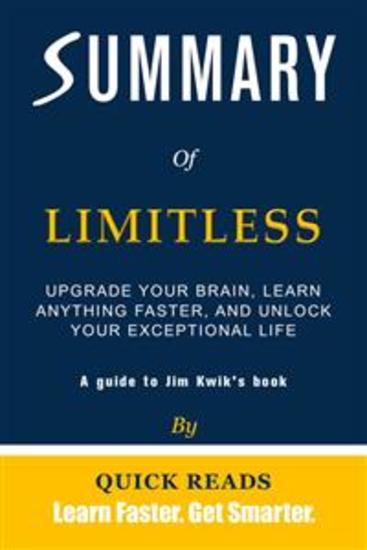
Summary of Limitless - Upgrade Your Brain Learn Anything Faster and Unlock Your Exceptional Life by Jim Kwik | Get The Key Ideas Quickly - cover
LER

Summary of Limitless - Upgrade Your Brain Learn Anything Faster and Unlock Your Exceptional Life by Jim Kwik | Get The Key Ideas Quickly

Quick Reads

Editora: Quick Reads

  • 0
  • 0
  • 0

Sinopse

Limitless: Upgrade Your Brain, Learn Anything Faster, and Unlock Your Exceptional Life by Jim Kwik is your ultimate guide to unlocking your full potential and becoming the best version of yourself. 

Based on decades of research and experience as a leading memory and learning expert, Kwik provides actionable strategies for upgrading your brain, enhancing your memory, and unlocking your ability to learn anything faster. 

From simple tips for boosting your focus and productivity, to cutting-edge techniques for enhancing your memory and creativity, this book is packed with practical and powerful insights that will help you achieve more, faster. 

Whether you're looking to advance your career, improve your relationships, or simply unleash your full potential, "Summary of Limitless" is the ultimate blueprint for unlocking the exceptional life you were meant to live. Don't settle for ordinary, upgrade your brain and transform your life today by clicking on the Buy Now button to Order your copy now!

---------
DISCLAIMER

This book is an unofficial summary and analysis of Jim Kwik's book, Limitless: Upgrade Your Brain, Learn Anything Faster, and Unlock Your Exceptional Life, which should be read in conjunction with the original work, not as a substitute. This content is solely the responsibility of Quick Reads, which is not affiliated with the original author in any way.
Disponível desde: 30/01/2023.


Outros livros que poderiam interessá-lo

  • Overthinking - cover

    Overthinking

    Amy Williams

    • 0
    • 0
    • 0
    GIVE YOUR MIND A BREAK — Stop Your Mind From Going Into Overdrive And Start Making Better Decisions!Welcome to the overthinker’s guide to putting an end to excessive rumination!On the surface, thinking is considered a good thing… but when you go overboard, you start bumping into problems. Overthinking causes your mind to get cloudy and negatively hamper your judgement. And since you spend too much time wallowing in negative thoughts and scenarios, your stress levels become elevated. This, in turn, can make it difficult for you to make sound decisions.In this master guide, Amy Williams will teach you how to stop overthinking, eliminate negative thoughts, declutter your mind, improve self-esteem, build mental toughness, and unlock your mind’s limitless potential!Here’s what you’ll learn:•	How to prevent overthinking from sabotaging your performance•	How to eliminate negative thoughts•	Practical tips to declutter your mind and free up mental space•	How to develop mental toughness and stay strong•	TOP STRATEGIES for building resilience•	How to use manipulation to unlock your mind power and attract success•	Simple, yet PROVEN ways to boost your self-esteem quicklyPeace of mind is one of life’s greatest gifts. When your mind is at peace, you are, too! A clear head is free to think of innovative, life-changing ideas that will help you achieve life-long success.This book will help you achieve peace of mind… and so much more!
    Ver livro
  • The human machine - cover

    The human machine

    Arnold Bennett

    • 0
    • 0
    • 0
    "The Human Machine" by Arnold Bennett is a classic self-help book published in 1908. In this work, Bennett explores the intricacies of human psychology and behavior, offering insights into how individuals can better understand and control their thoughts, emotions, and actions to lead more fulfilling lives. Through practical advice and philosophical reflections, Bennett delves into the inner workings of the human mind, examining topics such as habit formation, willpower, concentration, and personal development.
    Ver livro
  • St Petersburg - cover

    St Petersburg

    Kelly Mass

    • 0
    • 0
    • 0
    St Petersburg's structures lay over the skeletons of the press-ganged servant workers who worked to build it, making it the label "the city built on bones." Historians approximate that 100,000 18th-century slaves are buried underneath the city's stunning Italianate estates and large Parisian-style streets.They passed away of cold, appetite, illness, or, if they were truly unfortunate, wolves. They were drawn from all around the Russian Empire at the time. They dedicated their lives for the magnificence of Imperial Russia, and the city they built, St Petersburg, stands as a testimony to the Russian state's single-mindedness.Its extravagant palaces radiate European elegance and were actively built in a Western way to bring Russia closer to Europe.Still, more than 3 centuries later, Russia has yet to finish this journey, and St Petersburg is a witness to the trouble of the journey.Let’s take a look at what else makes Saint Petersburg such a unique place.
    Ver livro
  • City Steps of Pittsburgh - A History & Guide - cover

    City Steps of Pittsburgh - A...

    Laura Zurowski, Charles Succop,...

    • 0
    • 0
    • 0
    Exploring Pittsburgh's Ups and Downs 
     
    In Pittsburgh, the elevation varies wildly, fluctuating 660 feet from highest to lowest points throughout the area and making it one of the hilliest cities in the United States. Throughout this unruly and physically challenging landscape, the city's first mass transportation system was built—a steadily expanding network of public stairways, locally referred to as city steps, these flights of stairs are a throwback to a very different time in history and a very different Pittsburgh. Authors Laura Zurowski, Charles Succop, and Matthew Jacob present the history of the Steel City steps and a walking guide to their scenic locations today.
    Ver livro
  • The Viking Age - Raiders and Traders - cover

    The Viking Age - Raiders and...

    Harris Ropes

    • 0
    • 0
    • 0
    The story of the Vikings begins in the rugged, coastal lands of Scandinavia, where modern-day Norway, Sweden, and Denmark now stand. These northern regions, characterized by their cold climate, deep fjords, and dense forests, shaped a resilient and resourceful people. Isolated by geography and challenged by limited arable land, the early Norse communities developed a strong connection to nature, the sea, and their close-knit societies. Life in Scandinavia during the early Middle Ages was not easy, but it fostered a culture of survival, adaptability, and innovation. 
    At the heart of Viking society was a deep belief in their mythology and gods. Norse mythology offered a complex system of deities, heroes, and mythical creatures that guided the moral and spiritual lives of the people. Central figures like Odin, the wise All-Father; Thor, the thunder god and protector; and Freyja, the goddess of love and fertility, were not just worshipped but also deeply integrated into the everyday lives of the Norse. These myths were passed down through oral storytelling, poetic sagas, and ritual practices, helping to create a shared identity among the diverse Scandinavian tribes. 
    Viking society was organized into a hierarchical structure that valued strength, honor, and loyalty. At the top were the jarls, or chieftains, who held power over clans and led warriors into battle or on raids. Below them were the karls, the free farmers, craftsmen, and traders who formed the backbone of Viking communities. At the bottom were the thralls, or slaves, who were usually captured during raids or born into servitude. Despite this stratification, Viking culture emphasized personal achievement and reputation, allowing individuals to rise in status through bravery, skill, and loyalty.
    Ver livro
  • Dream Psychology - cover

    Dream Psychology

    Sigmund Freud

    • 0
    • 0
    • 0
    "Dream Psychology" is a seminal work by Sigmund Freud, published in 1899 as "Die Traumdeutung" in German and later translated into English. In this book, Freud explores the significance of dreams and their interpretation in the context of psychoanalysis. He posits that dreams are manifestations of unconscious desires, fears, and conflicts, and by analyzing them, individuals can gain insight into their innermost thoughts and motivations. Freud introduces concepts such as dream symbolism, the latent and manifest content of dreams, and the role of the unconscious mind in shaping dreams.
    Ver livro