Join us on a literary world trip!
Add this book to bookshelf
Grey
Write a new comment Default profile 50px
Grey
Subscribe to read the full book or read the first pages for free!
All characters reduced
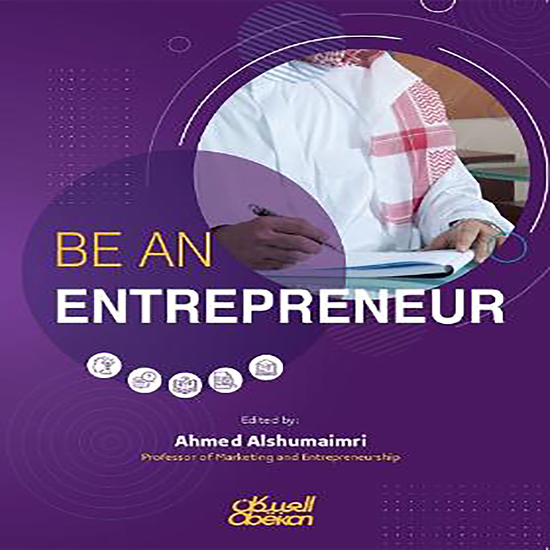
Be An Entrepreneur - cover

Be An Entrepreneur

PROFESSOR AHMED ALSHUMAIMRI

Publisher: Obeikan

  • 0
  • 0
  • 0

Summary

About this Book

We believe that we are in the era when the college student should learn how to create jobs for himself and for others rather than just be a job seeker upon graduation. This book is meant to explain the steps to take in starting a venture and running a business. It is about the adventure of starting a small business step by step. It is designed for both undergraduate and graduate courses that focus on entrepreneurship theory and practice.


About the Editor

Professor Ahmed Alshumaimri is a practitioner and mentor for entrepreneurial innovation. He is one of the founders of Entrepreneurship in the Kingdom of Saudi Arabia. He has got consulting, direct marketing, strategic planning, and SME and entrepreneurship background spanning over twenty-five years, including international business projects across North America, United Kingdom, and the Kingdom of Saudi Arabia. He is a venture capitalist and a member of Angel investor group who establishes tens of SMEs. Dr. Ahmed's interests include entrepreneurship, networking, business collaborations, business incubation, and technology.
Available since: 07/05/2025.
Print length: 359 pages.

Other books that might interest you

  • How to teach english to spanish speakers - cover

    How to teach english to spanish...

    María Teresa Orlando

    • 0
    • 0
    • 0
    Although there are several teaching methodology books for teachers on the market, there is little if anything specifically focused on how to teach English to Spanish speakers.  The large and growing Hispanic community in the United States that wants and needs to learn English along with the daily-increasing demand for English classes in Latin American countries underline the need for an instructional text such as this one.
     "How to Teach English to Spanish Speakers" is a comprehensive introduction to teaching . English to students with Spanish-language backgrounds.  It provides practical step-by-step guidance for new teachers and offers fresh ideas for more experienced teachers.  It is also ideal for English translators and native English speakers who wish to give English classes.  his resource book examines straightforward teaching procedures, underlying pedagogy and fundamental principles of teaching English, and includes a considerable variety of classroom and research approaches for language instruction.  It suggests practical pedagogic options while exploring various teaching methodologies, comprehensive strategies and effective methods for teaching and developing one's own distinctive teaching style.  It analyzes the crucially important qualities of an effective English teacher.  
    The most critical reason for this book is to look into what we teach, whom we teach, where we teach and, above all, how we can most successfully teach.  Through valuable insights and personal experiences of working with different learning styles, predominant intelligences and different ways of building confidence, it discusses teaching and the learning process, classroom management and different ways to improve learners' listening, speaking, reading and writing skills.  It also provides clear explanations as well as examples of class observations, lesson and unit plans, and offers reliable procedures, practical tips and activities  for teaching Spanish-speaking children, adolescents and adults from beginning to advanced language levels.------------------------------------------------------------------------------------------------
    
    Aunque hay varios libros sobre metodología de enseñanza para profesores en el mercado, hay poco o nada que esté enfocado específicamente en cómo enseñar inglés a los hispanohablantes. La numerosa y creciente comunidad hispana en los Estados Unidos que quiere y necesita aprender inglés, junto con la demanda cada vez mayor de clases de inglés en los países de América Latina, incrementan la necesidad de este práctico texto. "Cómo enseñar inglés a los Hispanohablantes" es una introducción accesible para los estudiantes de habla hispana que quieren enseñar inglés; proporciona una guía práctica paso a paso para los docentes que recién se inician y ofrece nuevas ideas para los profesores con más experiencia. También es ideal para los traductores de inglés y los nativos de dicho idioma que quieran ejercer la docencia. Este libro de consulta examina los procedimientos, la pedagogía y los principios fundamentales de los diferentes métodos e incluye una variedad considerable de enfoques de investigación para la enseñanza/aprendizaje de la lengua. Sugiere opciones pedagógicas prácticas mientras explora diversas metodologías de enseñanza, estrategias integrales y herramientas efectivas tanto para desarrollar como para aplicar el estilo propio de cada docente. También analiza las habilidades indispensables para ser un profesor de inglés eficiente y eficaz. El propósito crucial de este libro no es solamente analizar qué, a quién, dónde y para qué enseñamos, sino sobre todo, cómo podemos enseñar con más éxito . Se abarcan todos los niveles, desde principiantes hasta avanzados, para el aprendizaje de niños, adolescentes y adultos de habla hispana.
    Show book
  • Bright Eyes-A Memoir - Surviving Our Monsters and Learning to Live Without Them - cover

    Bright Eyes-A Memoir - Surviving...

    Bridey Thelen-Heidel

    • 0
    • 0
    • 0
    Fans of Jennette McCurdy’s I’m Glad My Mom Died will root for Bridey Thelen-Heidel as she struggles to unshackle herself from her mother’s chaos in this triumphant debut memoir. 
    Bridey is tethered to her mom’s addiction to dangerous men who park their Harley-Davidsons in the house and kick holes in all their doors. Raised to be her mother’s keeper, rescuer, and punching bag, Bridey gets used to stuffing her life into black trash bags, hauling them between Alaska and California, and changing schools every time her mom moves in a new monster—or runs away from one. Desperately seeking the normal life she’s observed in sitcoms and her friends’ families, Bridey earns her way into a fancy, private college, where she tries to forget who she is—until her mom calls with a threat that drops Bridey to her knees. Watching doctors and police interrogate her mother at the hospital, Bridey realizes her mom has become a monster herself . . . and she doesn’t want to be saved. 
    But Bridey does. 
    Bright Eyes is about the indomitable spirit of a young girl forced to be brave, required to be resilient, and conditioned to be optimistic, and how she ultimately uses the same traits that helped her to survive her mother’s chaos to create her own happily-ever-after.
    Show book
  • Beyond Measure - The Hidden History of Measurement from Cubits to Quantum Constants - cover

    Beyond Measure - The Hidden...

    James Vincent

    • 0
    • 0
    • 0
    A vibrant account of how measurement has invisibly shaped our world, from ancient civilizations to the modern day. 


    From the cubit to the kilogram, the humble inch to the speed of light, measurement is a powerful tool that humans invented to make sense of the world. In this revelatory work of science and social history, James Vincent dives into its hidden world, taking listeners from ancient Egypt, where measuring the annual depth of the Nile was an essential task, to the intellectual origins of the metric system in the French Revolution, and from the surprisingly animated rivalry between metric and imperial, to our current age of the "quantified self." At every turn, Vincent is keenly attuned to the political consequences of measurement, exploring how it has also been used as a tool for oppression and control. 


    Beyond Measure reveals how measurement is not only deeply entwined with our experience of the world, but also how its history encompasses and shapes the human quest for knowledge.
    Show book
  • Hebrew Prophets The: A Jewish Perspective - cover

    Hebrew Prophets The: A Jewish...

    David Ben Yosef

    • 0
    • 0
    • 0
    This book explores the concept of prophecy in Judaism as defined by two great figures of Jewish history. Moses Maimonides and Abraham Joshua Heschel are two influential scholars who have impacted the many streams of Judaism. A simplistic dichotomy could be made between their two perspectives labeling Maimonides as a rational philosopher and Heschel as a mystical one. Both the study of Jewish prophecy and the approaches of both of the scholars are complex topics, but not impossible to decipher. The nature of revelation is also part of this discussion. To some scholars Maimonides' and Heschel's perspectives of God seem to be in conflict, one being Aristotelian while the other being a more traditional one in line with the Bible and the Talmud.With these factors in mind and based on the available data my book will support the following contention: Maimonides' and Heschel's different philosophical approaches about the biblical prophets are within the bounds of classical Judaism.
    Show book
  • Ancient Iran: A Captivating Guide to Persia from the Elamites through the Medians Achaemenids Seleucid Empire Parthia and Sasanian Dynasty to the Arab Conquest - cover

    Ancient Iran: A Captivating...

    Captivating History

    • 0
    • 0
    • 0
    Discover the history of Ancient Iran that spans from Iran’s mysterious origins to the Islamic conquest. 
    Ancient Persia conjures images of extravagant palaces, beautiful gardens, mighty armies, and all-powerful kings, queens, and princes. The beginnings of Iranian antiquity are enigmatic, but from the cradle of the western Zagros Mountains came the greatest empires the world has ever known. The Elamites, Medians, Achaemenids, Parthians, and Sassanids all sprang from interlinked cultural origins that could trace their roots back through each successive empire. 
    The ancient Persians experienced cultural mingling over time, such as the Mediterranean Hellenistic era, which brought the Greeks and Romans. Much later, the Muslim Arabs disrupted the last of the ancient empires and imprinted their new religion, Islam, across Greater Iran. But the Persian culture held firm for millennia, and after five thousand years of imperial conquests, Iran retains the ancient identity of its first people. 
    In this audiobook, you will learn: More about the prehistoric ancestors of Iran and their tribal originsWhat is meant by “Persia” and how this changed over timeAbout the mighty Iranian Empires that dominated half of EurasiaThe influence of foreign empires and why they didn’t lastHow the Persian kings impacted major world religionsThe complexity of Iranian culture and why it survived for millenniaHow ancient causes have inspired Iran’s national identity 
    Scroll up and click the “add to cart” button to learn more about Ancient Iran!
    Show book
  • The Swedish Famine of 1867-1869 - A Nordic Tragedy - cover

    The Swedish Famine of 1867-1869...

    Sarah Willards

    • 0
    • 0
    • 0
    In the years leading up to the Swedish Famine of 1867–1869, the Kingdom of Sweden stood at a crossroads between tradition and transformation. The mid-19th century was a period of great change, with emerging industrialization in urban areas clashing with the deep-rooted agrarian lifestyle that still defined the countryside. A vast majority of Swedes lived in rural regions, relying heavily on subsistence farming and small-scale agriculture. This dependence on crop yields, particularly barley, rye, and potatoes, made the rural population extremely vulnerable to climatic changes and poor harvests. 
    Despite some gradual modernization efforts, Sweden’s agricultural systems remained underdeveloped and highly sensitive to weather conditions. Farming techniques were largely traditional, and the infrastructure for food storage and distribution was limited. There was little to cushion communities in the event of failed crops. In a nation where most people lived off what they could grow or trade locally, a single bad season could spell hardship. Several parts of the country had endured minor food shortages in prior decades, but none on the scale that would soon descend upon the nation. 
    Adding to this vulnerability were the unusual weather patterns beginning to emerge in the mid-1860s. Winters grew colder and longer, and summers were often too short or too wet for successful harvesting. These anomalies were not yet fully understood at the time, and meteorological science was in its infancy. Farmers, used to working in rhythm with the natural seasons, found themselves unprepared for the climatic disruptions that lay ahead. The winter of 1867 would prove to be particularly devastating, marking the beginning of a three-year catastrophe.
    Show book