¡Acompáñanos a viajar por el mundo de los libros!
Añadir este libro a la estantería
Grey
Escribe un nuevo comentario Default profile 50px
Grey
Suscríbete para leer el libro completo o lee las primeras páginas gratis.
All characters reduced
Warren Commission: Complete Investigation & Commission's Report - 552 Testimonies Regarding All the Circumstances of JFK's Assassination - cover

Warren Commission: Complete Investigation & Commission's Report - 552 Testimonies Regarding All the Circumstances of JFK's Assassination

President's Commission on the Assassination of President Kennedy U.S. Government

Editorial: e-artnow

  • 0
  • 0
  • 0

Sinopsis

The President's Commission on the Assassination of President Kennedy, known unofficially as the Warren Commission, was established by President Lyndon B. Johnson through Executive Order 11130 on November 29, 1963 to investigate the assassination of United States President John F. Kennedy that had taken place on November 22, 1963.  This book includes the Commission's report, which was based on the investigation, as well as all the supporting documents collected during the investigation, and the testimony or depositions of 552 witnesses.
Disponible desde: 20/11/2023.
Longitud de impresión: 10367 páginas.

Otros libros que te pueden interesar

  • Tyrannosaurus Rex and Velociraptors: The History of the Cretaceous Period’s Most Famous Carnivores - cover

    Tyrannosaurus Rex and...

    Editors Charles River

    • 0
    • 0
    • 0
    The massively popular 1990 novel Jurassic Park by Michael Crichton and its subsequent movie adaptations led to a huge resurgence in interest in dinosaurs and the prehistoric world. That interest continues to the present day, even though most of the dinosaurs in Jurassic Park weren’t actually from the Jurassic period. Triceratops, Velociraptor, Tyrannosaurus Rex and the huge sauropods such as Brachiosaurus that feature in the book and movies all actually belong to the Late Cretaceous period, more than 40 million years after the end of the Jurassic. Regardless, certain kinds of dinosaurs remain instantly recognizable, and among them, the “king” is undoubtedly the Tyrannosaurus.  
    The first discovery of a Tyrannosaurus was made in 1902 and the largest carnivorous dinosaur ever found at the time quickly gripped the popular imagination. Even its name was dramatic - Tyrannosaurus Rex means “King of the Tyrant Lizards.” The T-Rex as it quickly became known didn’t appear until the last age of the Late Cretaceous period, the Maastrichtian, but when it did, it was the biggest and most terrifying of all the theropod predators.  
    	Thanks to the movie, there has been some unwitting confusion over the identity of the Velociraptor, and this confusion was due in large part to the fact the name sounds far more scary than the creature to which the name originally belonged. Moreover, the creature to which the label was applied in the novel and movie was actually a distant cousin named Deinonychus, but as the story goes, the author, Michael Crichton, thought “Velociraptor” sounded “more dramatic.” The actual Velociraptor lived not in the badlands of North America, but in the badlands of central-eastern Asia, and it was not nearly as intimidating as Deinonychus. In fact, the main species of genus Velociraptor - Velociraptor mongoliensis - was no bigger than a turkey.
    Ver libro
  • Jack Kerouac: A short biography - 5 Minutes: Short on time - long on info! - cover

    Jack Kerouac: A short biography...

    5 Minutes, 5 Minute Biographies,...

    • 0
    • 0
    • 0
    Jack Kerouac, American writer and voice of the beat generation: Life and work in a short biography! Everything you need to know, brief and concise. Infotainment, education and entertainment at its best!
    Ver libro
  • Kaiseki - The Art of Japanese Haute Cuisine - cover

    Kaiseki - The Art of Japanese...

    Malte Härtig

    • 0
    • 0
    • 0
    Simplicity, mindfulness, tranquility, attention to detail — all these elements of Japanese philosophy are nor only reflected in the famous tea ceremony but also in kaiseki cuisine.
    
    Why do the pretty Japanese wagashi sweets taste like dusty sugar, why do the tea bowls have dents, why does the soup taste like nothing? Malte Härtig, chef and philosopher, is puzzled when he tries Japan's famous haute cuisine kaiseki for the first time. Neither his Western philosophical approach nor his European culinary training can help him decipher kaiseki. But then he finds a way in through Zen Buddhism and the famous tea ceremony. And with them, he encounters fundamental wisdom and a refreshing attitude, not only towards food, but also towards life.
    
    Malte Härtig takes us on his journey and guides us through a complete kaiseki menu and the experiences he had with it. It begins with the tea itself, continues with the host's preparations, the guest's knowledge, and the making of the tea bowl, and ends with the various dishes. You learn interesting facts and stories about all the elements that have accumulated over thousands of years of tradition: why a fish called hamo plays such an important role, what is special about growing bamboo shoots, and what rice has to do with Japanese identity. And you understand why Japan, the mentality of its inhabitants, and kaiseki cuisine have become so popular in recent years.
    Ver libro
  • Black America - History of Slavery Revolutions Political Activists and Conflicts - cover

    Black America - History of...

    Kelly Mass

    • 0
    • 0
    • 0
    In this combo with several books in one, you'll find the following topics: 
    1 - African American History 
    2 - Haitian Revolution 
    3 - Martin Luther King 
    4 - Malcolm X 
    5 - Abraham Lincoln
    Ver libro
  • Social Movements and Change - How Collective Action Shapes the World - cover

    Social Movements and Change -...

    Fred Grandsen

    • 0
    • 0
    • 0
    Social movements have long been a driving force for change, shaping societies and influencing policies across the world. These movements emerge when groups of people collectively organize to challenge existing social, political, or economic conditions. They can be sparked by various grievances, including inequality, injustice, environmental concerns, or human rights violations. Throughout history, social movements have played a critical role in securing rights, shifting cultural attitudes, and restructuring institutions, proving that collective action has the power to transform society. 
    One of the defining features of social movements is their ability to mobilize people around a shared cause. Unlike isolated acts of resistance, social movements are sustained efforts that involve coordination, strategy, and widespread participation. They can take different forms, ranging from peaceful protests and grassroots organizing to legal advocacy and digital activism. Movements may operate at local, national, or even global levels, depending on the scope of their goals and the issues they address. The Civil Rights Movement, the Women’s Suffrage Movement, and modern climate activism are all examples of how collective efforts have led to significant social and political shifts. 
    Social movements can be categorized in various ways based on their objectives and methods. Reform movements seek to change specific laws or policies without overthrowing the existing system, such as labor rights movements advocating for better working conditions. Revolutionary movements, on the other hand, aim for more radical transformation, challenging and replacing entire political or social structures. Other types include resistance movements, which emerge in opposition to certain policies or cultural shifts, and new social movements, which focus on issues like identity, environmental concerns, and globalization.
    Ver libro

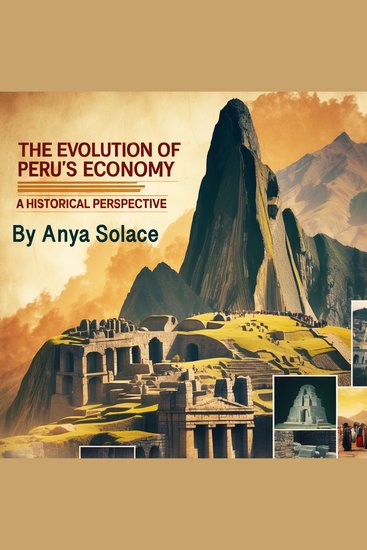
  • The Evolution of Peru's Economy - A Historical Perspective - cover

    The Evolution of Peru's Economy...

    Anya Solace

    • 0
    • 0
    • 0
    Peru’s economy has undergone a remarkable transformation over the centuries, shaped by geography, cultural heritage, and global economic forces. From the highly organized economic structures of pre-Colonial civilizations to the challenges of modern globalization, Peru’s development reflects a complex interplay of resource management, foreign influence, and domestic policies. Understanding the evolution of Peru’s economy requires a historical perspective that highlights the fundamental shifts in trade, industry, and governance that have defined the nation’s financial landscape.  
      
    The economic foundations of Peru were deeply influenced by its diverse geography and rich natural resources. The Andes, Amazon rainforest, and coastal plains provided a variety of ecosystems that supported agriculture, mining, and trade. Long before Spanish colonization, the Andean civilizations, particularly the Incas, developed sophisticated economic systems that relied on communal labor, redistribution networks, and agricultural innovations. These early economic structures created a foundation for productivity and social organization that persisted even after European intervention.  
      
    The arrival of the Spanish in the 16th century drastically altered Peru’s economic trajectory. The colonial period introduced extractive systems, such as the encomienda and mita, which forced indigenous populations into labor-intensive industries, particularly silver mining. This period established Peru as a key contributor to the Spanish Empire’s wealth but also entrenched an economic model centered on resource extraction and dependency on European markets. The restrictions imposed by Spain limited Peru’s economic autonomy, setting the stage for struggles following independence. 
    Ver libro