Join us on a literary world trip!
Add this book to bookshelf
Grey
Write a new comment Default profile 50px
Grey
Subscribe to read the full book or read the first pages for free!
All characters reduced
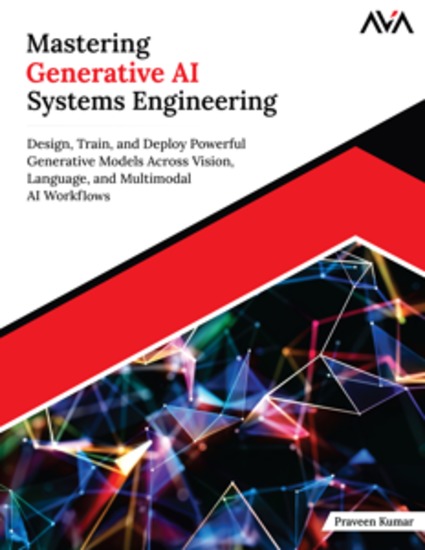
Mastering Generative AI Systems Engineering - Design Train and Deploy Powerful Generative Models Across Vision Language and Multimodal AI Workflows - cover

Mastering Generative AI Systems Engineering - Design Train and Deploy Powerful Generative Models Across Vision Language and Multimodal AI Workflows

Praveen Kumar

Publisher: Orange Education Pvt Ltd

  • 0
  • 0
  • 0

Summary

Create, Imagine, and Innovate with the Power of Generative AIKey Features● Get a free one-month digital subscription to www.avaskillshelf.com● Comprehensive coverage of generative models—from VAEs and GANs to Diffusion and LLMs.● Hands-on projects using PyTorch, TensorFlow, LangChain, and modern AI toolchains.Book DescriptionGenerative AI is rapidly transforming how organizations create content, build intelligent systems, and automate complex tasks. Understanding how these models work—and how to build them—is now a career-defining skill for developers and data professionals.Mastering Generative AI Systems Engineering begins with the core foundations of generative AI. You will explore the essential mathematics, latent spaces, probability concepts, and neural network principles behind VAEs and GANs. The book then guides you through advanced systems such as CycleGANs, StyleGANs, and cutting-edge Diffusion Models—the engines behind today’s most powerful generative tools.What you will learn● Design, train, and fine-tune state-of-the-art GANs, VAEs, and diffusion models.● Build powerful LLM and GPT-based applications using RAG, LangChain, and agentic workflows.● Apply core mathematical concepts to understand and optimize generative architectures.Who is This Book For?This book is designed for machine learning engineers, data scientists, AI developers, NLP engineers, computer vision specialists, research scientists, and software engineers aiming to advance their expertise in generative AI. Readers should have the basic knowledge of Python, deep learning fundamentals, and familiarity with neural networks to fully benefit from the hands-on projects and real-world case studies.Table of Contents1. Introduction to Generative Models2. Mathematical Foundations3. Introduction to Variational Autoencoders4. Introduction to Generative Adversarial Networks5. Deep Convolutional GANs6. Conditional Generative Adversarial Networks7. Cycle GANs8. Style GANs9. Variational Autoencoders Revisited: β-VAE and CVAE10. Diffusion Models11. Data Augmentation with Generative Models12. Generative Models in Natural Language Processing13. Model Evaluation and Optimization14. Deployment of Generative Models15. Ethical Considerations and Future Directions16. Introduction to Large Language Models17. Generative Pre-Trained Transformers18. Langchain: Building AI-Powered Applications19. Prompt Engineering, RAG, and Fine-Tuning20. Advanced Concepts21. Best Practices for Generative Models       Index 
Available since: 02/25/2026.
Print length: 550 pages.

Other books that might interest you

  • The Sacred Chain - How Understanding Evolution Leads to Deeper Faith - cover

    The Sacred Chain - How...

    Jim Stump

    • 0
    • 0
    • 0
    “In this marvelously accessible book, philosopher-Christian Jim Stump provides the reader with new eyes for a journey through time, the origin of the soul, suffering, and morality, and reveals how the latest scientific findings about what it means to be human have led him to a deeper and more authentic faith.”—Francis S. Collins, Director of the Human Genome Project and Founder of BioLogos, author of The Language of God 
    A thought-provoking and eye-opening work by Jim Stump, Vice President at BioLogos and host of the Language of God podcast, offering a compelling argument about how evolution does not have to be at odds with faith, but can actually enrich and deepen it. 
    In this moving and deeply thoughtful book, Jim Stump takes readers with him on his journey to understanding evolution and reconciling it with his faith. The Sacred Chain draws on philosophy, theology, and the latest scientific research to tackle some of the biggest questions facing humanity and people of faith today, such as: 
    How can we hold the Bible as a sacred text and yet reconcile modern science with it?By condensing noteworthy events in the history of our universe into one calendar week, what can we learn about God’s creative process and priorities, and where humans fit in?If humans are created in the image of God, what does evolution have to teach us about our species and our place in creation?What about the soul? How can we understand our transcendent qualities if the human body is the product of evolution?How does evolutionary science help us understand how God might use pain and suffering for important and good purposes?Does it have to be one or the other—science or religion—or is there a third way, one that not only preserves faith in the face of modern science, but leads to a stronger, more relevant, and more authentic faith?Deeply researched and a delight to read, The Sacred Chain provides clarity in our uncertain times, revealing a bigger picture of our world and our place within it. It is a panorama consistent with the scientific findings about who we are and where we come from that can actually bolster our faith as it engages our curiosity about ourselves, our universe, and the nature of existence itself.
    Show book
  • The Beginning Comes After the End - Notes on a World of Change - cover

    The Beginning Comes After the...

    Rebecca Solnit

    • 0
    • 0
    • 0
    Rebecca Solnit offers a thrilling account of the sheer breadth and scale of social, political, scientific, and cultural change over the past three quarters of a century. 
     
    In this sequel to her enduring bestseller Hope in the Dark, Solnit surveys a world that has changed dramatically since the year 1960. Despite the forces seeking to turn back the clock on history, change is not a possibility; it is an inevitability. 
     
    The changes amount to nothing less than dismantling an old civilization and building a new one, whose newness is often the return of the old ways and wisdoms. In this rising worldview, interconnection is a core idea and value. But because the transformation is obscured within a longer arc of history, its scale is seldom recognized. 
     
    While the white nationalist and authoritarian backlash drives individualism and isolation, this new world embraces antiracism, feminism, a more expansive understanding of gender, environmental thinking, scientific breakthroughs, and Indigenous and non-Western ideas, pointing toward a more interconnected, relational world.
    Show book
  • A Dumb Birds Field Guide to the Worst Birds Ever - cover

    A Dumb Birds Field Guide to the...

    Matt Kracht

    • 0
    • 0
    • 0
    We can all agree—birds are terrible. They're stupid and won't shut up. 


    Featuring fifty of the absolute worst birds to fly the earth, Kracht identifies each of their most terrible qualities, details exactly why they suck, and shows you why. Including all-new, all-worst fowl, such as: the absolute waste of feathers Cruddy Turdstone (Ruddy Turnstone), the utter a-hole Blank Staring-Eyes Flycrapper (Black Paradise Flycatcher), the outright loser Dowdy Woodfucker (Downy Woodpecker), and many more! 


    Even the author's previous bird takedown guides are no preparation for this hilariously harrowing collection of squawking, conceited, trash-eating, and even murderous idiots. The horror. The horror . . . 


    LOVE BIRDS? HATE BIRDS?: For those who hate birds and for bird lovers everywhere with a sense of humor, this handbook is equal parts profane and funny, and—let's face it—true. 


    ENTERTAINING AND EDUCATIONAL: This uproarious guide to all things wings includes tips for bird identification, musings on the avian population and classification, and more. Plus, each entry is accompanied by facts about a bird's (annoying) call, its (dumb) migratory pattern, its (downright tacky) markings, and more.
    Show book
  • The Fox Shrew and You - How Brains Evolved - cover

    The Fox Shrew and You - How...

    Rogier B. Mars

    • 0
    • 0
    • 0
    A leading neuroscientist describes the long evolutionary process that led to the human brain. 
    Our human brain is both unique and similar to that of other species. The only way we can trace its evolution is by comparing it to the brains of animals alive today. In this book, leading neuroscientist Rogier Mars offers an engaging account of the evolution of the brain by exploring the brains and cognitive capacities of animals from the humble sea squirt to the socially minded fox and the tiny shrew. 
    By examining the challenges that different animals and their ancestors faced, Mars shows that we can understand what drove the evolution of their brains. Early vertebrates became predators of the sea; mammals evolved a complex neocortex to deal with foraging for high-energy food; and social primates adapted to contend with a fast-changing environment in which groups of individuals team up to get food. Over the course of a long evolutionary road, the ancestors of present-day animals and their descendants continually adapted to challenges, modifying their brains again and again. For us humans, this process gradually led to a brain that is capable of so much, from inventing language to traveling into space. 
    Mars leads listeners across eras and species, showing us how we resemble our animal cousins, how we differ from them, and how animals in one branch of the evolutionary tree did the hard evolutionary work of becoming human.
    Show book
  • 60 Most Delicious Coconut Oil Recipes and Amazing Health Benefit For Perfect Weight Loss - cover

    60 Most Delicious Coconut Oil...

    Tanya Simons

    • 0
    • 0
    • 0
    People nowadays are becoming increasingly concerned about their body weight, which seems to determine them to approach a wide array of weight loss regimens to shed pounds. At the same time, many people are putting a great effort into improving their general health using various multivitamin supplements that claim to help them achieve balance among several functions of their bodies. Dieting has quickly grown to become an efficient solution for both problems, yet many people fail to understand the importance of eating healthily. 
    Of all superfoods available, coconut oil is probably one of the best, especially since there is a lot of evidence to back up its efficiency in helping one lose weight, reduce belly fat, and restore his health – all of them by simply including this superfood to their day-to-day nutrition habits. Read on to find out how coconut oil works and how it can help you achieve these goals. 
    Click the Buy Now button. Grab your copy today and try these Amazing Recipes. You will be pleased with the mouth-watering food you are going to taste. 
    Thank you 
    Tanya Simons
    Show book
  • Building a Cyber Risk Management Program - Evolving Security for the Digital Age - cover

    Building a Cyber Risk Management...

    Brandon Bapst, Brian Allen,...

    • 0
    • 0
    • 0
    Cyber risk management is one of the most urgent issues facing enterprises today. This book presents a detailed framework for designing, developing, and implementing a cyber risk management program that addresses your company's specific needs. Ideal for corporate directors, senior executives, security risk practitioners, and auditors at many levels, this guide offers both the strategic insight and tactical guidance you're looking for. 


    You'll learn how to define and establish a sustainable, defendable, cyber risk management program, and the benefits associated with proper implementation. Cyber risk management experts Brian Allen and Brandon Bapst, working with writer Terry Allan Hicks, also provide advice that goes beyond risk management. You'll discover ways to address your company's oversight obligations as defined by international standards, case law, regulation, and board-level guidance. 


    This book helps you: understand the transformational changes digitalization is introducing, and new cyber risks that come with it; learn the key legal and regulatory drivers that make cyber risk management a mission-critical priority for enterprises; gain a complete understanding of four components that make up a formal cyber risk management program; and implement or provide guidance for a cyber risk management program within your enterprise.
    Show book