Junte-se a nós em uma viagem ao mundo dos livros!
Adicionar este livro à prateleira
Grey
Deixe um novo comentário Default profile 50px
Grey
Assine para ler o livro completo ou leia as primeiras páginas de graça!
All characters reduced
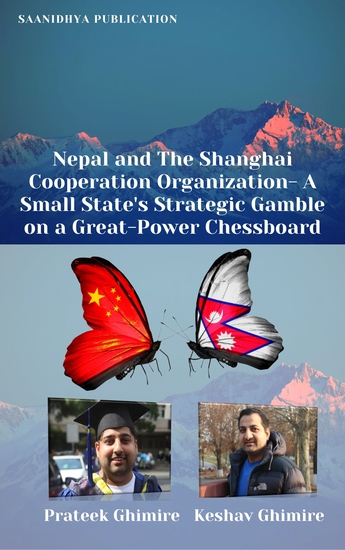
Nepal And The Shanghai Cooperation Organization- A Small State’s Strategic Gamble On A Great- Power Chessboard - cover
LER

Nepal And The Shanghai Cooperation Organization- A Small State’s Strategic Gamble On A Great- Power Chessboard

Prateek Ghimire, Keshav Ghimire

Editora: Publishdrive

  • 0
  • 0
  • 0

Sinopse

A tiny nation makes a bold move on the world’s most dangerous chessboard. The stakes? Its very sovereignty.Nestled in the heart of the Himalayas, Nepal has long navigated a precarious path between the two Asian giants: India and China. For centuries, its survival depended on a delicate balancing act. But now, the game has changed.In "Nepal And The Shanghai Cooperation Organization: A Small State’s Strategic Gamble On A Great-Power Chessboard," you are taken on a gripping journey into the high-stakes world of modern geopolitics. This is not just an academic analysis; it is a revealing exposé of how a small, strategically vital state is forced to play a game orchestrated by superpowers.This book uncovers:
 
The Grand Gambit: Why would a nation famous for its neutrality and non-alignment risk it all to join a club dominated by Russia and China? Discover the calculated—and desperate—reasons behind Nepal’s push for SCO membership.
 
Between a Dragon and an Elephant: Go beyond the headlines to understand the immense pressure Nepal faces from an increasingly assertive China seeking expansion and a traditional ally, India, guarding its sphere of influence. Every diplomatic move is a tightrope walk over a geopolitical abyss.
 
The Illusion of Balance: Is joining the SCO a masterstroke of strategic diversification, or a dangerous illusion that will ultimately constrain Nepal’s freedom and drown its voice in a chorus of great powers? This book challenges the very notion of "balance" in an era of sharp power and debt-trap diplomacy.
 
The Sovereignty Paradox: Explore the ultimate dilemma: does aligning with a powerful bloc like the SCO guarantee security and economic benefits, or does it secretly erode the very sovereignty Nepal seeks to protect?
 
A Warning and a Case Study: Nepal’s story is a microcosm of a new global order. It is a vital case study for understanding how smaller nations across Asia, Africa, and Latin America are navigating the 21st-century contest between superpowers. The outcome of Nepal's gamble will echo far beyond the Himalayas.Meticulously researched and written with narrative urgency, this book is essential reading for foreign policy experts, students of international relations, and anyone fascinated by the secret strategies of nations. It answers the critical question: In a world of giants, can a small state ever truly win?
 
Dive into the intrigue, the power plays, and the profound strategic calculations of a nation fighting for its place in the world. Your understanding of global politics will never be the same.
Disponível desde: 05/09/2025.
Comprimento de impressão: 114 páginas.

Outros livros que poderiam interessá-lo

  • The Confirmation Bias - How Seeking Information That Confirms Your Beliefs Skews Reality - cover

    The Confirmation Bias - How...

    William Rands

    • 0
    • 0
    • 0
    Confirmation bias is a cognitive phenomenon that plays a significant role in shaping our beliefs and perceptions. It refers to the tendency of individuals to search for, interpret, and remember information in a way that confirms their preexisting beliefs or theories, while disregarding or minimizing evidence that contradicts those beliefs. This bias is not limited to any particular field or context and can influence people in a variety of ways, from politics and religion to personal relationships and health decisions. 
    At its core, confirmation bias serves to protect the individual from cognitive dissonance, which is the uncomfortable tension that arises when a person holds conflicting beliefs or encounters information that challenges their worldview. By favoring information that aligns with their existing views, individuals reduce the mental discomfort of having to reconcile opposing ideas. While this process may offer short-term comfort, it can lead to long-term distortions in thinking, preventing growth and the development of more accurate or well-rounded perspectives. 
    This cognitive bias operates at both conscious and unconscious levels. On a conscious level, people may deliberately seek out information that supports their views, whether it be through selective reading, watching certain news outlets, or engaging in discussions with like-minded individuals. However, confirmation bias also operates unconsciously, influencing the way information is processed, remembered, and recalled. For example, individuals may be more likely to remember information that supports their beliefs and forget or dismiss data that contradicts them, even if they are unaware of this selective memory process.
    Ver livro
  • A Slavic People A Russian Superpower A Charismatic World Leader - cover

    A Slavic People A Russian...

    Goeran B Johansson

    • 0
    • 0
    • 0
    A comprehensive analysis of the MH 17 tragedy over eastern Ukraine begins the book. It is followed by a review of ISIS and the background to the conflict in the Middle East in the shadow of the importance of oil and concerning the US Pax Americana advance. Further description of Russia's military rearmament occurs to a lesser extent, but the extremely dramatic development in the South China Sea is examined all the more. In the shadow of the refugee crisis, Sweden's situation and its historically unstable attitude towards Russia, and its focus on the United States is critically examined. Putin's strategy in Syria and the Middle East is analyzed in detail. Detailed source list
    Ver livro
  • The Anarchist Handbook - cover

    The Anarchist Handbook

    Michael Malice

    • 0
    • 0
    • 0
    Anarchism has been both a vision of a peaceful, cooperative society—and an ideology of revolutionary terror. Since the term itself—anarchism—is a negation, there is a great deal of disagreement on what the positive alternative would look like. The black flag comes in many colors.The Anarchist Handbook is an opportunity for all these many varied voices to speak for themselves, from across the decades. These were human beings who saw things differently from their fellow men. They fought and they loved. They lived and they died. They disagreed on much, but they all shared one vision: Freedom.
    Ver livro
  • Killing Kennedy: - Exposing the Plot the Cover-Up and the Consequences - cover

    Killing Kennedy: - Exposing the...

    Jack Roth

    • 0
    • 0
    • 0
    Startling new insights into the JFK assassination 
    In Killing Kennedy: Exposing the Plot, the Cover-Up, and the Consequences, author Jack Roth interviews researchers, scholars, eyewitnesses, and family members of those who were part of the tangled web of US intelligence operations associated with the Cold War and the circumstances surrounding the assassination of John F. Kennedy. The author asks important questions, including why the assassination still matters today and what the lasting ripple effects have been since that fateful day. 
     The Kennedy assassination represents one of the most impactful events in not only American but also world history, and this book represents an important addendum to understanding its enduring significance. On November 22, 1963, the duly elected president of the United States was murdered in cold blood, forever destroying “Camelot” and national optimism for world peace. 
     Gleaning a “people’s history” of the assassination through dozens of insightful and heartfelt interviews, Roth presents a riveting narrative by creating a respectful, well-crafted, and emotionally charged book from which both older and younger generations will gain a greater understanding of our nation’s history and current status in the modern world. 
     
    Ver livro
  • On Disinformation - How to Fight for Truth and Protect Democracy - cover

    On Disinformation - How to Fight...

    Lee McIntyre

    • 0
    • 0
    • 0
    The effort to destroy facts and make America ungovernable didn't come out of nowhere. It is the culmination of seventy years of strategic denialism. In On Disinformation, Lee McIntyre shows how the war on facts began, and how ordinary citizens can fight back against the scourge of disinformation that is now threatening the very fabric of our society. Drawing on his twenty years of experience as a scholar of science denial, McIntyre explains how autocrats wield disinformation to manipulate a populace and deny obvious realities, why the best way to combat disinformation is to disrupt its spread, and most importantly, how we can win the war on truth. 


    McIntyre goes through the history of strategic denialism to show how we arrived at this precarious political moment and identifies the creators, amplifiers, and believers of disinformation. On Disinformation lays out ten everyday practical steps that we can take as ordinary citizens—from resisting polarization to pressuring our Congresspeople to regulate social media—as well as the important steps our government (if we elect the right leaders) must take. 


    On Disinformation empowers us to save our republic from autocracy before it is too late.
    Ver livro
  • True Story of Fake News The: Book Summary & Analysis - cover

    True Story of Fake News The:...

    Briefly Summaries

    • 0
    • 0
    • 0
    This is a concise summary and analysis of The True Story of Fake News, by Mark Dice.
     
    It is not the original book and is not affiliated with or endorsed by Mark Dice.
     
    Ideal those seeking a quick and insightful overview.
     
    Explore the fascinating and provocative world of modern media in The True Story of Fake News. This book dives deep into the rise and influence of misinformation, media manipulation, and the consequences of propaganda in shaping public opinion. Drawing on historical examples and contemporary incidents, it uncovers how truth is distorted and used as a tool of power. From sensational headlines to social media echo chambers, this book challenges readers to question the narratives they consume and equips them to think critically in an era dominated by media noise.
    Ver livro