¡Acompáñanos a viajar por el mundo de los libros!
Añadir este libro a la estantería
Grey
Escribe un nuevo comentario Default profile 50px
Grey
Suscríbete para leer el libro completo o lee las primeras páginas gratis.
All characters reduced
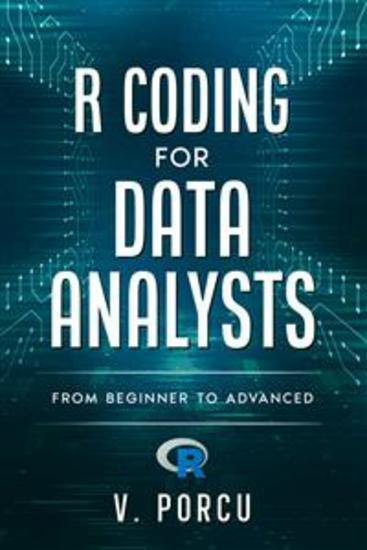
R coding for data analysts - from beginner to advanced - cover

R coding for data analysts - from beginner to advanced

Porcu Valentina

Editorial: Valentina Porcu

  • 0
  • 0
  • 0

Sinopsis

This book on coding with R for aspiring data analysts is designed to be a guide in this programming language from the basics. By the end of this book, you will be able to create, import, manipulate and manage datasets. We will learn together how to download, install and use some of the most important tools and libraries for using R. We will then move on to the creation of objects: R is based on certain structures that you need to know, such as vectors, matrices, lists and dataframes. Once we understand how to create and manipulate these data structures, extract elements from them and save them locally on the computer, we will move on to the use of loops and the creation of functions. 

We will look at a number of useful topics: how to set up a working directory, how to install and retrieve a package, how to get information about data, where to find datasets for testing, and how to get help with a function. When analysing data, we need to understand the concept of dataset or dataframe. We will therefore see how to import a dataframe from your computer, or from the internet, into R. There are many functions that are suitable for this purpose, and many packages that are useful for importing data that is in some particular format, such as the formats for Excel, .csv, .txt or JSON. We will then see how to manipulate data, create new variables, aggregate data, sort them horizontally and longitudinally, and how to merge two datasets. To do this, we will use some specific packages and functions, such as dplyr, tidyr or reshape2. We will also briefly see how to interface with a database and use other packages to streamline the management of somewhat larger datasets. 

R is also a very important language in the field of statistics. We will therefore learn some of the basic functions, such as calculating averages per row or per column, and the most common statistical functions in the field of descriptive statistics. When it comes to data analysis, we will often find ourselves creating graphs to explain our data and analyses. For this reason, we devote part of the book to seeing how to create graphs with both the functions of the basic library and the ggplot2 package. In the final sections, we will see how to create and export reports and slides, summarise the topics we have seen and the functions we have used, and look at the supporting material.
Disponible desde: 10/08/2023.

Otros libros que te pueden interesar

  • Data Science for Beginners - A Beginner's Guide to the World of Analytics - cover

    Data Science for Beginners - A...

    Daniel Garfield

    • 0
    • 0
    • 0
    In an age where data reigns supreme, harnessing the power of information has become a paramount skill. "Data Science for Beginners" is your key to unlocking the secrets of data and delving into the captivating world of analytics. Whether you're a curious novice or an aspiring data enthusiast, this book offers a comprehensive and accessible introduction to the dynamic field of data science. 
    Embark on a journey of discovery as you uncover the fundamental principles and techniques that underpin data science. From understanding the different types of data and data formats to exploring the iterative data science process, you'll gain a solid foundation to navigate the vast sea of data with confidence. 
    Dive deep into the art of data acquisition and cleaning, learning how to gather and refine datasets from diverse sources. Discover the art of exploratory data analysis (EDA) through the lens of captivating visualizations, as you unravel hidden patterns, correlations, and trends within the data. 
    Delve into the heart of statistical analysis, mastering descriptive and inferential statistics to draw meaningful insights from data. Embrace the power of machine learning and its practical applications, from supervised learning for classification and regression to unsupervised learning for clustering and dimensionality reduction. 
    With a focus on ethical considerations, you'll explore the importance of data privacy, security, and fairness in the realm of data science. Discover how to evaluate model performance, ensuring the accuracy and reliability of machine learning algorithms. 
    Let "Data Science for Beginners" be your guiding light into the captivating realm of data exploration. 
     
    Ver libro
  • The Book of Prognostics - cover

    The Book of Prognostics

    Hippocrates

    • 0
    • 0
    • 0
    Hippocrates, a Greek physician who lived in the fifth century BCE, is best known for his work in medical ethics. However, he also wrote a number of important medical texts, including The Book of Prognostics. This text contains Hippocrates' thoughts on prognosis, or the art of predicting the course of a disease. In it, he discusses the importance of understanding a patient's symptoms and making an accurate diagnosis before attempting to treat the illness. Read in English, unabridged.
    Ver libro
  • Encoded Illusion - cover

    Encoded Illusion

    Kevin J Crosby

    • 0
    • 0
    • 0
    Uncover the hidden truths about education, brain mapping, and human potential. 'Encoded Illusion' reveals the unspoken knowledge and secrets suppressed out of fear and ignorance. Drawing from decades of research, this book explores the intersection of technology, consciousness, and the human experience. Get ready to question everything you thought you knew.
    Ver libro
  • 100 Quotes about Reason Volume 2 - cover

    100 Quotes about Reason Volume 2

    Gil Carroll

    • 0
    • 0
    • 0
    Reason has done much of the heavy lifting throughout history. In this second volume, this book presents quotations from many of history's key figures who both recognize the importance – and also the limitations – of reason.
    Ver libro
  • Agile and Scrum - Streamlining Project Management for Efficient Team Collaboration - cover

    Agile and Scrum - Streamlining...

    James Ferry

    • 0
    • 0
    • 0
    Agile and Scrum: Streamlining Project Management for Efficient Team Collaboration is a comprehensive guide for anyone looking to improve their project management practices and team collaboration. This book introduces the origins and principles of agile and scrum methodologies, providing a clear understanding of how they differ from traditional project management approaches. 
    Readers will gain insight into the foundations of scrum and key concepts and terminologies of agile and scrum. The book also covers the practical aspects of implementing agile and scrum, including preparing for implementation, building an agile and scrum team, conducting agile and scrum ceremonies, managing the product backlog, and reporting metrics. 
    Additionally, readers will learn advanced agile and scrum techniques, including best practices for distributed teams, scaling agile and scrum for large-scale projects, and applying agile and scrum to non-software projects. The book includes real-life case studies and success stories, as well as common pitfalls and how to avoid them. 
    Agile and Scrum: Streamlining Project Management for Efficient Team Collaboration is a must-read for anyone seeking to improve their project management practices and team collaboration through the power of agile and scrum methodologies. 
     
    Ver libro
  • Our AI - My Journey Your Invitation Our Future - cover

    Our AI - My Journey Your...

    Felicity Hill

    • 0
    • 0
    • 0
    Our AI is a human story about artificial intelligence, offering a seat at the table for anyone curious, cautious, or already in deep. It is the AI Book for People Who Don't Want to Read About AI (but also kind of do). 
    When I discovered ChatGPT, I didn't study it, I just used it and built my work around it. Like millions of others, I jumped in without understanding what I was getting into. 
    Then the headlines got darker, AI blackmailing researchers, jobs disappearing overnight. Something that felt helpful suddenly felt... complicated. 
    Our AI isn't another tech explainer. It's a personal story about what happens when you fall for something you don't fully understand and then realise you need to.  
    As a community worker, I've spent my career helping people find their voice in decisions that affect their lives. When AI started reshaping everything, I recognised a familiar pattern: big promises up front, while early consequences start appearing (some jobs already disappearing, data centres straining resources, opportunities concentrating in fewer hands). I've seen this before in other systems, and I know where it leads if communities don't have a voice.  
    This is my personal journey, and I don't just stay in algorithms and AI.  I follow the trail from a rural Australian caravan park to mines in Congo, from city sewers to satellites, from community meetings to corporate boardrooms. It's unpredictable, sometimes funny, always honest, and it connects dots you might not expect.   
    This isn't about doomsday predictions or technical jargon. It's about recognising patterns, asking better questions, and finding your voice in conversations shaping our future, with or without us. 
    This book is your invitation. AI is here whether we like it or not. The question isn't whether to engage, but whether we just get swept along or have say in how it shapes us. This is my story of figuring that out, and an invitation for you to do the same.
    Ver libro