¡Acompáñanos a viajar por el mundo de los libros!
Añadir este libro a la estantería
Grey
Escribe un nuevo comentario Default profile 50px
Grey
Suscríbete para leer el libro completo o lee las primeras páginas gratis.
All characters reduced
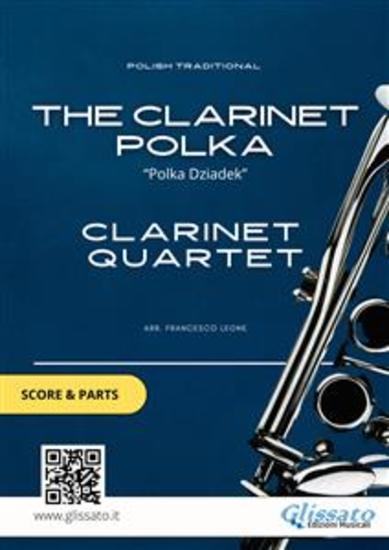
Clarinet Quartet "The Clarinet Polka" Score & Set of Parts - for intermediate players - cover

Clarinet Quartet "The Clarinet Polka" Score & Set of Parts - for intermediate players

Polish Traditional, a cura di Francesco Leone, Glissato Series Clarinet Quartet

Editorial: Glissato Edizioni Musicali

  • 0
  • 0
  • 0

Sinopsis

Experience the lively and joyful rhythms of "The Clarinet Polka," a traditional Polish folksong from the end of the 19th century. This delightful arrangement for Clarinet Quartet by Francesco Leone is perfect for intermediate-level musicians, bringing the infectious energy and charm of this classic polka to your ensemble.
Includes:

	Full Score
	Set of Parts:
	
		3 Bb Clarinets
		Bass Clarinet
		Optional Parts:
		
			Eb Piccolo Clarinet (instead of Bb Clarinet 1)
			Eb Alto Clarinet (instead of Bb Clarinet 3)


Features:


	Authentic Folk Feel: Francesco Leone's arrangement captures the lively and spirited qualities of the traditional polka, ensuring an engaging and fun performance for both musicians and audiences.
	Intermediate Level: Designed for intermediate-level clarinetists, this arrangement offers a balanced challenge that is both rewarding and accessible.
	Flexible Instrumentation: The inclusion of optional parts for Eb Piccolo Clarinet and Eb Alto Clarinet allows for greater flexibility in ensemble configuration, accommodating different instrumental setups.
	Comprehensive Package: Includes a full score and individual parts for each member of the quartet, ensuring a smooth rehearsal and performance process.

Why Choose This Arrangement? This arrangement is perfect for clarinet quartets looking to explore the rich traditions of Polish folk music and add a lively and cheerful piece to their repertoire. Whether for concerts, recitals, or community events, "The Clarinet Polka" arranged by Francesco Leone offers a captivating and enjoyable musical experience.
Bring the vibrant and joyful sounds of "The Clarinet Polka" to your clarinet quartet and delight audiences with this timeless folk classic. Get your copy today and let the music of "Polka Dziadek" inspire your next performance!
Disponible desde: 10/07/2024.

Otros libros que te pueden interesar

  • Easy Steps to Drawing Flowers - Failsafe Lessons for Drawing Floral and Botanical Elements for Journaling for Stationery for Keeps - cover

    Easy Steps to Drawing Flowers -...

    Bianca Giarola

    • 0
    • 0
    • 0
    Easy Steps to Drawing Flowers is a step-by-step guide to drawing flowers from the most basic to the more intricate blooms. It features modern flowers perfect for every kind of illustrative project, such as home prints, journals, and stationery. This book teaches a drawing technique that can be used on any flower and applied repeatedly because readers will develop a strong knowledge of how shapes and lines work. It starts with the anatomy of a flower with techniques on how to draw the bell, cross, crown, cup, funnel and more! The projects start with the easiest flowers to draw, like cherry blossoms and daisies, and progress to the more difficult ones, like roses and peonies. Featuring 15 basic flower shapes and 15+ flowers and wreaths to draw, author Bianca Giarola also includes troubleshooting tips to answer the most frequently asked questions about each project. Drawing a flower isn't just about drawing, coloring, and compositions. This book also teaches readers how to mentally approach a botanical drawing to set themselves up for success.
    Ver libro
  • Sundaland: The History of the Asian Landmass that Started Sinking After the Ice Age - cover

    Sundaland: The History of the...

    Editors Charles River

    • 0
    • 0
    • 0
    By the time the Pleistocene Epoch ended around 12,000 years ago, Homo sapiens had become one of the most significant species on the planet. 	It was also near the end of that period of time that modern humans began to gradually populate what would become Europe, Asia, and the Americas, eventually becoming the inheritors of the Paleolithic era and the only human species to make it into the Neolithic era. The process was long and difficult, and the survival of the species only happened through a combination of human tenacity and a fair amount of luck. As much as humans evolved during the Pleistocene, the topography, geography, and environment changed even more. 
    The cold Pleistocene temperatures lowered water levels across the planet, exposing land that was not there before or after the period. At the same time, significant regions of the planet were very different during the Pleistocene, including Southeast Asia, particularly the modern islands of Bali, Borneo, Sumatra, and the Malay Peninsula, roughly equivalent to parts of Indonesia, Malaysia, Myanmar, and Thailand. This region, which modern scholars refer to as Sunda or Sundaland, was unique because all of it was connected by land, meaning today’s islands were once part of a contiguous subcontinent, and in terms of the people, flora, and fauna, it was very different than it is today. If a modern traveler could somehow transport back to the Pleistocene, Sundaland would look nothing like modern Southeast Asia and would resemble as much of a lost world as something out of a science fiction novel.  
    Although much is still unknown about Sundaland, researchers have uncovered plenty of evidence bringing this lost world to life. As anthropologists and archaeologists developed new models and discovered ancient material culture, they learned that Sundaland played a significant role in the development of Neolithic Southeast Asia in many ways. 
    Ver libro
  • Domesticated Volume Two - cover

    Domesticated Volume Two

    James Domestic

    • 0
    • 0
    • 0
    In the second Domesticated instalment, East Anglian punk poet, James Domestic, is once again taking potshots at work, so-called-punk-rock, outdoor and indoor pursuits, aging, right wing lunatics, politics, feet, and himself. As if that wasn’t enough, you’ll also find his trademark surrealism, sarcasm, and quintessentially British whimsy applied to animals, emails, food, and the power of music, alongside his idiosyncratic illustrations, and photographs from his murky past. 
      
    A man in too many bands to count, a solo artist, a vocalist, a songwriter, a DJ, a poet, a painter, and a punk. James Domestic failed miserably at school through the distractions of music, alcohol, and girls, spent his early post-school life between the chemical factory and the dole, and somehow now has a PhD. A square peg in life’s round hole. A face that never fitted. He couldn’t care less. Come along for the ride. 
      
    “A sardonic, sarcastic wit, a penchant for the surreal, and a dynamic pace” (Nathan Brown, Louder Than War) 
      
    “Words that bite, belch, and bleed in their brilliance” (Mark Grist, multi-award-winning poet and battle rapper) 
      
    “A unique collection of poetic ventures into the human condition, with humour, anger, and a canny use of language: inspired and inspiring!” (Dick Lucas, Subhumans, Culture Shock etc.) 
      
    “Relentless” (Attila the Stockbroker, social surrealist poet and songwriter).
    Ver libro
  • Don’t Call It Hair Metal - Art in the Excess of ’80s Rock - cover

    Don’t Call It Hair Metal - Art...

    Seana Kelly

    • 0
    • 0
    • 0
    A love letter to the hard-rocking, but often snubbed, music of the era of excess: the 1980s
    		 
    There may be no more joyous iteration in all of music than 1980s hard rock. It was an era where the musical and cultural ideals of rebellion and freedom of the great rock ’n’ roll of the ’50s, ’60s, and ’70s were taken to dizzying heights of neon excess. Attention to songcraft, showmanship, and musical virtuosity (especially in the realm of the electric guitar) were at an all-time high, and radio and MTV were delivering the goods en masse to the corn-fed children of America and beyond.
    		 
    Time hasn’t always been kind to artists of that gold and platinum era, but Don’t Call It Hair Metal analyzes the sonic evolution, musical diversity, and artistic intention of ’80s commercial hard rock through interviews with members of such hard rock luminaries as Twisted Sister, Def Leppard, Poison, Whitesnake, Ratt, Skid Row, Quiet Riot, Guns N’ Roses, Dokken, Mr. Big, and others.
    Ver libro
  • 101 Amazing Facts About Clowns - cover

    101 Amazing Facts About Clowns

    Jack Goldstein

    • 0
    • 0
    • 0
    From ancient Egypt to the modern-day circus, the role of the clown can be traced throughout history. But how much do you really know about the profession that takes comedy very seriously? This fascinating audiobook takes the reader on a journey through the ages, explaining how clowns such as the whiteface and auguste came to be. You'll hear about history's best-loved performers such as Joseph Grimaldi, the father of modern clowning, and learn about the origin of terms used today such as the ‘clown alley’. If you want to know why blue make-up is supposed to bring bad luck, and who the literary world’s first ever killer clown was, then this is the audiobook for you.
    Ver libro
  • The Architecture of Disability - Buildings Cities and Landscapes beyond Access - cover

    The Architecture of Disability -...

    David Gissen

    • 0
    • 0
    • 0
    Disability critiques of architecture usually emphasize the need for modification and increased access, but The Architecture of Disability calls for a radical reorientation of this perspective by situating experiences of impairment as a new foundation for the built environment. With its provocative proposal for "the construction of disability," this book fundamentally reconsiders how we conceive of and experience disability in our world. 


    Stressing the connection between architectural form and the capacities of the human body, David Gissen demonstrates how disability haunts the history and practice of architecture. Examining various historic sites, landscape designs, and urban spaces, he deconstructs the prevailing functionalist approach to accommodating disabled people in architecture and instead asserts that physical capacity is essential to the conception of all designed space. 


    By recontextualizing the history of architecture through the discourse of disability, Gissen presents a unique challenge to current modes of architectural practice, theory, and education. Envisioning an architectural design that fully integrates disabled persons into its production, it advocates for looking beyond traditional notions of accessibility and shows how certain incapacities can offer us the means to positively reimagine the roots of architecture.
    Ver libro