¡Acompáñanos a viajar por el mundo de los libros!
Añadir este libro a la estantería
Grey
Escribe un nuevo comentario Default profile 50px
Grey
Suscríbete para leer el libro completo o lee las primeras páginas gratis.
All characters reduced
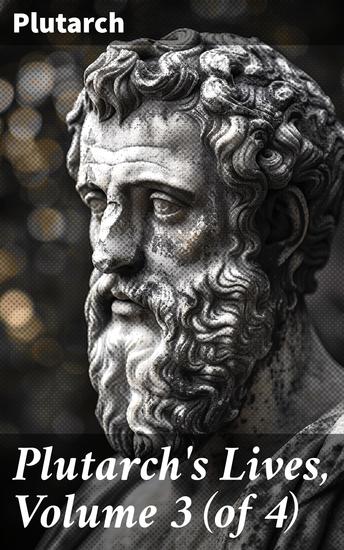
Plutarch's Lives Volume 3 (of 4) - Exploring Virtues and Vices: Insights on Historical Figures in Ancient Greece and Rome - cover

Plutarch's Lives Volume 3 (of 4) - Exploring Virtues and Vices: Insights on Historical Figures in Ancient Greece and Rome

Plutarch Plutarch

Traductor George Long, Aubrey Stewart

Editorial: Good Press

  • 0
  • 0
  • 0

Sinopsis

In "Plutarch's Lives, Volume 3 (of 4)", Plutarch curates a compelling comparative biography of notable Greeks and Romans, including figures such as Demosthenes and Cicero. This work diverges from mere historical recounting; instead, it captures the moral character and philosophical essence of these individuals, emphasizing the interplay between their lives and the socio-political contexts they navigated. Plutarch's prose is marked by clarity and eloquence, reflecting his Hellenistic educational background, while his thematic dualities compel readers to ponder the nature of virtue and vice across cultures through anecdotal narrations and insightful reflections. Plutarch, born in the first century A.D. in Chaeronea, Greece, was not only a biographer but also a philosopher, statesman, and priest. His scholarly pursuits and political experiences infused his biographies with rich ethical underpinnings and poignant observations about leadership and morality. Living through a time when Greco-Roman culture was transitioning, he sought to preserve the legacies of great figures while imparting timeless lessons that resonate beyond their eras. This volume is highly recommended for readers interested in the interplay of history, ethics, and literature. By exploring the lives juxtaposed by Plutarch, readers gain wisdom applicable to contemporary leadership and personal conduct. Ideal for scholars, students, and general readers alike, this work remains an essential contribution to the Western literary canon.
Disponible desde: 12/08/2023.
Longitud de impresión: 580 páginas.

Otros libros que te pueden interesar

  • A Legend - From their pens to your ears genius in every story - cover

    A Legend - From their pens to...

    Alexander Kuprin

    • 0
    • 0
    • 0
    Alexander Kuprin was born in Narovchat, Penza in Russia on 7th September 1870. 
    At 3 his Father died and he and mother moved to Moscow. By 10 he was enrolled at the Second Moscow Military High School and there his interest in literature began. The Alexander Military Academy followed and two years later he was a sub-lieutenant and posted to an Infantry Regiment for a further four years. 
    Despite his duties he was a now a keen writer and published his first short story at this time. His military duties also garnered him experiences for his breakthrough work ‘The Duel’.  Leaving the military he left for Kiev to work for local newspapers.  He continued to publish both stories and novels and by 1901 he was in St Petersburg becoming part of a group that included Chekhov, Ivan Bunin, Maxim Gorky and Leonid Andreyev.  
    In the years that followed further controversial works and acclaim followed.  His comments on the regime meant he was also put under secret police surveillance.   
    As World War I erupted, Kuprin opened a military hospital but was then given command of an infantry company in Finland. He was soon discharged on grounds of ill health.  
    The October Revolution saw him praise Lenin, but he warned that the Bolsheviks threatened Russian culture and might cause further widespread suffering to the peasants.  As Civil War raged he took his family to Helsinki and then on to Paris. 
    Exile saw his talents decline further and his succumbing to alcoholism. He became lonely and withdrawn. The family's poverty increased his malaise.   
    In May 1937, the Kuprin’s returned to Moscow.  He now saw his work published but wrote almost nothing new.  In 1938 his health rapidly deteriorated.  Already suffering from a kidney problems and sclerosis, he had now developed cancer of the oesophagus.  
    Alexander Kuprin died on 25th August 1938.
    Ver libro
  • Ashes to Ink: A Memoir - cover

    Ashes to Ink: A Memoir

    Lisa Lucca

    • 0
    • 0
    • 0
    Acceptance struggles to emerge from a cocoon of family secrets . . . 
    After her parents' divorce in 1974, Lisa Lucca's idyllic Midwestern childhood is shattered when she learns her father is gay. Sworn to secrecy, she begins carrying the emotions of her family like a cracked bucket, making a mess as she embarks on a life of rebellious choices. 
    Decades later, faced with the aftermath of her father’s death, Lisa revisits the complicated relationship she had with him, delving deeper into the stories she’s held about love, sexuality, and the family she comes from with a shimmering clarity that arises from her grief. 
    A story of heartache and the power of forgiveness, Ashes to Ink shines a light on the challenges of living true to who we are. 
    “Lisa Lucca weaves the past and present into a vividly written and important story with many layers: family secrets, fathers and daughters, love and sexuality, and at the core, forgiveness. What touched me most was the call to action to become the love of your own life. Read, learn, and become!”—Laura Munson, New York Times bestselling author
    Ver libro
  • Spinoza - Freedom's Messiah - cover

    Spinoza - Freedom's Messiah

    Ian Buruma

    • 0
    • 0
    • 0
    Ian Buruma explores the life and death of Baruch Spinoza, the Enlightenment thinker whose belief in freedom of thought and speech resonates in our own time 


    Baruch (Benedictus) Spinoza (1632–1677) was a radical free thinker who led a life guided by strong moral principles despite his disbelief in an all-seeing God. Seen by many as Satan's disciple during his lifetime, Spinoza has been regarded as a secular saint since his death. Many contradictory beliefs have been attached to his name: rationalism or metaphysics, atheism or pantheism, liberalism or despotism, Jewishness or anti-Semitism. However, there is no question that he viewed freedom of thought and speech as essential to an open and free society. 


    In this insightful account, the award-winning author Ian Buruma stresses the importance of the time and place that shaped Spinoza, beginning with the Sephardim of Amsterdam and followed by the politics of the Dutch Republic. Though Spinoza rejected the basic assumptions of his family's faith, and was consequently expelled from his Sephardic community, Buruma argues that Spinoza did indeed lead a modern Jewish life. To Heine, Hess, Marx, Freud, and no doubt many others today, Spinoza exemplified how to be Jewish without believing in Judaism. His defense of universal freedom is as important for our own time as it was in his.
    Ver libro
  • Steve McQueen & Charles Bronson: The Lives and Careers of the Top Action Stars of the 1970s - cover

    Steve McQueen & Charles Bronson:...

    Editors Charles River

    • 0
    • 0
    • 0
    In the 1960s and 1970s, no actor personified cool, calm and collected like Steve McQueen, whose suave anti-hero protagonists made men jealous and women swoon. As actor Donald Logue puts it in The Tao of Steve, “Steve is the prototypical cool American male. He's the guy on his horse, the guy alone. He has his own code of honor, his own code of ethics, his own rules of living. He never, ever tries to impress the women, but he always gets the girl." And indeed, that was the case not only in movies like The Thomas Crown Affair, Bullitt, The Getaway, and Papillon, but also in real life. Actress Ali MacGraw, who later became one of his wives, described his effect on women: "I remember seeing him across the swimming pool and my knees were knocking. He radiated such macho energy. Men wanted to be like him. Uptight society ladies and biker molls wanted to be with him." But unlike many actors who become this type of heartthrob, McQueen seemed to have the bona fides.   
    To accompany the rough-hewn appearance of Charles Bronson’s new class of hero, the typical script gave his remarkably enduring persona little to say in terms of dialogue that would reveal his inner thoughts. With minimal text, even those he attempts to help are unsure of his intentions, and few clues are offered by which the viewer can come to know his mind. As the grotesqueness of his characters’ violent acts increased, so did the heinous deeds of the criminals he fought, upping the ante to an eager public in search of a simple cure for its social ills. In a career of almost eighty films and a total body of work totaling 160 appearances including television, Bronson pushed the envelope of what graphic action the studios were willing to offer, what the censors would accept, and what the sensibilities of movie-goers were able to endure more than anyone in his era.
    Ver libro
  • Dancing with Muddy - Muddy Waters Eric Clapton and My Lucky Life In and Out of the Blues - cover

    Dancing with Muddy - Muddy...

    Jerry Portnoy

    • 0
    • 0
    • 0
    Jerry Portnoy grew up in Chicago hearing the blues being played outside his father's rug store on famed Maxwell Street during the late 1940s and early '50s. After dropping out of college, he became immersed in the colorful world of pool hustlers as he managed the largest pool hall in Chicago. During a stint as a paratrooper early in the Vietnam war, he applied for discharge as a conscientious objector, and lived in San Francisco during 1967's "summer of love." While bumming around Europe the following year, Portnoy heard the blues again on a record by Sonny Boy Williamson and became obsessed with mastering blues harmonica.He returned to Chicago and in 1974 he was playing in small Black clubs at night when Muddy Waters plucked him from his day job at Cook County Jail to fill the harmonica chair in his fabled band. Eric Clapton followed suit in 1991. In a career that took him from ghetto taverns to the White House and the Royal Albert Hall, he went from the raggedy vans and cheap roadside motels of the blues world to the private jets and five-star hotels of the rock world. Between those two very different gigs was a struggle to survive the vagaries of the music business and the pressures of life on the road. In a remarkable life, he also assisted in surgery, lodged in a Moroccan house of ill repute, and dined at Giorgio Armani's. 
    Ver libro
  • The Prussian Officer - cover

    The Prussian Officer

    D. H. Lawrence

    • 0
    • 0
    • 0
    Power, desire, and violence collide in The Prussian Officer, a haunting exploration of the human psyche by D.H. Lawrence. This novella peels back the façade of authority to reveal the seething passions and suppressed emotions lurking beneath. With prose that strikes like a thunderclap, Lawrence immerses the reader in a world where rigid discipline clashes with primal instincts, and the cost of obedience is measured in human suffering.
    In this gripping narrative, Lawrence examines the tension between the oppressor and the oppressed, unraveling the fragile balance between control and rebellion. The story pulses with psychological intensity, as unspoken emotions erupt in unexpected ways, leading to a shattering crescendo. It's a tale that doesn't flinch from the darkness of human nature but also offers glimmers of raw humanity and the longing for freedom.
    Rich in symbolism and driven by an almost cinematic sense of foreboding, The Prussian Officer captures Lawrence's unparalleled ability to probe the depths of passion and power dynamics. This is not merely a story—it's an experience, a journey into the heart of what it means to feel trapped and to yearn for release.
    Ver libro