¡Acompáñanos a viajar por el mundo de los libros!
Añadir este libro a la estantería
Grey
Escribe un nuevo comentario Default profile 50px
Grey
Suscríbete para leer el libro completo o lee las primeras páginas gratis.
All characters reduced
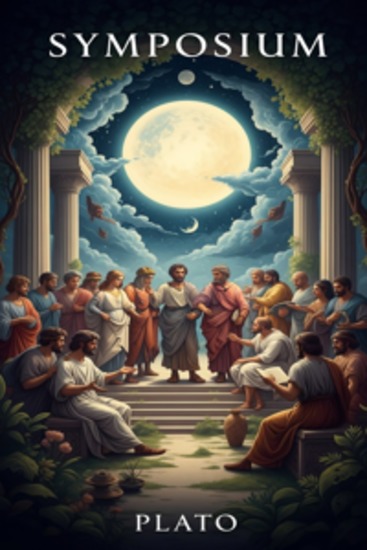
Symposium - cover

Symposium

Plato

Editorial: Bu Classics Books

  • 0
  • 0
  • 0

Sinopsis

Attend a banquet in Athens where a series of speeches are given in praise of Eros, culminating in Socrates' recounting of the mysteries revealed by Diotima. This masterpiece explores the nature of love, moving from physical attraction to the intellectual ascent toward the Form of Beauty itself. Each speaker offers a different perspective, creating a rich tapestry of views on desire, relationships, and the human condition. It is a profound and beautifully written examination of how love can serve as a bridge to the divine.
Disponible desde: 29/01/2026.
Longitud de impresión: 130 páginas.

Otros libros que te pueden interesar

  • Inner Space - Malibu 1971 - Dialogue 2 - cover

    Inner Space - Malibu 1971 -...

    Jiddu Krishnamurti

    • 0
    • 0
    • 0
    Inner space" - 26 March 1971. Duration: 61 minutes. 
    Is it possible to be free of the centre so that the centre doesn't create space around itself and build a wall? Can the centre be still or fade away? Can consciousness empty itself of its content? Is love within the field of consciousness?If you don't form an image now, the past images have no place. Are there environments which can be conducive to liberation? The company of the good doesn't teach me what is good and what is false or true. I have to see it.
    Ver libro
  • Thanks for Your Service - The Causes and Consequences of Public Confidence in the US Military - cover

    Thanks for Your Service - The...

    Peter D. Feaver

    • 0
    • 0
    • 0
    A definitive study on the decades-long run of high public confidence in the military and why it may rest on some shaky foundations. 


    What explains the high levels of public confidence in the US military and does high confidence matter? In Thanks for Your Service, the eminent civil-military relations scholar Peter D. Feaver addresses this question and focuses on what it means for the military. Proprietary survey data show that confidence is partly based on public beliefs about the military's high competence, adherence to high professional ethics, and a determination to stand apart from the bitter divisions of partisan politics. However, as Feaver argues, confidence is also shaped by a partisan gap and by social desirability bias, the idea that some individuals express confidence in the military because they believe that is the socially approved attitude to hold. Not only does Feaver help us understand how and why the public has confidence in the military, but he also exposes problems that policymakers need to be aware of. Specifically, this book traces how confidence in the institution shapes public attitudes on the use of force and may not always reinforce best practices in democratic civil-military relations.
    Ver libro
  • Reflections on the Mind of Plato - cover

    Reflections on the Mind of Plato

    Joseph Norio Uemura

    • 0
    • 0
    • 0
    «Plato was not a Platonist! I would like to show in the following pages that anyone who reads the dialogues of Plato without bias or an ax to grind will find a humorous, witty, pleasant friend; and not a desiccated scholarly mandarin. Plato was an open-minded, tolerant, reasonable individual, not a tight-lipped, pietistic, puritan. In a word, Plato was an Athenian, not a Spartan!»
     
    In the twenty-four centuries that have passed since the Athenians put Socrates to death, every generation has interpreted the meaning of Plato’s work differently. Joseph Uemura guides us through six dialogues in an effort to promote a dialectical quest rather than seek a final resting place. Plato’s dialogues treat the big questions that confront any thoughtful person. Eythyphro explores religion, Phaedo reflects on mind, Theatetus examines knowledge, Sophist probes being, Phaedrus reflects on art, and the Republic ponders society. All great literature must be experienced first-hand. Because it is not self-explanatory, it must be interpreted and evaluated. Professor Uemura’s reflections serve as a touchstone by which to test every new reading of Plato’s work.
    Ver libro
  • Darius the Great - Biography of the Persian Ruler during the Achaemenid Empire - cover

    Darius the Great - Biography of...

    Kelly Mass

    • 0
    • 0
    • 0
    Darius I, more commonly known as Darius the Great, reigned as the third King of Kings of the Achaemenid Empire from 522 BCE until his death in 486 BCE. Under his rule, the empire reached its zenith, encompassing vast territories across Western Asia, parts of the Balkans (including Thrace, Macedonia, and Paeonia), the Caucasus, the Black Sea's coastal regions, Central Asia, the Indus Valley in the east, and portions of North and Northeast Africa, such as Egypt (Mudrâya), eastern Libya, and coastal Sudan. His reign marked a critical period of expansion and consolidation for the Persian Empire. 
    Darius ascended to power through a complex and controversial process. He orchestrated the assassination of Bardiya, the rightful heir to the throne, whom he claimed to be an impostor named Gaumata. Once in power, Darius turned his attention to strengthening and expanding the empire. One of the defining episodes of his reign was his campaign against Greece. This effort aimed to punish Athens and Eretria for their involvement in the Ionian Revolt. Although his forces suffered a significant defeat at the Battle of Marathon, Darius achieved notable victories elsewhere. He successfully reasserted Persian control over Thrace, annexed Macedon, and subjugated the Cyclades and the island of Naxos. His campaign also saw the destruction of Eretria, a Greek city.
    Ver libro
  • Big Men Fear Me - The Fast Life and Quick Death of Canada’s Most Powerful Media Mogul - cover

    Big Men Fear Me - The Fast Life...

    Mark Bourrie

    • 0
    • 0
    • 0
    The remarkable true story of the rise and fall of one of North America's most influential media moguls. 
    When George McCullagh bought The Globe and The Mail and Empire and merged them into the Globe and Mail, the charismatic 31-year-old high school dropout had already made millions on the stock market. It was just the beginning of the meteoric rise of a man widely expected to one day be prime minister of Canada. But the charismatic McCullagh had a dark side. Dogged by the bipolar disorder that destroyed his political ambitions and eventually killed him, he was all but written out of history. It was a loss so significant that journalist Robert Fulford has called McCullagh’s biography "one of the great unwritten books in Canadian history"—until now.  
    In Big Men Fear Me, award-winning historian Mark Bourrie tells the remarkable story of McCullagh’s inspirational rise and devastating fall, and with it sheds new light on the resurgence of populist politics, challenges to collective action, and attacks on the free press that characterize our own tumultuous era.
    Ver libro
  • But you don't look autistic at all - cover

    But you don't look autistic at all

    Bianca Toeps

    • 0
    • 0
    • 0
    Autism – that’s being able to count matches really fast and knowing that 7 August 1984 was a Tuesday, right? Well, no. In this book, Bianca Toeps explains in great detail what life is like when you’re autistic.She does this by looking at what science says about autism (and why some theories can go straight in the bin), but also by telling her own story and interviewing other autistics. Bianca talks in a refreshing and sometimes hilarious way about different situations autistic people encounter in daily life. She has some useful tips for non-autistic people too: what you should do if someone prefers not to look you in the eye, why it is sometimes better to communicate by email, and, most important of all, why it is not a compliment if you say: “But you don’t look autistic at all!”
    Ver libro