Begleiten Sie uns auf eine literarische Weltreise!
Buch zum Bücherregal hinzufügen
Grey
Einen neuen Kommentar schreiben Default profile 50px
Grey
Jetzt das ganze Buch im Abo oder die ersten Seiten gratis lesen!
All characters reduced
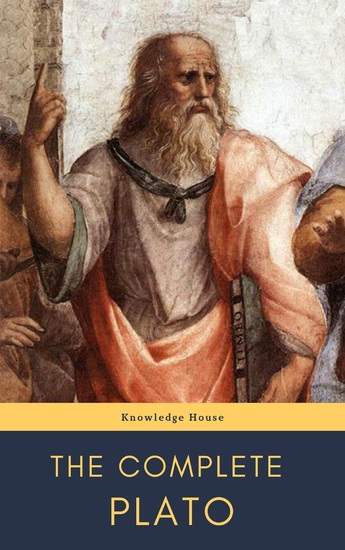
Plato: The Complete Works - cover

Plato: The Complete Works

Plato Plato, knowledge house

Übersetzer Benjamin Jowett

Verlag: knowledge house

  • 0
  • 0
  • 0

Beschreibung

Plato (428/427–348/347 BCE) was a Greek philosopher and mathematician of the Classic Age who founded the Academy of Athens. Noted as a student of Socrates, Plato has distinguished himself as one of the founders of Western philosophy by recording the teachings of his master and his own philosophies in 35 dialogues and 13 letters (some are disputed as spurious).

This collection contains the following works by Plato:

All books translated by Benjamin Jowett
Part 1: Early Dialogues
The Apology
Crito
Charmides
Laches
Lysis
Euthyphro
Menexenus
Ion
Gorgias
Protagoras
Meno
Part 2: Middle Dialogues
Euthydemus
Cratylus
Phaedo
Phaedrus
The Symposium
Theaetetus
Parmenides
Part 3: Late Dialogues
Sophist
Statesman
Philebus
Timaeus
Critias
Part 4: The Republic
I: Of Wealth, Justice, Moderation, and their Opposites
II: The Individual, the State, and Education
III: The Arts in Education
IV: Wealth, Poverty, and Virtue
V: On Matrimony and Philosophy
VI: The Philosophy of Government
VII: On Shadows and Realities in Education
VIII: Four Forms of Government
IX: On Wrong or Right Government, and the Pleasures of Each
X: The Recompense of Life
Part 5: The Laws
Books I–XII
Verfügbar seit: 20.09.2022.
Drucklänge: 3000 Seiten.

Weitere Bücher, die Sie mögen werden

  • Ode to the front end - The Home Depot - cover

    Ode to the front end - The Home...

    Charles Ford

    • 0
    • 0
    • 0
    This book is somewhat unique. I am not the author although it was written through me . He is the author not me. Why I ended up being the one to be used by Him remains a complete baffling mystery. I am simply His humble steward in this process. 
    Everyone living in America recognizes Home Depot. They are a staple. It is a poem containing 2,500 quatrains that contain life as a part time cashier in a small Home Depot store. It is not always easy reading but it has appeal and value for anyone willing to read it. 
    What are the takeaways? For me the greatest takeaway is humility. The people portrayed in thsi writing are far superior to me. I am not worthy to be the proverbial gum on their shoe. Their trust and friendship provided me is more valuable than gold from Ophir. They live very difficult lives in an extraordinary manner. They never had a level playing filed. they must climb Mt Everest each day. 
    There is humor, pathos and at times Upton Sinclair type muckraking all mixed into the writing. The work shows the good and the bad of life, work and in some ways America today.
    Zum Buch
  • Napoleonic Wars The: An Enthralling Guide to Global Conflict Revolutionary Tactics and the Empire’s Expansion - cover

    Napoleonic Wars The: An...

    Billy Wellman

    • 0
    • 0
    • 0
    The Napoleonic Wars: A Power Struggle That Shaped the Modern World 
    What if the true impact of the Napoleonic Wars has been misunderstood? Immerse yourself in an era of colossal battles, revolutionary military strategies, and a world forever altered by Napoleon Bonaparte’s relentless ambition. The Napoleonic Wars offers you a front-row seat to a time when the fate of nations hung in the balance. 
    Why this audiobook?Uncover Napoleon’s Tactical Mastery: Learn how Napoleon Bonaparte’s innovative military strategies led to his stunning victories—and the critical errors that ultimately led to his downfall.Relive Legendary Battles: Feel the thunder of cannon fire and the clash of swords in decisive battles such as Austerlitz, Jena, and Wagram, and endure the harsh realities of campaigns in Trafalgar and Russia.Witness the Shifting Balance of Power: Explore the complex web of alliances and betrayals that redefined European politics and laid the groundwork for modern nation-states.Explore Cultural Transformations: Discover how the Napoleonic Wars left an indelible mark on art, music, and national identities across Europe and beyond. 
    This audiobook is your gateway to understanding how one man’s ambition reshaped history, affecting every corner of the world. Whether you’re a history enthusiast, a student of military strategy, or someone intrigued by the forces that have shaped our present, The Napoleonic Wars is a must-have. 
    Scroll up and click "Add to Cart" to embark on your journey into this captivating chapter of history.
    Zum Buch
  • Ukrainian History: 2 Books In 1 - Kievan Rus Cossacks The Ukraine Revolution & Chernobyl - cover

    Ukrainian History: 2 Books In 1...

    HISTORY FOREVER

    • 0
    • 0
    • 0
    ★ Do you want to discover the History of Ukraine? ★ 
    If your answer is yes, get this book now! 
    In book 1 you will discover;History of Ukraine - Ruthenian UnionHistory of Ukraine - Kievan RusUkrainian Origins of Genetic and Cultural HistoryUkraine and the Rus Kingdom 1187-1349Polish-Lithuanian & Turkish Rule 1349-1648The Zaporizhian and Ukrainian Host 1648-1764The Partition of Poland 1772-1795New Russia and Little Russia 1764-1917WURP and Polich Galacia 1772-1939The Ukrainian Revolution in 191712 UPR, Hetmanate, USSR and Korenizatsiya 1917-1941Reichskommissaiat to USSR 1941-1972USSR to Ukraine 1972-1991 
    In book 2 you will discover;Ukraine and Europe as a Nation StateUkraine’s International obligations and freedomUkraine and Taiwan RelationsUkraine and United State RelationsHow Ukraine Became Part of the USSR - The Soviet–Ukrainian WarUkraine after the Fall of the Soviet UnionWhy Ukraine's Orthodox Church split from RussiaGermany's Historical Responsibility For UkraineThe Story Of Volodymyr Zelensky 
    ★ BUY THIS BOOK NOW AND DISCOVER MORE ABUOT UKRAINE TODAY! ★
    Zum Buch
  • Tao Te Ching by Lao Tzu - (Lao Tsu) (Laozi) Tao De Ching - cover

    Tao Te Ching by Lao Tzu - (Lao...

    j.h.mcdonald

    • 0
    • 0
    • 0
    Tao Te Ching by Lao Tzu (Lao Tsu) (Laozi) Tao De Ching 
    Tao Te Ching - Written by Lao-Tzu 
    A Translation for the PUBLIC DOMAIN 
    by j.h.mcdonald, 1996 
      
    READ by Dr. Paul E Calarco, Jr. 
      
    The Tao Te Ching is an ancient Chinese philosophical text, with its earliest known origins 4th century BC. Traditionally attributed to Laozi, meaning "Old Master," though the historical existence of this figure is debated. The text offers guidance on living in harmony with the "Tao" (meaning "The Way") - the underlying order of the universe, emphasizing concepts like simplicity, non-action (Wu Wei), and self-restraint, with the goal of achieving inner peace and balance through a life of naturalness and compassion; considered a central text of Taoism, containing 81 short chapters filled with aphorisms and parables.  
      
    It can be translated as The Classic of the Way and its Power, The Book of the Tao and Its Virtue, The Book of the Way and of Virtue, The Tao and its Characteristics, The Canon of Reason and Virtue, The Classic Book of Integrity and the Way, or A Treatise on the Principle and Its Action. 
    Wu Wei (Non-action): Letting things unfold naturally without forceful intervention.  
    Humility: Avoiding arrogance and striving for simplicity.  
    Inner peace: Cultivating a calm and balanced state of mind. 
    Influence: Considered one of the most influential philosophical texts in the world, impacting various aspects of Chinese culture and thought. 
    *A portion of all sales will be redistributed to serve the local community where I reside. 
    ALBUM ART: Mason Matthew Calarco
    Zum Buch
  • TV Lobotomy The Scientific Truth About the Effects of Television - cover

    TV Lobotomy The Scientific Truth...

    Michel Desmurget

    • 0
    • 0
    • 0
    "TV unleashes the imagination and feeds intelligence." • "A child deprived of TV risks social isolation." • "TV dumbs you down." • "TV makes you obese." It seems that everything—and its opposite—has already been said about TV. But what is it really? How can we distinguish between the radical "No TV" of some and the supposedly entertaining virtues touted by others? Michel Desmurget, a doctor in neuroscience, has sifted through and synthesized thousands of research articles published over the last fifty years in the most rigorous international journals. The conclusion is unequivocal—we must stop watching television for good, whatever the program. All content, even that meant to teach, can never come close to any other learning method. The data is clear—television viewing is detrimental to school performance. For a child in elementary school, for example, every hour spent daily watching television increases the likelihood that he or she will one day leave the school system without any qualifications. For specialists, there is no doubt that television has a negative influence, not only on intellectual development but also on behavior. Thus, certain eating disorders (anorexia, bulimia) are related to a frantic consumption of—television programs! In short, watching television has an impact on our life expectancy. However, the harmful impact of this risk is largely underestimated, because of the large sector of the public exposed to television (more than 85% of Western households have at least one television set), and because of a debate on the subject that has become inaudible and confused. Moreover, the results of the research initiated by the big media groups on the subject remain "proprietary," i.e., closed to the general public. Believing that we is facing a real public health problem, Michel Desmurget wants to act as a responsible scientist—with a clear, concise and rigorously referenced book, the message cannot go unnoticed. Michel Desmurget is a doctor of neuropsychology. He attended several major American universities (MIT, Emory, UCSF) and is now a research director at INSERM in cognitive neuroscience. He is particularly interested in the problems of brain organization and plasticity. He is the author of the book TV Lobotomy (Max Milo, 2022), which is based in part on his personal history. Exasperated by having to constantly justify the choice not to have television at home—and to prevent his children from having access to it—and not to be seen as a sociopath in the eyes of those around him, he has done a massive job to argue his point. 
    This audiobook is read by a synthesized voice.
    Zum Buch
  • The Tangut Kingdom - And Its Struggles for Survival - cover

    The Tangut Kingdom - And Its...

    Rolf Hedger

    • 0
    • 0
    • 0
    The Tangut people, an ethnic group of uncertain origins, gradually emerged as a distinct force in northwestern China. They are believed to have descended from the Qiang tribes, a collection of nomadic and semi-nomadic groups that roamed the Tibetan Plateau and the Ordos region. Over centuries, they migrated and settled in what is now modern-day Ningxia and parts of Gansu and Inner Mongolia, where they established communities and developed a unique cultural identity. Their position between the Tibetan Plateau, the Central Asian steppes, and the Chinese heartland made them an important intermediary in regional affairs. 
    The Tangut rise to prominence was influenced by their interactions with the dominant powers of the region. The Tibetan Empire, which controlled vast areas of western China until its decline in the ninth century, played a significant role in shaping early Tangut culture and governance. The collapse of the Tibetan Empire created a power vacuum that allowed smaller groups like the Tangut to assert their independence. At the same time, the weakening of the Tang Dynasty left northern China vulnerable to fragmentation, further enabling the Tangut to carve out a space for themselves. 
    By the tenth century, the Tangut had developed into a formidable military and political entity, leveraging their strategic location along trade routes to establish economic and diplomatic ties with neighboring states. They maintained relations with the Song Dynasty to the east, the Tibetan remnants to the south, and the nomadic Khitan Liao Empire to the north. These interactions not only enriched Tangut society but also introduced them to a variety of political models, from the bureaucratic governance of the Chinese dynasties to the tribal confederations of the steppe.
    Zum Buch