Junte-se a nós em uma viagem ao mundo dos livros!
Adicionar este livro à prateleira
Grey
Deixe um novo comentário Default profile 50px
Grey
Assine para ler o livro completo ou leia as primeiras páginas de graça!
All characters reduced
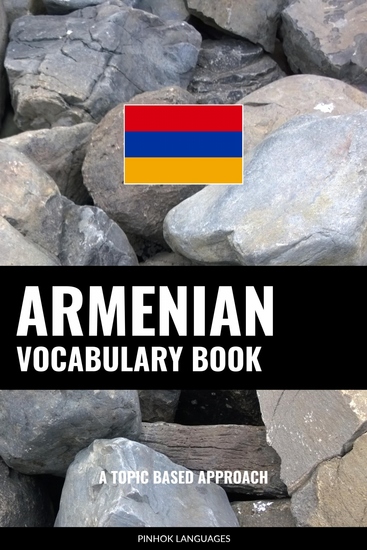
Armenian Vocabulary Book - A Topic Based Approach - cover
LER

Armenian Vocabulary Book - A Topic Based Approach

Pinhok Languages

Editora: Pinhok Languages

  • 0
  • 0
  • 0

Sinopse

Armenian vocabulary book + Armenian dictionaryThis Armenian vocabulary book contains more than 3000 words and phrases which are grouped by topic to make it easier for you to pick what to learn first. On top of that, the index in the second half of the book provides you with a basic Armenian-English as well as English-Armenian dictionary which makes this a great resource for learners of all levels.
 
What you can expect from this book:This Armenian learning resource is a combination of Armenian vocabulary book and a two-way basic Armenian dictionary:Part 1 - Topic based Armenian vocabulary book: This is the main part of the book and represents a list of chapters each containing Armenian vocabularies for a certain topic. The Armenian vocabularies in the chapters are unsorted on purpose to separate remembering them from a defined alphabetical order. You can start at any chapter and dive directly into the topics that interest you the most.Part 2 - Basic English-Armenian dictionary: The index in the second half of the book can be used as a basic Armenian dictionary to look up words you have learned but can't remember or learn new words you need.Part 3 - Basic Armenian-English dictionary: Easy to use and with just the right amount of words, this third part finishes off with a second index that allows you to look for Armenian words and directly find the English translation
 
How to use this Armenian vocabulary book:Not sure where to start? We suggest you first work your way through the verbs, adjectives and phrases chapters in part one of the book. This will give you a great base for further studying and already enough vocabulary for basic communication. The Armenian dictionaries in part two and three can be used whenever needed to look up words you hear on the street, English words you want to know the Armenian translation for or simply to learn some new words.
 
Some final thoughts:Vocabulary books have been around for centuries and as with so many things that have been around for some time, they are not very fashionable and a bit boring, but they usually work very well. Together with the basic Armenian dictionary parts, this vocabulary book is a great resource to support you throughout the process of learning Armenian and comes in particularly handy at times when there is no internet to look up words and phrases.
Disponível desde: 17/11/2022.
Comprimento de impressão: 240 páginas.

Outros livros que poderiam interessá-lo

  • Need a Job? Publish a Book! with LibreOffice - Professional Secrets Revealed - cover

    Need a Job? Publish a Book! with...

    Steven W. Johnson

    • 0
    • 0
    • 0
    Need a Job? Publish a Book! with LibreOffice 
    Discover the Secret to finding Royalty-FREE books begging to be published. 
    Find out where to download FREE desktop publishing and graphics editing software. 
    Uncover the Secret Techniques to successful Prepress setup. 
    Learn the Secret to publishing your book for FREE 
    Unearth the Secret to professionally designed for under $50 
    Expose the Secret International Distribution Systems available to YOU for FREE!
    Ver livro
  • The Sunk Cost Fallacy - Continuing a Venture Due to Past Investments - cover

    The Sunk Cost Fallacy -...

    William Rands

    • 0
    • 0
    • 0
    The sunk cost fallacy is a psychological phenomenon that influences how people make decisions. At its core, this fallacy occurs when individuals continue investing time, money, or effort into a venture simply because they have already made prior investments, even when it becomes clear that continuing is not the best course of action. The irrational commitment to these past investments often overrides logic, leading to suboptimal outcomes. 
    The term "sunk cost" refers to resources that have already been expended and cannot be recovered. Examples include the money spent on a non-refundable ticket, the hours devoted to a project that’s unlikely to succeed, or the emotional energy invested in an unhealthy relationship. Once these resources are gone, they should not factor into future decision-making. However, human nature frequently drives people to consider these costs as if they can be salvaged, causing them to persist in unproductive pursuits. 
    The roots of the sunk cost fallacy are deeply tied to human psychology. Loss aversion, a key principle in behavioral economics, plays a significant role. People have a natural tendency to avoid losses, often valuing what they’ve already invested more than the potential benefits of walking away. Cognitive dissonance further complicates matters, as individuals may find it uncomfortable to admit that their previous choices were mistakes. This discomfort often leads to doubling down on those choices in an attempt to justify them.
    Ver livro
  • Italian for Intermediate learners - an audiocourse of italian language for intermediate and advanced learners - cover

    Italian for Intermediate...

    Matteo Bianchi, Tomas Dvoracek

    • 0
    • 0
    • 0
    Thank you for your interest in the Italian for  the intermediate level audioacourse by Audioacademyeu.  The course is aimed at advanced learners who have already learned English for  three or four years h and who should have almost fluent communication skills.The course is based on contextual learning, which means that you will not only learn words but alsosentences in which you can use the words you have learned. In this course you will find you will find a total of 1,400 words and practice sentences.The individual lessons are organized by by topic and each contains a different number of words and sentences. The language level B2 is an intermediate level, so that most of the course is devoted to topics such as work, characteristics and activities, while while the topics like  travel, leisure and family are covered to a lesser extent,  as they have been covered more extensively in the previous parts of the course. In the last two lessons you will also find a large overview of the irregular verbs. What is the best way to work with the course? Choose the lesson you want to start with. Each lesson contains six tracks. First,  familiarize yourself with the actual vocabulary (tracks 1 and 2). In order to get a better grip over the new expressions  in Italian, in track one you hear the  Italian word twice.Next, you have a  word followed by a contextual sentence, again in both translation options (tracks 3 and 4).  Then you move on to complete sentences (tracks 5 and 6). ). Again, in track 5, you will hear the sentence in Italian twice. Once you have mastered translating sentences from English into Italian (lesson 6) in the time gap before the English translation, you have won. The words alone will help you in understanding the meaning, but using the mastered complete sentences will help you communicate much better.There is a script to this course available for free download at www.audioacademyeu.eu which will make your activities with the course much more effective. In its  introduction, you will find a learning guide along with helpful tips on how to make the lessons more effective and a lesson plan for you to record your learning progress. The script is divided thematically into three parts.  In the first part you will find a written version of the audio tracks you will listen to.  In the second part you will find the writing tests. For each lesson there is one test of vocabulary and one test of sentences. The key to both tests is available right after the tests too In the third part of the script you will find double-sided flashcards that you can cut out with scissors and practice even when you can't or don't want to listen. The course is narrated by native speakers - Jeff Short in English and Eisa Ciravegna and Matteo Bianchi in Italian. No AI generated voices have been used.Lesson 01_Activities 01Lesson 02_Activities 02Lesson 03_TravellingLesson 04_CommunicationLesson 05_WorkLesson 06_CommunityLesson 07_BodyLesson 08_CharacteristicsLesson 09_LeisureLesson 10_Inregular verbs_01Lesson 11_Irregular verbs_02
    Ver livro
  • Classic American Detective - cover

    Classic American Detective

    Jacques Futrelle, Gelett...

    • 0
    • 0
    • 0
    "It is quite possible that the time will come when literary historians, discussing works created in English in the twentieth century, will only briefly dwell on the works of serious writers, and all attention will be focused on the extensive and diverse staging of detective stories.. And then they will have to answer first, which explains the unheard-of popularity of this genre." This, perhaps contradictory, but remarkable statement belongs to the critic of detective fiction, the famous English writer William Somerset Maugham.What could be more exciting and interesting than a well-written detective story?The audiobook is read by American actor Brent Bradley in English. Content:1. Jacques Futrelle. The Phantom Motor2. Gelett Burgess. The Denton Boudoir Mystery3. Melville Davisson Post. Naboth's Vineyard4. Jack London. The Leopard Man's Story5. Suzan Glaspell. A Jury of Her Peers
    Ver livro
  • Shirley Homes and the Cyber Thief - cover

    Shirley Homes and the Cyber Thief

    Jennifer Bassett

    • 0
    • 10
    • 0
    Shirley Homes, private investigator. Like Sherlock Holmes a hundred years ago, she lives in London, enjoys working on difficult cases, and has some helpful friends. She understands people, is a good listener, and of course, she is clever with computers. In today's world that is important, because a lot of crime is cyber crime.  In this second Shirley Homes detective story, Shirley must catch a cyber thief. But how? You can't see a cyber thief, you can't hear a cyber thief. Only the computer knows, and the computer isn't talking ...
    Ver livro
  • The United States of English - The American Language from Colonial Times to the Twenty-First Century - cover

    The United States of English -...

    Rosemarie Ostler

    • 0
    • 0
    • 0
    The story of how English became American—and how it became Southern, Bostonian, Californian, African American, Chicano, elite, working-class, urban, rural, and everything in between 


    By the time of the Revolution, the English that Americans spoke was recognizably different from the British variety. Americans added dozens of new words to the language, either borrowed from Native Americans (raccoon, persimmon, caucus) or created from repurposed English (backwoods, cane brake, salt lick). Americans had their own pronunciations (bath rhymed with hat, not hot) and their own spelling (honor, not honour), not to mention a host of new expressions that grew out of the American landscape and culture (blaze a trail, back track, pull up stakes). Americans even invented their own slang, like stiff as a ringbolt to mean drunk. American English has continued to grow and change ever since. 


    The United States of English tells the engrossing tale of how the American language evolved over four hundred years, explaining both how and why it changed and which parts of the "mother tongue" it preserved (I guess was heard in the British countryside long before it became a typical Americanism). Plentiful examples of the American vernacular, past and present, bring the language to life and make for an engaging as well as enlightening listen.
    Ver livro