Junte-se a nós em uma viagem ao mundo dos livros!
Adicionar este livro à prateleira
Grey
Deixe um novo comentário Default profile 50px
Grey
Assine para ler o livro completo ou leia as primeiras páginas de graça!
All characters reduced
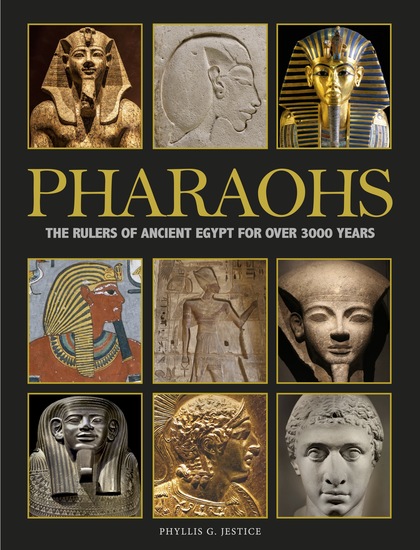
Pharaohs - cover
LER

Pharaohs

Phyllis G. Jestice

Editora: Amber Books Ltd

  • 0
  • 0
  • 0

Sinopse

Ancient Egypt is one of the great wellsprings of human civilization, first developing around the city of Memphis on the Nile River in the fourth millennium BCE. Egyptian life was centred on a complex system of religious rituals, with the pharaoh (king) seen as a living god among the people. Mighty pyramids, tombs and monuments were built to celebrate the pharaohs, many of which can still be seen in all their grandeur today. Arranged by dynastic period, Pharaohs offers a compact history of the reign of these god- kings, from Menes, who united the north and south kingdoms, to the Ptolemaic Queen Cleopatra, who was defeated along with her lover Mark Antony at the Battle of Actium (31 BCE) by imperial Rome. Along the way the reader will learn about the Great Pyramid constructed by Khufu, the last of the Seven Wonders of the ancient world; Queen Hatshepsut, a rare female pharaoh whose name means “foremost of noblewomen” and who launched a massive building programme at Luxor; the young pharaoh Tutankhamun, whose tomb was discovered intact in the Valley of the Kings, complete with the fabulous trappings of his divine status; and Ramesses II (“the Great”), who is thought to have enslaved the Israelites, built the magnificent temple of Abu Simbel, and defeated the Hittites at the Battle of Kadesh (1274 BCE) riding his trade-mark chariot. Carefully researched, superbly entertaining and illustrated throughout with more than 180 photographs and artworks, Pharaohs is an accessible history of the kings who ruled Ancient Egypt for more than 4,000 years.
Disponível desde: 13/02/2024.
Comprimento de impressão: 224 páginas.

Outros livros que poderiam interessá-lo

  • Fragmentation and Conflict - A Divided China (3 in 1) - cover

    Fragmentation and Conflict - A...

    Rolf Hedger

    • 0
    • 0
    • 0
    The grand narrative of Chinese history is often presented as a seamless succession of unified dynasties. Yet between these periods of unity, China experienced crucial eras of division that profoundly shaped its cultural and political development. "Fragmentation and Conflict: A Divided China" examines three fascinating periods when competing states vied for dominance across the Chinese landscape. 
    Following the collapse of the Han Dynasty, the Three Kingdoms period (220-280 CE) saw China fractured into the competing states of Wei, Shu, and Wu. This era of military genius, political intrigue, and strategic maneuvering became immortalized in the classic novel "Romance of the Three Kingdoms," transforming historical figures like Cao Cao, Liu Bei, and Sun Quan into cultural icons. Beyond the battlefield drama, these rival states developed distinct regional cultures and governance approaches while competing for legitimacy as the true inheritors of the Han legacy. 
    The Jin Dynasty (265-420 CE) briefly reunified China before succumbing to internal rebellions and nomadic invasions, leading to further fragmentation. This tumultuous period witnessed massive population movements as northern Chinese fled southward, dramatically reshaping the cultural geography of China while Buddhist influence expanded significantly throughout society. 
    Centuries later, as the Song Dynasty controlled much of traditional China, the Western Xia (1038-1227 CE) emerged as a powerful independent state in the northwest. Founded by the Tangut people, this sophisticated kingdom developed its own unique script, produced remarkable Buddhist art, and maintained a complex relationship with its Chinese and nomadic neighbors before ultimately falling to the Mongol conquest.
    Ver livro
  • Brassroots Democracy - Maroon Ecologies and the Jazz Commons - cover

    Brassroots Democracy - Maroon...

    Benjamin Barson

    • 0
    • 0
    • 0
    Brassroots Democracy recasts the birth of jazz, unearthing vibrant narratives of New Orleans musicians to reveal how early jazz was inextricably tied to the mass mobilization of freedpeople during Reconstruction and the decades that followed. Benjamin Barson presents a "music history from below," following the musicians as they built communes, performed at Civil Rights rallies, and participated in general strikes. Perhaps most importantly, Barson locates the first emancipatory revolution in the Americas—Haiti—as a nexus for cultural and political change in nineteenth-century Louisiana. In dialogue with the work of recent historians who have inverted traditional histories of Latin American and Caribbean independence by centering the influence of Haitian activists abroad, this work traces the impact of Haitian culture in New Orleans and its legacy in movements for liberation.Brassroots Democracy demonstrates how Black musicians infused participatory music practice with innovative forms of grassroots democracy. Late nineteenth-century Black brass bands and activists rehearsed these participatory models through collective performance that embodied the democratic ethos of Black Reconstruction. Termed "Brassroots Democracy," this fusion of political and musical spheres revolutionized both. Brassroots Democracy illuminates the Black Atlantic struggles that informed music-as-world-making from the Haitian Revolution through Reconstruction to the jazz revolution. The work theorizes the roots of the New Orleans brass band tradition in the social relations grown in maroon ecologies across the Americas. Their fruits contributed to the socio-sonic commons of the music we call jazz today.
    Ver livro
  • Charlie's Good Tonight - The Life the Times and the Rolling Stones: The Authorized Biography of Charlie Watts - cover

    Charlie's Good Tonight - The...

    Paul Sexton

    • 0
    • 0
    • 0
    “An affectionate portrait, one that recognizes Watts as musician, colleague, family man, obsessive collector and immaculate dresser.”—Sunday Times 
    “Sexton, a longtime Stones chronicler, tells Watts’s story with warmth and diligence.”—Observer 
    The fully authorized and official biography of legendary Rolling Stones drummer Charlie Watts, one of the world’s most revered and celebrated musicians of the last half century. 
    Forewords by Mick Jagger and Keith Richards 
    Charlie Watts was one of the most decorated musicians in the world, having joined the Rolling Stones, a few months after their formation, early in 1963. 
    A student of jazz drumming, he was headhunted by the band after bumping into them regularly in London’s rhythm and blues clubs. Once installed at the drum seat, he didn’t miss a gig, album or tour in his 60 years in the band. He was there throughout the swinging sixties, the early shot at superstardom and the Stones' world conquest; and throughout the debauchery of the 1970s, typified by 1972's Exile on Main St., considered one of the great albums of the century. By the 1980s, Charlie was battling his own demons, but emerged unscathed to enhance his unparalleled reputation even further over the ensuing decades. 
    Watts went through band bust-ups, bereavements and changes in personnel, managers, guitarists and rhythm sections, but remained the rock at the heart of the Rolling Stones for nearly 60 years—the thoughtful, intellectual but no less compelling counterpoint to the raucousness of his bandmates Keith Richards, Mick Jagger and Ronnie Wood. And this is his story. 
     
    Ver livro
  • Irreplaceable - How to Create Extraordinary Places that Bring People Together - cover

    Irreplaceable - How to Create...

    Kevin Ervin Kelley

    • 0
    • 0
    • 0
    Do we still need physical places like grocery stores, restaurants, and office buildings? Or will the "Replacement Economy" led by the tech titans and retail giants wipe out these venues in their rapid ascent to unicorn status? 


    What about museums, universities, and performing arts venues? Considering the power of technology today, can't we replace these relics with faster, cheaper, and more efficient online tools, apps, and AI? 


    Through engaging storytelling, human behavior insights, and proven design techniques, Kevin Kelley—an attention architect and cofounder of Shook Kelley, a strategic design firm that pioneered the field of "convening"—unfolds why physical places are essential to civil society, business, and community. 


    In this book, he reveals what it takes for brick-and-mortar establishments to attract an audience and maintain a competitive edge in our increasingly digital world, whether you're a: 


    ● Retail leader or institutional manager trying to attract people to your offering while keeping the disruptors at bay 


    ● Student of design who values social facilitation over object-oriented design 


    ● Concerned citizen worried about the loss of community and civility
    Ver livro
  • Greatest Radio Shows Volume 9 - Ten Classic Shows from the Golden Era of Radio - cover

    Greatest Radio Shows Volume 9 -...

    Various Various

    • 0
    • 0
    • 0
    OASIS AUDIO CLASSIC RADIO SHOWCASE SERIES   Oasis Audio has gone into the vaults and dusted off the very earliest form of audio book, old time radio shows, for our listeners. Introduced episode by episode by Jim Engel, old time radio authority and board member of the Museum of Broadcast Communications in Chicago, this series of classic radio shows is sure to have something for everyone. Celebrity casts and top-notch writers made the 1920s through the early 1950s, the golden era of radio. The series features seven exciting themes with 100 episodes in each. That is 700 classic radio programs in all.   Greatest Radio Shows   New to Old-time Radio? Join Oasis Audio for 100 radio shows from across all genres. Thrill to detective stories and mysteries, Dig your spurs in for some dusty trail western adventures, laugh until you cry with the kings and queens of radio comedy, sit on the edge of your seat for the greatest radio dramas. Be filled with nostalgia as you enjoy this unique collection of 100 of the all-time best radio shows. Volume 9 Rocky Fortune 1953_10_13 Steven in a Rest HomeRocky Jordan 1950_07_The Dead ColleenRogues Gallery 1945_10_18 Blondes Prefer GentlemenThe Roy Rogers Show 1951_10_26 Prospector Needs HelpThe Saint 1950_11_19 No Hiding PlaceThe Screen Directors Playhouse 1949_08_04 Fort ApacheThe Screen Guild Players 1947_04_21 Too Many HusbandsThe Sealed Book 1945_04_15 Escape by DeathThe Story of Dr Kildare 1950_06_22 Pricilla’s Broken ArmThe Strange Dr Weird 1945_05_08 Picture of a Killer
    Ver livro
  • The Qing Dynasty - The Last Imperial Dynasty - cover

    The Qing Dynasty - The Last...

    Jun Liu

    • 0
    • 0
    • 0
    The Qing Dynasty, the last imperial dynasty of China, was established in 1644 by the Manchu people, an ethnic group from the northeast of China. The rise of the Qing Dynasty was a result of a combination of military conquest, strategic alliances, and a deep understanding of Chinese traditions. The Manchus, initially a small tribe in what is today known as Manchuria, were able to capitalize on the weakening Ming Dynasty and internal strife within China. This chapter will explore how the Manchu rulers successfully expanded their power and established one of the longest and most influential dynasties in Chinese history. 
    The Manchu people, led by the ambitious and skilled leader Nurhaci, had been unified under his banner in the early 17th century. Nurhaci’s military campaigns in Manchuria helped create a strong foundation for what would later become the Qing Dynasty. After his death in 1626, his son, Hong Taiji, continued to build on his father’s legacy, consolidating power and forming alliances with various Chinese factions. Hong Taiji's strategic foresight helped prepare the Manchus for a successful invasion of China. In 1636, he formally declared the establishment of the Qing Dynasty, marking the official beginning of their imperial rule. 
    By the early 1640s, the Ming Dynasty was in a state of disarray. The empire was plagued by corruption, peasant uprisings, and economic instability. The most notable rebellion was the Li Zicheng-led peasant revolt, which culminated in the fall of the Ming capital, Beijing, in 1644. In this moment of vulnerability, the Manchus, under the leadership of Emperor Shunzhi, seized the opportunity to invade China. The Qing forces entered Beijing and effectively replaced the fallen Ming dynasty, marking the beginning of the Qing rule over China.
    Ver livro