Junte-se a nós em uma viagem ao mundo dos livros!
Adicionar este livro à prateleira
Grey
Deixe um novo comentário Default profile 50px
Grey
Assine para ler o livro completo ou leia as primeiras páginas de graça!
All characters reduced
Lost Tramways of England: Manchester North and Salford - cover
LER

Lost Tramways of England: Manchester North and Salford

Peter Waller

Editora: Graffeg

  • 0
  • 0
  • 0

Sinopse

One of two volumes in the ‘Lost Tramways’ series featuring the tramways of Manchester and its environs, this volume explores in detail the routes to the north of the city centre. Also covered are the history of the city’s tramways in the post-World War II era and those of neighbouring Salford Corporation. Separated by the River Irwell, relations between the two operators was not always harmonious but both were to survive into the late 1940s.
Disponível desde: 28/02/2023.
Outros livros que poderiam interessá-lo

  • A Philosophy of Walking - cover

    A Philosophy of Walking

    Frédéric Gros

    • 0
    • 0
    • 0
    This "passionate affirmation of the simple life, and joy in simple things" explores how walking influenced history's greatest thinkers—from Henry David Thoreau and Jack Kerouac to Gandhi and Nietzsche (Observer).In this French bestseller, leading thinker and philosopher Frédéric Gros charts the many different ways we get from A to B—the pilgrimage, the promenade, the protest march, the nature ramble—and reveals what they say about us.Gros draws attention to other thinkers who also saw walking as something central to their practice. On his travels he ponders Thoreau's eager seclusion in Walden Woods; the reason Rimbaud walked in a fury, while Nerval rambled to cure his melancholy. He shows us how Rousseau walked in order to think, while Nietzsche wandered the mountainside to write. In contrast, Kant marched through his hometown every day, exactly at the same hour, to escape the compulsion of thought. Brilliant and erudite, A Philosophy of Walking is an entertaining and insightful manifesto for putting one foot in front of the other.
    Ver livro
  • Walking London 9th Edition - Thirty Original Walks In and Around London - cover

    Walking London 9th Edition -...

    Andrew Duncan

    • 0
    • 0
    • 0
    Walking London is the essential companion for any urban explorer―visitor or native―committed to discovering the true heart of one of the world's greatest capital cities. In 30 original walks, distinguished historian Andrew Duncan reveals miles of London's endlessly surprising landscape. From wild heathland to formal gardens, cobbled mews to elegant squares and arcades, bustling markets to tranquil villages―Duncan reveals the pick of the famous sights, but also steers walkers off the tourist track and into the city's hidden corners. Handsomely illustrated with specially commissioned color photographs and complete route maps, the book provides full details of addresses, opening times and the best bars and restaurants to visit en route.
    Ver livro
  • Why You Should Go on a Cultural Weekend in Paris - cover

    Why You Should Go on a Cultural...

    Mark Ferdinand

    • 0
    • 0
    • 0
    Paris is the ultimate city for culture lovers—a place where every street corner seems to hide a story, every gallery bursts with masterpieces, and every café hums with creative spirit. A weekend here is enough to immerse yourself in the world’s greatest art, history, and style. 
    Mark Ferdinand shows you how to make the most of a cultural escape in the French capital: exploring the treasures of the Louvre and the Musée d’Orsay, strolling through the literary cafés of Saint-Germain, watching cabaret sparkle at the Moulin Rouge, and uncovering hidden gems beyond the tourist trails. From iconic landmarks to intimate artistic moments, Paris is a city that nourishes the mind, heart, and soul—perfect for a weekend you’ll never forget.
    Ver livro
  • Pictures from Italy - cover

    Pictures from Italy

    Charles Dickens

    • 0
    • 0
    • 0
    Who better to travel to Italy with than Charles Dickens? From the travails of 19th century travel to the wonder of discovering the great art of western civilization, all are brought to life with the characteristic humour, wryness, sentimentality, fervour and love that are poured into the best of the author’s fiction. 
    Modern readers will recognise many of Italy’s historical treasures that millions have enjoyed since Dickens described them over 150 years ago; in that sense surprisingly, little has changed.  
    What might be more interesting to us today are the nature and mechanics of tourism in 1846. So used are we to the relative comfort and speed of global transport that we forget the discomforts (and at times horrors) undertaken by those few that would endeavour to see the world in previous centuries. By comparison we journey at our leisure whereas Dickens’ journal is more the record of a pilgrim and pioneer.  
    Far be it from him however to dwell on the rigours of Victorian tourism, indeed he saves his pithiest wit for such times and is much more interested, as he always is, in the humanity of all he encounters.  
    His vibrant and colourful description of the Roman Festival is as joyful as his reserved observation of an execution is sombre and reserved. Dickens is not enamoured of all he experiences and is quick to let us know when he suspects sham commercialism, hypocrisy or injustice.
    Ver livro
  • English Journey: ‘The finest book ever written about England and the English’ - cover

    English Journey: ‘The finest...

    J. B. Priestley

    • 0
    • 0
    • 0
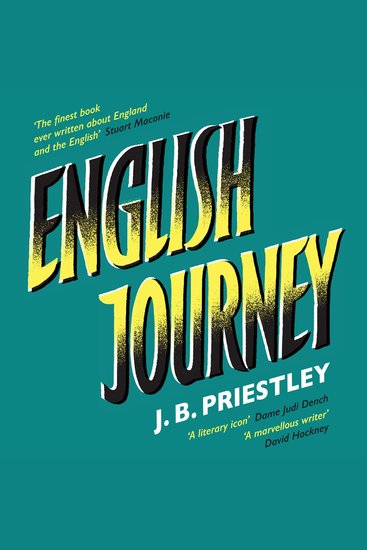
    ‘The finest book ever written about England and the English’ Stuart Maconie 
    ‘J. B. Priestley is one of our literary icons of the 20th Century and it is time that we all became re-acquainted with his genius.’ Dame Judi Dench 
    Three years before George Orwell made his expedition to the far and frozen North in The Road to Wigan Pier, celebrated writer and broadcaster JB Priestley cast his net wider, in a book subtitled ‘a Rambling but Truthful Account of What One Man Saw and Heard and Felt and Thought During a Journey Through England During the Autumn of the Year 1933.’ Appearing first in 1934, it was a huge and immediate success. Today, it still stands as a timeless classic: warm-hearted, intensely patriotic and profound. 
    An account of his journey through England – from Southampton to the Black Country, to the North East and Newcastle, to Norwich and home – English Journey is funny and tender. But it is also a forensic reading of a changing England and a call to arms as passionate as anything in Orwell’s bleak masterpiece. Moreover, it both captured and catalysed the public mood of its time. In capturing and describing an English landscape and people hitherto unseen, writing scathingly about vested interests and underlining the dignity of working people, Priestley influenced the thinking and attitudes of an entire generation and helped formulate a public consensus for change that led to the birth of the welfare state. 
    Prophetic and as relevant today as it was nearly ninety years ago, English Journey is an elegant and readable love letter to a country Priestley finds unfathomable. 
    Priestley's English Journey is a special exploration of Britain, a top choice for those who appreciate travelogues and social history. His essays are a testament to his deep affection for his homeland, marking this book as one of the best in non-fiction. 
    For fans of Rory Stewart (The Marches), Maggie O'Farrell (I Am, I Am, I Am), and Marion Turner (The Wife of Bath). 
    HarperCollins 2023
    Ver livro
  • Ancient Greece’s Most Famous Oracles: The History of the Oracles at Delphi and Dodona - cover

    Ancient Greece’s Most Famous...

    Editors Charles River

    • 0
    • 0
    • 0
    In ancient Greece, “no other practice was so universal than the consultation of oracles.” These holy sites were found in 260 locations around the Greek-speaking world, and they were considered the “most satisfactory means of ascertaining the future.” These sanctuaries were “set apart from the profane, ordinary world” and were in the beginning restricted to natural locations where the divine was thought to be “especially present.” They were set aside for special spiritual functions, and a state of purity was generally required of its participants. A historical tendency toward providing haven for criminals was based on the fear of shedding blood in a holy place, and the “fear that the evil magic would emanate from his curse.” 
    The Oracle of Delphi was one of the greatest religious institutions in Greece and one which played a significant role not only in the formation and collective decisions of Hellenic localities and city-states but also in the personal lives of Greeks known and unknown. The site was dedicated to the god Apollo, and the Greeks believed the god spoke his oracles through his prophetess known as the Pythia. The judgments and decisions rendered by the oracle were so important to the Greeks that they often put them above all other interests, even security threats posed by the likes of the Persians, and Delphi was popular even amongst outsiders. Many authors of antiquity mention the oracle for one reason or another, and there even survive epigraphic collections that preserve the god’s words on stone. 
    The Oracle of Dodona was the oldest of all, and it was one of the few dedicated to Zeus and his consort goddess Dione. The oracular utterances heard at the oracles are generally referred to as “smokiness” in Greek, but at Dodona, the answers came in natural sounds and other peripheral phenomena.
    Ver livro