Junte-se a nós em uma viagem ao mundo dos livros!
Adicionar este livro à prateleira
Grey
Deixe um novo comentário Default profile 50px
Grey
Assine para ler o livro completo ou leia as primeiras páginas de graça!
All characters reduced
The Scene Break - Using Visual or Typographical Breaks to Indicate a Shift in Time or Place - cover
LER

The Scene Break - Using Visual or Typographical Breaks to Indicate a Shift in Time or Place

Peter Thompson

Editora: Heritage Books

  • 0
  • 0
  • 0

Sinopse

A well-placed scene break can do more than just separate paragraphs. It can signal the passage of time, shift perspectives, build suspense, or create a seamless flow between moments. Writers across genres rely on these subtle yet powerful tools to control pacing, enhance clarity, and guide the reader through complex narratives.


The Scene Break explores how visual and typographical breaks such as extra spaces, symbols, or section dividers can transform storytelling. From novels to screenplays, this book examines the mechanics of effective scene transitions, offering practical examples and techniques to master their use. Whether you are crafting an intricate multi-threaded plot or simply aiming to sharpen your story's rhythm, understanding the art of the scene break will help you create a smoother and more engaging reading experience.
Disponível desde: 23/02/2025.
Comprimento de impressão: 72 páginas.


Outros livros que poderiam interessá-lo

  • Easy Money - American Puritans and the Invention of Modern Currency - cover

    Easy Money - American Puritans...

    Dror Goldberg

    • 0
    • 0
    • 0
    A sweeping history of the American invention of modern money. 
    Economists endlessly debate the nature of legal tender monetary systems—coins and bills issued by a government or other authority. Yet the origins of these currencies have received little attention. 
    Dror Goldberg tells the story of modern money in North America through the Massachusetts colony during the seventeenth century. As the young settlement transitioned to self-governance and its economy grew, the need to formalize a smooth exchange emerged. Printing local money followed. 
    Easy Money illustrates how colonists invented contemporary currency by shifting its foundation from intrinsically valuable goods—such as silver—to the taxation of the state. Goldberg traces how this structure grew into a worldwide system in which, monetarily, we are all Massachusetts. Weaving economics, law, and American history, Easy Money is a new touchstone in the story of monetary systems.
    Ver livro
  • When Black Students Excel - How Schools Can Engage and Empower Black Students - cover

    When Black Students Excel - How...

    Joseph F. Johnson Jr., Cynthia...

    • 0
    • 0
    • 0
    This book draws from the successes of award-winning schools, teachers, students, and parents to help leaders understand how they can positively change the educational experience of Black students. 


    When Black Students Excel offers real-life examples of outstanding elementary, middle, and high schools where teachers and school leaders have rejected policies and practices built upon deficit perceptions about the capacity of Black students. Chapters highlight leadership implications and offer specific suggestions for educators who are seeking to transform their schools in ways that advance the success of Black students. This practical guide includes questions to ask students and their parents, self-assessment tools, and an array of leadership and teaching practices that are effective to empower Black students, elevate school attendance and academic engagement, and improve other important outcomes. 


    Unpacking important themes that influence the success of Black students, this book is a useful tool for educators who are seeking to understand how they can change programs, procedures, and practices in ways that engage and empower Black students.
    Ver livro
  • AV on History - Amelia Earhart - cover

    AV on History - Amelia Earhart

    Academy Voices

    • 0
    • 0
    • 0
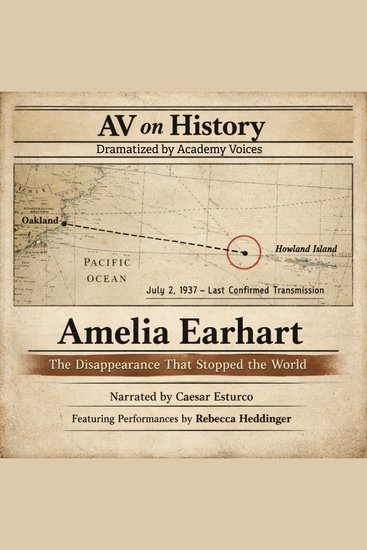
    In July 1937, Amelia Earhart disappeared over the Pacific Ocean during the final leg of her attempt to fly around the world. Despite one of the most extensive search efforts in modern history, no definitive answer has ever been recorded. 
    AV on History: Amelia Earhart presents her disappearance as it was experienced at the time—through official reports, radio transmissions, press coverage, and the historical record as it stands today. This is not a biographical tribute, nor a speculative true-crime retelling. It is a documented investigation into what was known, what was reported, and where the record ultimately ends. 
    Narrated by Caesar Esturco, with dramatized performances by Rebecca Heddinger, this episode blends historical documentation with restrained dramatization to recreate the tension, uncertainty, and global attention surrounding Earhart’s final flight. The story unfolds through timelines, locations, and confirmed communications, allowing the mystery to emerge through absence rather than conjecture. 
    AV on History is a documentary audio series that examines pivotal historical moments that remain unresolved—not to solve them, but to present them clearly, accurately, and responsibly. 
    This is history as it was recorded. 
    And where it stopped.
    Ver livro
  • Rome’s Best Emperors: The History and Legacy of the Roman Empire’s Most Able Leaders - cover

    Rome’s Best Emperors: The...

    Editors Charles River

    • 0
    • 0
    • 0
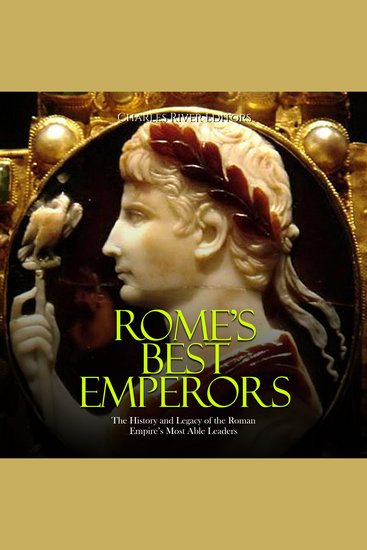
    The importance of Gaius Julius Caesar Augustus (or as he was known from birth, Gaius Octavius “Octavian” Thurinus) to the course of Western history is hard to overstate. His life, his rise to power, his political, and his social and military achievements all laid the foundations for the creation of an empire which would endure for almost five centuries, and whose traditions, laws, architecture and art continue to influence much of Europe and the world today. Octavian was the first true Roman Emperor, and the first man since the Etruscan Tarquins five centuries earlier to establish a successful hereditary ruling dynasty in what had been a proud Republic for over half a millennium. He was a canny strategist, an excellent orator, a fine writer, a generous patron of the arts and enthusiastic promoter of public works, but above all he was a master politician. Octavian’s great-uncle (and adoptive father) Julius Caesar was a great general, and his rival Mark Antony was a great soldier, but as a politician Octavian outmatched them all. He still stands in bronze on Rome’s Via dei Fori Imperiali to this day, along with the likes of Caesar, Hadrian, Trajan and Marcus Aurelius, and he is forever immortalized in all Western calendars as the patron of the month of August, which was dedicated to him when he was deified, following his death, as Divus Augustus.  
    	“The Five Good Emperors,” a reference to the five emperors who ruled the Roman Empire between 96 and 180 CE (Nerva, Trajan, Hadrian, Antoninus Pius, and Marcus Aurelius), was a term first coined by Machiavelli and later adopted and popularized by historian Edward Gibbon, who said that under these men, the Roman Empire “was governed by absolute power under the guidance of wisdom and virtue.” This period of 84 years is generally regarded as the high point of the Roman Empire, at least after Augustus.
    Ver livro
  • The Iraq Wars - A Very Short Introduction - cover

    The Iraq Wars - A Very Short...

    Samuel Helfont

    • 0
    • 0
    • 0
    American wars in Iraq were a defining feature of global politics for almost thirty years. The Gulf War of 1991, the American invasion of Iraq in 2003, and the campaign against the Islamic State beginning in 2014 each had their own logic. Each occurrence was a distinct conflict; however they must not only be considered in isolation. The United States spent the 1990s trying but failing to implement the Gulf War's cease fire agreement. After the terrorist attacks of September 11, 2001, American leaders decided to settle the open-ended aftermath of the Gulf War by launching the Iraq War of 2003. The Iraq War unleashed resistance, civil war, insurgency and eventually the Islamic State in Iraq and Syria. Thus, following the Gulf War, each war was fought to finish the previous conflict. The Iraq Wars, therefore, are perhaps best understood as a chain of events.Academics, journalists, statesmen, and soldiers have produced many library shelves of books on the Iraq Wars. Yet, no short, easily digestible volume exists to synthesize this vast literature of both English and Arabic sources. The Iraq Wars: A Very Short Introduction covers this series of important conflicts as a whole, in a highly succinct and uniquely listenable way.
    Ver livro
  • Gupta Empire The: The History and Legacy of India’s Ruling Dynasty in Late Antiquity - cover

    Gupta Empire The: The History...

    Charles River Editors

    • 0
    • 0
    • 0
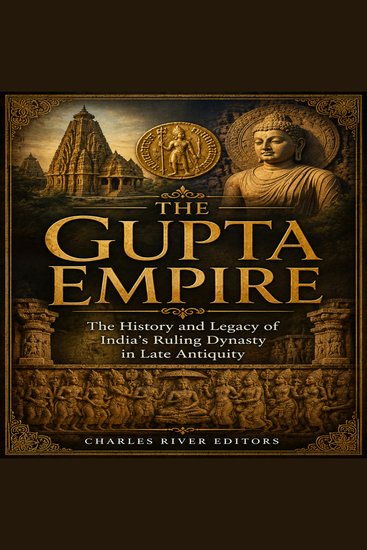
    The rise and fall of great empires have shaped the course of human history, but few left so enduring an imprint upon the Indian subcontinent as the Gupta Empire. Countless studies have examined its rulers, famous battles, and its remarkable scientific and cultural achievements, and when viewed as a whole, the history of the Gupta Empire from its obscure beginnings to its remarkable expansion and eventual decline reveals a civilization that achieved an extraordinary degree of political, cultural, and intellectual development. 
    	Between the 4th and 6th centuries A.D., the dynasty grew from little more than a regional power nestled in the fertile Gangetic plain into one of the largest empires the wider Indian subcontinent had ever seen. Under prominent rulers like Chandragupta I, Samudragupta, Chandragupta II, Kumaragupta I, and Skandagupta, the Guptas expanded their authority across much of northern India and established a political order that brought a long period of stability after generations of fragmentation. In conjunction with that, their court emerged as a center of intellectual life where literature, mathematics, astronomy, philosophy, religion, and architecture thrived, and their culture would influence India and much of Asia for centuries to come. Scholars such as Aryabhata revolutionized astronomy and introduced mathematical concepts that were built upon by subsequent scholars in other parts of Asia and eventually Europe. Sanskrit flourished under poets and dramatists like Kalidasa, whose works remain among the greatest achievements of classical Indian literature. Advances in metallurgy produced remarkable monuments such as the famous Iron Pillar of Delhi, and architects and artists created temples and sculptures whose elegant proportions and incredible detail have endured for centuries. Religion also experienced a major transformation of its own under the Guptas, yet they were also tolerant of religious diversity. 
    Ver livro