Join us on a literary world trip!
Add this book to bookshelf
Grey
Write a new comment Default profile 50px
Grey
Subscribe to read the full book or read the first pages for free!
All characters reduced
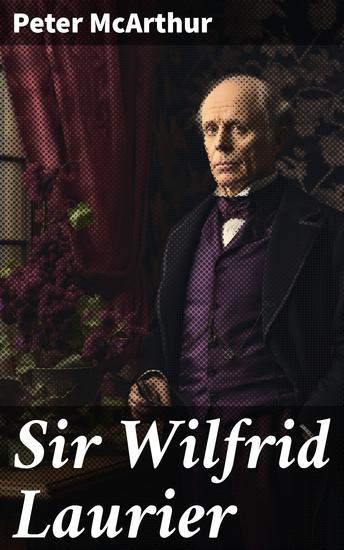
Sir Wilfrid Laurier - The Influential Prime Minister: A Critical Analysis of Canada's Development - cover

Sir Wilfrid Laurier - The Influential Prime Minister: A Critical Analysis of Canada's Development

Peter McArthur

Publisher: Good Press

  • 0
  • 0
  • 0

Summary

In "Sir Wilfrid Laurier," Peter McArthur delivers a profound examination of one of Canada's most distinguished Prime Ministers, weaving a narrative rich in historical detail and political insight. The book utilizes a blend of biographical storytelling and analytical commentary, positioning Laurier within the broader context of early 20th-century Canadian politics. McArthur's lyrical prose invites readers to understand Laurier's vision of nationhood, his strategies in navigating a rapidly changing political landscape, and his legacy that continues to influence Canadian identity today. Peter McArthur, a prominent journalist and historian, draws deeply from his extensive knowledge of Canadian political history to craft this insightful biography. His background in journalism lends a critical edge to his writing, allowing him to present Laurier not merely as a political figure but as a man grappling with the complexities of his time. This undertaking reflects McArthur'Äôs desire to contribute to a more nuanced understanding of Canada's past and the intricacies of its governance. "Sir Wilfrid Laurier" is an essential read for anyone interested in Canadian history, politics, or the biographical genre. McArthur's masterful storytelling not only informs but also captivates, making this work a valuable addition to both academic libraries and personal collections.
Available since: 10/12/2023.
Print length: 88 pages.

Other books that might interest you

  • From the Memoirs of Satan - From their pens to your ears genius in every story - cover

    From the Memoirs of Satan - From...

    William Hauff

    • 0
    • 0
    • 0
    The bookshelves of European literature are incredible collections that have gathered together centuries of very talented authors.  From this continent their fame spread and whilst among their number many are now forgotten or neglected their talents endure.  Among them is William Hauff.
    Show book
  • Lord Byron and Lord Tennyson: The Lives and Works of 19th Century England’s Most Famous Poets - cover

    Lord Byron and Lord Tennyson:...

    Charles River Editors

    • 0
    • 0
    • 0
    Lord Byron’s very name conjures up visions of the Romantic movement and outlandishly dressed bohemians, for if Alfred, Lord Tennyson was the poetic darling of the masses, Byron was the hero of the hedonists. While the traditional English literary hero was a nobleman rescuing a damsel in distress, Byron created the anti-hero, a man plagued by self-doubt and hidden sorrow. At the same time, his hero was also capable of facing reality once he had wrestled through his own angst, and even of occasionally acting nobly in the great tradition of the author’s Puritan forebears. 
    Whereas poets like Wordsworth and Browning were easy to love, Lord Byron inspired a certain amount of fear among the upper classes, and pious mothers were reluctant to let their daughters read his work. In a manner more appropriate to the 21st century than the 19th, Lord Byron was a man true to his own beliefs, supporting the rights of the oppressed even while enjoying all the benefits offered to him as a member of the British aristocracy.  
    Born to a father plagued by bouts of drinking and depression, and surrounded by siblings with similar ailments, Alfred Tennyson grew up believing that he must be a victim of hereditary illness, to the point that he believed he must never marry or father children less he perpetuate the suffering on future generations. With these thoughts always in his head, he turned his mind towards a near worship of romantic love, while at the same time repeatedly painting a tragic ending for his most cherished characters, many of whom seemed to die of a broken heart or some illness or accident related to it. In fact, by the time Tennyson began to prosper, he was so accustomed to sorrow that he felt compelled to seek it out, focusing his attention in his middle years not on the comfortable home and growing family he had been blessed with, but instead on the tragic losses experienced by his country during the Crimean War.
    Show book
  • Samurai Sword Murder - The Morne Harmse Story - cover

    Samurai Sword Murder - The Morne...

    Nicole Engelbrecht

    • 0
    • 0
    • 0
    When 18-year-old Morné Harmse walked into his Krugersdorp high school, armed with a samurai sword on a Monday in 2008, he had one mission – to commit a massacre. Inspired by the Columbine high school killings, his fantasy to make people "take notice" had been brewing for more than a year. By the time his sword-slashing spree had ended, 16-year-old Jacques Pretorius was dead, and three others were brutally injured. 
    In the aftermath of what was described as “the most barbaric act of schoolboy violence in South African history” the country was left reeling. How does an ordinary boy from a "normal" family become a brutal killer overnight? Was Morné under the influence of a satanic cult? A protégée of mastermind Devilsdorp killer, Cecilia Steyn? Did his obsession with heavy metal band Slipknot drive him over the edge? Now, 14 years later, Morné Harmse is out on controversial parole. Written in mesmerising detail, Samurai Sword Murder finally puts together the pieces of this brutal tragedy.
    Show book
  • The Man Who Consumed Everything - The Curious Case of an Unusual Hunger - cover

    The Man Who Consumed Everything...

    John Harpoon

    • 0
    • 0
    • 0
    Tarrare, a name that echoes through medical history as the embodiment of insatiable hunger, was a Frenchman whose life and condition baffled both his contemporaries and generations of scientists that followed. Born in 1772 in Lyon, France, to a poor farming family, Tarrare’s early years were marked by an extraordinary appetite that seemed to grow with him, quickly surpassing the needs of a typical child. His insatiable hunger was not a mere curiosity—it was a symptom of a condition that would haunt him throughout his short life, leaving behind a trail of mystery, tragedy, and fascination. 
      
    Tarrare’s hunger was unlike anything the world had ever seen. From his teenage years onward, his body demanded far more than the normal intake of food; he consumed vast quantities that would overwhelm any ordinary person. In a single sitting, he could eat the food intended for fifteen people. His consumption ranged from the normal—meats and vegetables—to the bizarre and horrifying: live animals, including cats, snakes, lizards, and even puppies. The most unsettling aspect of his condition was his ability to devour inanimate objects, such as stones, corks, and litter. He seemed to have an insatiable urge to eat anything in sight, a drive that could not be quelled by typical methods of nourishment. 
      
    Despite consuming vast amounts of food, Tarrare’s body remained gaunt, almost skeletal, which perplexed doctors and those around him. His unusual condition led him to be admitted to a military hospital, where he became the subject of study by doctors intrigued by the sheer scope of his hunger. Tarrare’s case was not merely one of gluttony; it was an intricate puzzle that pointed to deeper medical and psychological conditions, which, at the time, were beyond the understanding of the medical community.
    Show book
  • Bandit Country - Brothers betrayal and murder in the heart of a gambling empire - cover

    Bandit Country - Brothers...

    Jamie Reid

    • 0
    • 0
    • 0
    A True-Crime Story Set Against the Backdrop of an After-Dark World Filled with New Money, Hedonism, and ExcessGripping, atmospheric, true-crime noir. Bandit Country takes you on a thrilling journey into the shadowy underworld of England’s organized crime. In this atmospheric tale, you are introduced to a cast of characters as diverse as the luxurious nightclubs they frequent: racketeers, gamblers, glamorous women, entrepreneurs, bunny girls, politicians, and policemen. At the heart of the story are the Luvaglio brothers, visionaries who dared to dream of an empire amidst the industrial skylines and bridges of Newcastle.Unfolding like a cinematic thriller.Bandit Country is more than just a true crime story; it's a meticulously researched and emotionally charged portrayal of a bygone era. It delves deep into the heart of the British gambling boom and the forces that shaped it, with a particular focus on the influence of organized crime and the elusive Mafia empire. For fans of true crime biographies, books about the Mafia, gripping suspense, and noir books, Bandit Country offers a unique and captivating narrative that inspired the British classic gangster film, Get Carter.Inside:Discover the secrets of an empire built on ambition and shattered by betrayalExplore the rise of the British gambling industry during the 1960sFind the perfect addition to organized crime books for the true crime obsessedIf you love books about true crime such as The Life We Chose, Five Families, or The Best New True Crime Stories, then Bandit Country is for you.
    Show book
  • Choosing Family - A Memoir of Queer Motherhood and Black Resistance - cover

    Choosing Family - A Memoir of...

    Francesca T. Royster

    • 0
    • 0
    • 0
    A brilliant literary memoir of chosen family and chosen heritage, told against the backdrop of Chicago’s North and South Sides. 
     
    As a multiracial household in Chicago’s North Side community of Rogers Park, race is at the core of Francesca T. Royster and her family's world, influencing everyday acts of parenting and the conception of what family truly means. Like Maggie Nelson’s The Argonauts, this lyrical and affecting memoir focuses on a unit of three: the author; her wife Annie, who's white; and Cecilia, the Black daughter they adopt as a couple in their forties and fifties. Choosing Family chronicles this journey to motherhood while examining the messiness and complexity of adoption and parenthood from a Black, queer, and feminist perspective. Royster also explores her memories of the matriarchs of her childhood and the homes these women created in Chicago’s South Side—itself a dynamic character in the memoir—where “family” was fluid, inclusive, and not necessarily defined by marriage or other socially recognized contracts. 
        
    Calling upon the work of some of her favorite queer thinkers, including José Esteban Muñoz and Audre Lorde, Royster interweaves her experiences and memories with queer and gender theory to argue that many Black families, certainly her own, have historically had a “queer” attitude toward family: configurations that sit outside the white normative experience and are the richer for their flexibility and generosity of spirit. A powerful, genre-bending memoir of family, identity, and acceptance, Choosing Family, ultimately, is about joy—about claiming the joy that society did not intend to assign to you, or to those like you.
    Show book