Junte-se a nós em uma viagem ao mundo dos livros!
Adicionar este livro à prateleira
Grey
Deixe um novo comentário Default profile 50px
Grey
Assine para ler o livro completo ou leia as primeiras páginas de graça!
All characters reduced
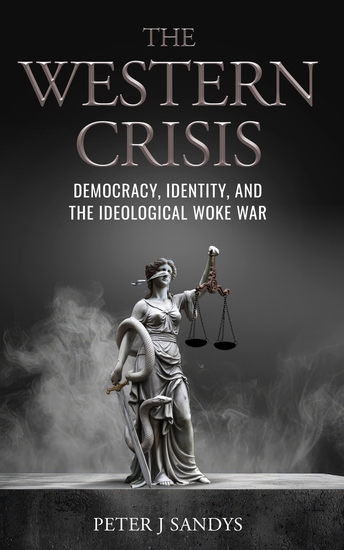
The Western Crisis - Democracy Identity and the Ideological Woke War - cover
LER

The Western Crisis - Democracy Identity and the Ideological Woke War

Peter J. Sandys

Editora: Defiance Press and Publishing

  • 0
  • 0
  • 0

Sinopse

For decades, the Western world has embraced "liberal democracy" and "human rights" as its guiding principles. But beneath these ideals lurks a dangerous globalist agenda, eroding Western culture from within. Once a beacon of faith and tradition, the West now finds itself divided: its best citizens are disillusioned, while its worst are emboldened by a toxic zeal. Leftist intellectuals, with the help of elites, have spread their ever-shifting ideologies—merging democracy, socialism, and liberalism—leading to the capture of Western civilization by progressive, socialist, and left-liberal forces.As Western societies struggle with identity and values, the battle over diversity, nationalism, patriotism, and race intensifies. A suicidal dogma of wokeness, historical revisionism, and divisive politics masquerades as "democracy" and "equality," pushing progressivism and utopianism as the new religion. Meanwhile, non-Western, national-conservative states uphold independence and traditional moral values, presenting a stark contrast to the West's ideological collapse.This book presents a politically incorrect and radical narrative that challenges the foundations of liberal democracy. It calls for readers to reject despair, awaken to the truth, and take action against the forces tearing the West apart. The "Disunited States of America" has become a modern echo of the Soviet Union, while the so-called "Wokers' Paradise" harbors the seeds of modern barbarism. America's identity crisis reflects a deeper fracture across the entire Western world—one driven by cultural decline, economic deception, and the abandonment of democratic values.With bold insight, this book exposes how woke-globalist agendas and rainbow capitalism conceal a Marxist worldview, threatening the very fabric of Western civilization. The fight for the future of the West is more than a clash between democracy and autocracy—it is an ideological and cultural war, and the stakes have never been higher. The time to act is now.
Disponível desde: 07/04/2025.
Comprimento de impressão: 389 páginas.
Outros livros que poderiam interessá-lo

  • State of the Union 1986 - cover

    State of the Union 1986

    Ronald Reagan

    • 0
    • 0
    • 0
    The 1986 State of the Union Address delivered February 4, 1986, was delayed following the Space Shuttle Challenger disaster which killed its seven crew members. Reagan reports the U.S. is the economic miracle to which the world once again turns, with record economic growth and inflation cut from over 12 to under 4 percent.  
    But the federal budget system is broken. “We do not face large deficits because American families are undertaxed; we face those deficits because the Federal Government overspends.” “We must proceed with Grace commission reforms against waste.” Tax cuts have done more to “help America's economy break free than any program since John Kennedy's tax cut almost a quarter century ago.” 
    We “must redouble our efforts for freer and fairer trade.” We oppose legislation touted as providing protection that raises prices for us all.  
    We see a renaissance in education and support “vouchers that give parents freedom of choice”. Hundreds of billions of dollars in poverty programs have led to a breakdown of the family and deteriorating schools. As Franklin Roosevelt said, “Welfare is a narcotic, a subtle destroyer of the human spirit.” Welfare “should be judged by how many of its recipients become independent of welfare.” 
    Reagan sees technology as the solution to “the greatest problem of the 20th century. A security shield can one day render nuclear weapons obsolete and free mankind from the prison of nuclear terror.”  
    “The American dream is a song of hope… to discover a new universe inside a tiny silicon chip or a single human cell.” “So, let us go forward to create our world of tomorrow in faith, in unity, and in love. God bless you, and God bless America.” 
    Audio recording courtesy of the Ronald Reagan Presidential Library. 
    AspenLeafMedia.com
    Ver livro
  • Inventing the Future - Postcapitalism and a World Without Work - cover

    Inventing the Future -...

    Nick Srnicek, Alex Williams

    • 0
    • 0
    • 0
    This major new manifesto offers a "clear and compelling vision of a postcapitalist society" and shows how left-wing politics can be rebuilt for the twenty-first century (Mark Fisher, author of Capitalist Realism 


    Neoliberalism isn't working. Austerity is forcing millions into poverty and many more into precarious work, while the left remains trapped in stagnant political practices that offer no respite. 


    Inventing the Future is a bold new manifesto for life after capitalism. Against the confused understanding of our high-tech world by both the right and the left, this book claims that the emancipatory and future-oriented possibilities of our society can be reclaimed. Instead of running from a complex future, Nick Srnicek and Alex Williams demand a postcapitalist economy capable of advancing standards, liberating humanity from work and developing technologies that expand our freedoms. 


    This new edition includes a new chapter where they respond to their various critics.
    Ver livro
  • Who Has Buried the Dead? - From Stalin to Putin … The last great secret of World War Two - cover

    Who Has Buried the Dead? - From...

    KGE Konkel

    • 0
    • 1
    • 0
    The Second World War was fought not only on the front lines but also in secrets, some of which have never been revealed. One such secret was buried in the deep, dark forest of Katyn, Poland. The other in the pages of a notebook hidden in an otherwise unremarkable café in an ancient Polish city.
    		 
    That notebook, known as the Scottish Book, was an obscure work of intellectual gamesmanship between a specialized group of mathematicians who met at a local pub near the town’s medieval university, where they shared and solved complex mathematical problems in the pages of the book. In 1939, as the Nazis overran the country, the book mysteriously vanished from its hiding place in the café. Some of its contributors avoided certain death by fleeing Poland  for America, where the government recruited them. Ultimately, some of these intellectuals became participants in a deadly undertaking: the Manhattan Project.
    		 
    Who Has Buried the Dead? may be fiction, but it draws on years of research to plausibly answer the real questions surrounding one of the last great secrets of the Second World War. What did the Scottish Book contain that led the NKVD, the Gestapo, and the Allies on a desperate search, using any means to find it? Why has its existence not factored into the telling of Second World War history? What is ultimately revealed within the Scottish Book that brought mortal enemies and their top spy operatives into a deadly contest for its discovery and seizure?
    Ver livro
  • What's Wrong With Socialism - A Biblical Investigation for Everyone - cover

    What's Wrong With Socialism - A...

    Daniel Alan Brubaker

    • 0
    • 0
    • 0
    What’s Wrong With Socialism: A Biblical Investigation For Everyone takes a clear, accessible look at one of the most debated political and economic systems of our time—through the lens of the Bible. 
    Author Daniel Alan Brubaker, PhD explores socialism not just as an abstract theory, but as a lived reality with deep implications for human freedom, justice, wealth, and responsibility. Drawing on Scripture, history, and practical examples, Brubaker asks whether socialism’s promises of equality and fairness hold up when tested against biblical principles and real-world outcomes. 
    This audiobook helps listeners understand:The core ideas of socialism and why they appeal to many.How socialism differs from voluntary sharing and generosity modeled in the Bible.What Scripture teaches about wealth, justice, and the proper use of possessions.The dangers of materialism, state control, and the suppression of personal responsibility.How mercy and justice are often confused in debates about public policy. 
    Written in straightforward, non-technical language, this is a biblical investigation for everyone—students, pastors, church groups, anyone wrestling with the promises and pitfalls of socialism. Brubaker takes the topic seriously, showing where and why socialism ultimately fails the biblical test. 
    Whether you are new to the discussion or already familiar with political and economic debates, this audiobook will equip you with clear categories and biblical grounding to think more deeply about socialism and its alternatives. 
    For Christians seeking clarity in an age of confusion, or for anyone interested in the intersection of faith, economics, and justice, What’s Wrong With Socialism offers a compelling and thought-provoking guide.
    Ver livro
  • Conspiracy - Why the Rational Believe the Irrational - cover

    Conspiracy - Why the Rational...

    Michael Shermer

    • 0
    • 0
    • 0
    Best-selling author Michael Shermer presents an overarching theory of conspiracy theories—who believes them and why, which ones are real, and what we should do about them. 
     
    Nothing happens by accident, everything is connected, and there are no coincidences: that is the essence of conspiratorial thinking. Long a fringe part of the American political landscape, conspiracy theories are now mainstream: 147 members of Congress voted in favor of objections to the 2020  
    presidential election based on an unproven theory about a rigged electoral process promoted by the mysterious group QAnon. But this is only the latest example in a long history of ideas that include the satanic panics of the 1980s, the New World Order and Vatican conspiracy theories, fears about  
    fluoridated water, speculations about President John F. Kennedy's assassination, and the notions that the Sandy Hook massacre was a false-flag operation and 9/11 was an inside job. 
     
    In Conspiracy, Michael Shermer presents an overarching review of conspiracy theories—who believes them and why, which ones are real, and what we should do about them. Trust in conspiracy theories, he writes, cuts across gender, age, race, income, education level, occupational status—and even  
    political affiliation. One reason that people believe these conspiracies, Shermer argues, is that enough of them are real that we should be constructively conspiratorial: elections have been rigged (LBJ's 1948 Senate race); medical professionals have intentionally harmed patients in their care (Tuskegee); your  
    government does lie to you (Watergate, Iran-Contra, and Afghanistan); and, tragically, some adults do conspire to sexually abuse children. But Shermer reveals that other factors are also in play: anxiety and a sense of loss of control play a role in conspiratorial cognition patterns, as do certain personality traits. 
     
    This engaging book will be an important read for anyone concerned about the future direction of American politics, as well as anyone who's watched friends or family fall into patterns of conspiratorial thinking. 
     
    A supplemental PDF is included with this audiobook.
    Ver livro
  • Kleptocracy Exposed - The Mechanics of Government Corruption and Theft - cover

    Kleptocracy Exposed - The...

    Arlo Holders

    • 0
    • 0
    • 0
    Kleptocracy, derived from the Greek words kleptēs (thief) and kratos (rule), refers to a system of governance where leaders exploit their positions of power to enrich themselves at the expense of the public. It is a regime of theft, where corruption is not merely an incidental byproduct of governance but a fundamental aspect of its operation. In kleptocratic systems, the state becomes a tool for personal and collective gain for a small elite, often at the cost of societal well-being and economic development. 
    Historically, kleptocracy has thrived in societies with weak institutions, limited accountability mechanisms, and concentrated political power. Leaders in these systems manipulate laws, suppress dissent, and use propaganda to maintain their grip on authority while diverting resources for personal use. Such regimes have emerged across various political systems, from monarchies and dictatorships to democracies with eroded checks and balances. 
    The global scale of kleptocracy is staggering, with trillions of dollars siphoned from public coffers annually. This stolen wealth often finds its way into offshore accounts, luxury properties, and high-value assets, creating a shadow financial system that transcends national borders. These stolen funds not only undermine the economies of the affected countries but also perpetuate poverty and inequality, as vital resources meant for public welfare, healthcare, and education are diverted into private hands.
    Ver livro