Junte-se a nós em uma viagem ao mundo dos livros!
Adicionar este livro à prateleira
Grey
Deixe um novo comentário Default profile 50px
Grey
Assine para ler o livro completo ou leia as primeiras páginas de graça!
All characters reduced
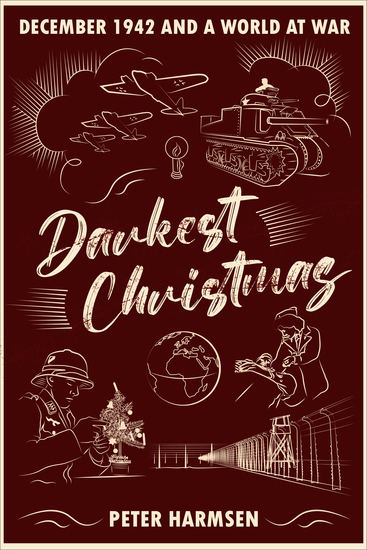
Darkest Christmas - December 1942 and a World at War - cover
LER

Darkest Christmas - December 1942 and a World at War

Peter Harmsen

Editora: Casemate

  • 0
  • 0
  • 0

Sinopse

"This book is of interest to any scholar of World War II, particularly those focused on bridging culture and war. Highly readable, this text is suitable for undergraduate and popular audiences as well. Many should find its analysis to be a refreshing take on the well-trodden field of World War II histories." — Journal of Military HistoryDecember 1942 saw the bloodiest Christmas in the history of mankind. From the islands in the Pacific to the China front, from the trenches in Russia to the battle lines in North Africa, in the skies over Europe and in the depths of the Atlantic, men were killing each other in greater numbers than ever before. The Holocaust continued, and innocent civilians were murdered by the thousands throughout the evil Nazi empire, even as the perpetrators celebrated the birth of Christ.  Millions stationed in far-off lands amid the greatest conflict in human history feared this was their last Christmas in freedom, or their last Christmas alive. At the same time as the slaughter continued unabated, throughout the world there were random acts of kindness, born out of an instinctive feeling of the essential brotherhood of man. These gestures also straddled religious barriers and sometimes included those of non-Christian faiths. Even some Japanese, otherwise embarked on a self-declared crusade against the West, relented for a few precious hours in acknowledgment of the holiday.  At the same time, Christmas 1942 saw the injunction of ‘good will to man’ distorted in ugly and callous ways. At Auschwitz, SS guards played cruel games with their prisoners. In Berlin, the German heart of darkness, Propaganda Minister Joseph Goebbels spent time with his family while still buried in feverish fantasies about the Jewish world conspiracy.  Christmas 1942 saw the entire range of man’s conduct towards his fellow man, reflecting the extremes of behavior, good and bad, that World War II gave rise to. The way the holiday was marked around the world tells a deeper and more universal story of the human condition in extraordinary times.
Disponível desde: 21/10/2022.
Comprimento de impressão: 240 páginas.

Outros livros que poderiam interessá-lo

  • Mysterious Chicago - History at Its Coolest - cover

    Mysterious Chicago - History at...

    Adam Selzer

    • 0
    • 0
    • 0
    A historian shares strange-but-true stories of the city and its unsolved mysteries, from the nineteenth century to today. 


    From Chicago historian Adam Selzer, expert on all of the Windy City's quirks and oddities, comes a compelling anthology of forty unsolved mysteries from the 1800s to the modern day. Among many other topics, he explores what really started the great Chicago fire; who was the first "automobile murderer;" the identity of the Tylenol killer; and whether there was actually a vampire slaying at Rosehill Cemetery. 


    The result is both a colorful listen separating true crime from urban legend and an offbeat historical tour of this Midwestern metropolis, from the person behind the Mysterious Chicago blog, podcasts, and tours.
    Ver livro
  • Deborah and the War of the Tanks 1917 - cover

    Deborah and the War of the Tanks...

    John A. Taylor

    • 0
    • 0
    • 0
    Deborah is a British First World War tank that rose from the grave after taking part in one of the most momentous battles in history. In November 1917, she played a leading role in the first successful massed tank attack at Cambrai. Eighty years later, in a remarkable feat of archaeology, the tank's buried remains were rediscovered and excavated, and are now preserved as a memorial to the battle and to the men who fought in it. John Taylor's book tells the tale of the tank and her crew and tracks down their descendants to uncover a human story every bit as compelling as the military one.
    Ver livro
  • Walden - and Civil Disobedience - cover

    Walden - and Civil Disobedience

    Henry David Thoreau

    • 0
    • 0
    • 0
    Walden, an American classic, details the experiences of Henry David Thoreau while he lived at Walden Pond near Concord, Massachusetts.  Thoreau, a transcendentalist author and poet, writes extensively of reflections on his natural surroundings, as well as his values and experiences of independence, self-reliance, and relation to nature and society. 
    On the Duty of Civil Disobedience is a powerful essay by Thoreau arguing the case for each person's duty to follow their individual conscience and reject thoughtless acceptance of governmental and social injustices.
    Ver livro
  • The Book of Fear - cover

    The Book of Fear

    Billy Pedro

    • 0
    • 0
    • 0
    As humans, our thought processes, actions and reactions, outcomes and the psychological effect of our fear experiences influence our beliefs, lifestyle and other factors. These life changing experiences and factors determine our behaviour in communication and interaction with our environment, whether logical or illogical. 
    As we grow, learn and develop our own environment, we choose to avoid, confront, ignore or learn to live with our fears. The most intriguing part of it is that we voluntarily believe that our fear is a major problem and a hindrance to us making our goals attainable. 
    We become completely powerful when we are able to put our fear reactions in context, reflect on our reactions which are birthed from situations of perceived fear and dissect the often unrecognised counter-reactions that make our situation affect our actions.
    Ver livro
  • Activating the Common Good - Reclaiming Control of Our Collective Well-Being - cover

    Activating the Common Good -...

    Peter Block

    • 0
    • 0
    • 0
    A powerful, inspiring, and achievable vision of a society based on cooperation and community instead of competition and commodification. 
     
    This book counters the dominant and destructive story that we are polarized, violent, selfish, and destined to consume everything in sight. That is not who we are. 
     
    The challenge, Peter Block says, is that we are suffering under an economic theology that is based on scarcity, self-interest, competition, and infinite growth. We're told we can purchase and outsource all that matters. Block calls this the "business perspective narrative." It dominates not only the economy but also architecture, faith communities, journalism, arts, neighborhoods, and much more. 
     
    Block offers an antidote:  the "common good narrative." It embodies the belief that we are basically communal and cooperative. And that we have the capacity to communally produce what we care most about: raising a child, safety, livelihood, health, and a clean and sustainable environment. 
     
    This book describes how shifts to the common good perspective could transform many areas, fostering journalism that reports on what works, architecture that designs habitable spaces creating connection, faith collectives that build community, a market that is restrained and local, and leadership and activism that build social capital by creating trust among citizens. With these shifts, we would fundamentally change the world we live in for the better.
    Ver livro
  • The Five Civilized Tribes - cover

    The Five Civilized Tribes

    Editors Charles River

    • 0
    • 0
    • 0
    The Five Civilized Tribes are among the best known Native American groups in American history, and they were even celebrated by contemporary Americans for their abilities to adapt to white culture. But tragically, they are also well known tribes due to the trials and tribulations they suffered by being forcibly moved west along the Trail of Tears. 
    The Cherokee began the process of assimilation with whites very early, even before the establishment of the Unites States, and by the early 19th century they were one of the “Five Civilized Tribes.” Ultimately, however, it is unclear what benefits “civilization” brought the tribe. Throughout the colonial period and after the American Revolution, the Cherokee struggled to satisfy the whims and desires of American government officials and settlers, often suffering injustices after complying with their desires. Nevertheless, the Cherokee continued to endure, and after being pushed west, they rose from humble origins as refugees new to the southeastern United States to build themselves back up into a powerhouse both economically and militarily. Even after being forced to leave their traditional homeland again, they once more rose to become a powerful tribe and nation, ruling themselves and building their economic power through wise and skillful leadership. 
    Though not as well known as the Cherokee, two of the Five Civilized Tribes were the Chickasaw and Choctaw. With roots that tie them to the Ancient Moundbuilders, the Chickasaw and Choctaw were among the most established groups in the Southeastern United States, and they were among the first natives encountered by Spanish explorer Hernando De Soto’s historic expedition in the mid-16th century. They became known as two of the Five Civilized Tribes for quickly assimilating aspects of European culture, but in response to early European contact, they also became part of one of the strongest confederacies in the region.
    Ver livro