¡Acompáñanos a viajar por el mundo de los libros!
Añadir este libro a la estantería
Grey
Escribe un nuevo comentario Default profile 50px
Grey
Suscríbete para leer el libro completo o lee las primeras páginas gratis.
All characters reduced
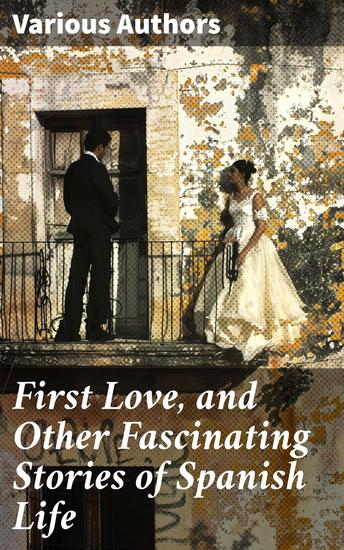
First Love and Other Fascinating Stories of Spanish Life - Exploring Love and Life in Spanish Tales - cover

First Love and Other Fascinating Stories of Spanish Life - Exploring Love and Life in Spanish Tales

Pedro Antonio de Alarcón, Juan Eugenio Hartzenbusch, Armando Palacio Valdés, Serafín Estébanez Calderón, Emilia Pardo Bazán

Editorial: Good Press

  • 0
  • 0
  • 0

Sinopsis

First Love, and Other Fascinating Stories of Spanish Life offers an enthralling journey through the intricacies of Spanish culture and society, encapsulated through a diverse array of literary styles and narratives. This anthology paints a vivid picture of Spain's rich tradition of storytelling, blending romance, social commentary, and a deep exploration of human emotions. By curating stories that range from the whimsical to the profound, the collection affirms the dynamism of Spanish literature, inviting readers into a world where the personal becomes universal. The anthology teems with expertly crafted tales that not only entertain but also provoke reflection on societal norms, love, and the human experience. The compendium features the works of seminal authors such as Pedro Antonio de Alarcón, Juan Eugenio Hartzenbusch, Armando Palacio Valdés, Serafín Estébanez Calderón, and Emilia Pardo Bazán, each contributing to a nuanced tapestry of narratives. These authors, while distinguished in their own right, collectively illuminate the varied facets of life in Spain during the 19th and early 20th centuries. As proponents of Romanticism and Realism, they imbue the anthology with insights drawn from their engagement with cultural and historical movements, making each story a microcosm of broader societal dialogues. For readers eager to traverse the geographical and emotional landscapes of Spain, this anthology provides an indispensable portal. The collection promises not just an aesthetic experience but an educational one, facilitating a multifaceted exploration of Spanish literary artistry. Through its broad spectrum of voices and perspectives, First Love, and Other Fascinating Stories of Spanish Life encourages a dialogue across time and space, making it a must-read for those seeking to deepen their understanding of Spain's literary heritage and cultural nuances.
Disponible desde: 12/08/2023.
Longitud de impresión: 40 páginas.
Otros libros que te pueden interesar

  • America’s Greatest Democratic Presidents of the 20th Century - cover

    America’s Greatest Democratic...

    Editors Charles River

    • 0
    • 0
    • 0
    Woodrow Wilson’s presidency was monumentally consequential, but it is not without its critics, nor is the man himself. Even as Wilson has come to be viewed as one of America’s greatest presidents, perception of Wilson and his administration as racist have also taken hold. Despite being one of the early 20th century’s most forceful proponents of a globalized foreign policy, Wilson’s personal views and comments were ardently anti-immigration, and Wilson’s administration entrenched and expanded segregation in the federal government. 
    	For over a decade, President Roosevelt threw everything he had at the Great Depression, and then threw everything the country had at the Axis powers during World War II. Ultimately, he succumbed to illness in the middle of his fourth term, just before the Allies won the war. The new president, Harry Truman, had to usher America through victory in Europe in his first month and decide to drop atomic bombs on Hiroshima and Nagasaki a few months later, but the end of World War II produced only the first of many consequential decisions Truman would face during his nearly 8 years in office. As president, Truman would lay the groundwork for the next 50 years of American foreign policy, as the architect of Cold War containment, the man who signed off on the Marshall Plan, and the commander-in-chief during much of the Korean War. He would also be the president who finally integrated the military, a crucial step on the way to full civil rights for the country’s minorities.  
    Had Lyndon Johnson’s presidency included just his domestic agenda, he would have unquestionably been one of America’s greatest presidents. Unfortunately, as he was engineering a new social contract at home, he was ramping up American military participation in a tiny country thousands of miles away in Southeast Asia. For a man who accomplished so much at home, it’s ironic and tragic that his presidency and legacy were permanently marred by Vietnam.
    Ver libro
  • About Man and God and Law - The Spiritual Wisdom of Bob Dylan - cover

    About Man and God and Law - The...

    Stephen Daniel Arnoff

    • 0
    • 0
    • 0
    About Man and God and Law is the story of how Bob Dylan sparked a revolution of the spirit and why it matters today. 


    Many of our assumptions about empathy, sensual pleasure, and the essence of work, community, country, race, and the divine have germinated in Bob Dylan's need to know what's blowing in the wind and how it feels. Tracing his work and vision through themes that have shaped religious and cultural history for millennia, Stephen Daniel Arnoff uncovers how Bob Dylan has re-enchanted ancient questions of meaning and purpose throughout popular culture, inspiring a pantheon of prophetic musicians along the way. This field guide to Dylan's spiritual wisdom aims to make good on the promise that if we look closely enough at his body of work—precisely at a moment when the world we thought we knew seems like uncharted territory—we can open up our eyes to see not only where we really are, but where we need to go.
    Ver libro
  • Stars of the Silent Film Era - cover

    Stars of the Silent Film Era

    Editors Charles River

    • 0
    • 0
    • 0
    Only a select few actors become international stars in their time, but none had as unique a career as Charlie Chaplin. Chaplin was the first true film star, and he managed to do so even when films were still silent. He has been honored with too many awards to count, and the fact that his name remains instantly recognizable nearly a century after his first film is a testament to his influence.  
    In the 1920s, the burgeoning movie industry was starting to come into its own, and alongside actor and director Charlie Chaplin, Buster Keaton was at the peak of Hollywood. It’s no surprise that Keaton was so effective in silent films, because he had been practicing comedy in his family’s vaudeville acts as “The Little Boy Who Can’t Be Damaged”, becoming a popular performer by the age of 5. Indeed, his physical form of comedy, which initially involved having his father throwing him around the stage, translated well onto the screen, and some of his slapstick and other comic gags remain legendary even today. 
    Everything about Rudolph Valentino, from his body to the characters he played, was exotic. His career may have been abbreviated by his premature death at the age of 31, but Valentino popularized the (somewhat racist) stereotype of the “Latin lover” in Hollywood, and even his name was markedly more out of the ordinary than those of other actors.  
    Of all the great movie stars, there may be none more enigmatic than Greta Garbo, who remains internationally famous despite the fact her life and career raise more questions than answers. How did a Swedish actress with very little film acting experience in her native land arrive in the United States and achieve instant stardom? Most actresses had to wait years before they were offered starring roles in major films, yet Garbo was ushered to the front of the line and perched atop the MGM pantheon at a time in which it was the studio par excellence. 
    Ver libro
  • Wild Dances - My Queer and Curious Journey to Eurovision - cover

    Wild Dances - My Queer and...

    William Lee Adams

    • 0
    • 0
    • 0
    As a boy, William Lee Adams spent his days taking care of his quadriplegic brother, while worrying about his undiagnosed bipolar Vietnamese mother, and steering clear of his openly racist and homophobic father. Too shy and anxious to even speak until he was six years old, it seemed unlikely William would ever leave small-town Georgia. 


    In time, William discovered that learning was both a refuge and a ticket out. So even as he struggled to understand and to get others to accept both his sexuality and his biracial identity, William focused on his schoolwork, his extracurricular activities, and building community with the students and teachers who embraced him for who he truly was. Though his scholarship to Harvard parachuted him into a whole new world, he still carried a lifetime of secrets and unanswered questions that would haunt him no matter how far he traveled. 


    Years later, as a journalist in London, William discovered the Eurovision Song Contest—an annual competition known for its extravagant performers and cutthroat politics. Initially just a fan, he started blogging about the contest, ultimately becoming the most sought-after expert on the subject. William was soon jetting across the continent to meet divas, drag queens, and aspiring singers, who welcomed him to their beautiful, if dysfunctional, family of choice.
    Ver libro
  • Civil War Presidents The: Abraham Lincoln and Jefferson Davis - cover

    Civil War Presidents The:...

    Editors Charles River

    • 0
    • 0
    • 0
    Abraham Lincoln is one of the most famous Americans in history and one of the country’s most revered presidents. Schoolchildren can recite the life story of Lincoln, the “Westerner” who educated himself and became a self made man, rising from lawyer to leader of the new Republican Party before becoming the 16th President of the United States. Lincoln successfully navigated the Union through the Civil War but didn’t live to witness his crowning achievement, becoming the first president assassinated when he was shot at Ford’s Theater by John Wilkes Booth on April 14, 1865.  
    In the generation after the Civil War, Lincoln became an American deity and one of the most written about men in history. With such a sterling reputation, even historians hesitate to write a critical word; in Team of Rivals Doris Kearns Goodwin casts Lincoln as an almost superhuman puppet master in control of his Cabinet’s political machinations and the war’s direction, juggling the balancing act flawlessly. As a result, Lincoln the man is far less known than Lincoln the myth.  
    Jefferson Davis holds a unique place in American history, as the man best remembered for being the president of the Confederacy during the Civil War. While other famous Confederates like Robert E. Lee and Stonewall Jackson are still celebrated across the reunited country, Davis continues to be the object of scorn, derided over his attempt to flee after the Civil War and criticized as ineffective by historians. Among the Confederates still lauded by today’s Southerners, Davis is well down the list. History has accorded Abraham Lincoln a spot in the pantheon of American politics for the manner in which he steered the Union to victory and into the Reconstruction period after the war. In turn, Davis has been heavily criticized.
    Ver libro
  • The Absinthe Forger - A True Story of Deception Betrayal and the World’s Most Dangerous Spirit - cover

    The Absinthe Forger - A True...

    Evan Rail

    • 0
    • 0
    • 0
    Absinthe, an elixir made of alcohol and herbs, is a booming business. Yet it is still an underground culture, associated with mystery, romance, and bohemian lifestyles, in keeping with its popularity among the writers, artists, and other ne'er-do-wells. First produced in eighteenth century, the spirit, known as "the Green Fairy," was banned worldwide by 1914 before the bans were gradually overturned beginning in 2005, the year Switzerland relegalized absinthe. 


    Enter a bon vivant who inveigles his way into the private Facebook groups where the modern absinthe demimonde converges and charms some of the best minds (and palates) in the beverage world into thinking that he was selling them precious vintage pre-ban bottles. How did he get away with it? 


    The Absinthe Forger pieces together the forger's subterfuge and motivation. It shows how absinthe can transform a person—and even connect drinkers with a deeper, often hidden sense of self. Rail digs deep into the modern absinthe underground, whose members are still frantic to find the last remaining bottles of pre-ban absinthe, and he visits modern producers of the spirit, who have, in a generation, changed in status from daring criminal bootleggers to sought-after celebrities. The Absinthe Forger is a bizarre crime drama that will make you never look at wormwood in the same way again.
    Ver libro