Junte-se a nós em uma viagem ao mundo dos livros!
Adicionar este livro à prateleira
Grey
Deixe um novo comentário Default profile 50px
Grey
Assine para ler o livro completo ou leia as primeiras páginas de graça!
All characters reduced
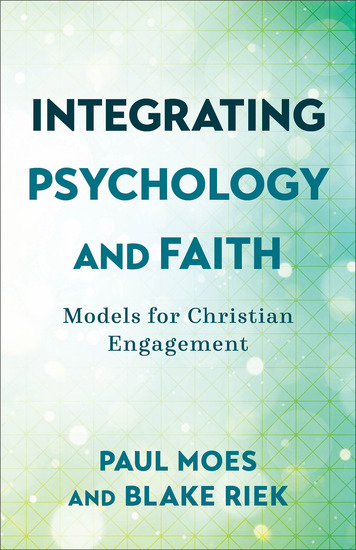
Integrating Psychology and Faith - Models for Christian Engagement - cover
LER

Integrating Psychology and Faith - Models for Christian Engagement

Paul Moes, Blake Riek

Editora: Baker Academic

  • 0
  • 0
  • 0

Sinopse

This textbook updates the conversation about models of psychology and faith integration, helping students understand the range of options for Christian engagement. Drawing from themes developed in Paul Moes's well-received Exploring Psychology and Christian Faith (coauthored with Donald J. Tellinghuisen), Integrating Psychology and Faith develops a set of worldview dimensions that serve to organize a variety of psychology-faith integration models. 
 
Paul Moes and Blake Riek set forth principles and themes and establish historical context to help students explore where different views fit on a continuum of approaches to integration and understand the perspectives of other Christians in the field of psychology. In this way, students come to better understand the organizing principles for various views about psychology that they encounter. The book also shows how theological traditions and positions shape views on natural science, social science, and psychology.
Disponível desde: 19/12/2023.
Comprimento de impressão: 192 páginas.
Outros livros que poderiam interessá-lo

  • Ancient Rome’s Provinces: The History of the Foreign Lands Ruled by the Roman Empire in Antiquity - cover

    Ancient Rome’s Provinces: The...

    Editors Charles River

    • 0
    • 0
    • 0
    It can be argued that Roman culture was, indeed, Graeco-Roman rather than Roman. It was the Greek language that served as the lingua franca in the Eastern Empire and much of the west including Italy. Many Greek intellectuals, including Galen, were based in Rome and the Roman aristocracy more and more came to embrace Greek literature and philosophy. Homer’s epics inspired Virgil’s Aeneid and Seneca wrote in Greek. Earlier, Scipio Africanus (236 – 183 B.C.), the epitome of the Roman martial hero, studied Greek philosophy and regarded Greek culture as the benchmark against which all others had to be judged. The Roman poet and philosopher Horace studied in Athens during the Principate and, in common with many of his class, saw that city as the intellectual centre of the world. 
    In the minds of most people today, Gaul equates to modern France. However, the vast geographical area that Caesar named Gaul, in fact, was made up of a number of very distinct regions and covered, in addition to modern-day France, Belgium, Luxembourg, parts of the Netherlands, Germany, Switzerland and Northern Italy. The Romans called the northern area of the Italian peninsula, which is now part of modern Italy, Cisalpine Gaul, or Gaul on this side of the Alps. Early Romans did not even consider this region as part of Italy and repeated incursions southwards, and the sacking of Rome itself in 390 B.C., resulted in Rome taking full control of the area in 221 B.C. and thoroughly Romanizing it to the extent that even the Celtic language totally disappeared and was replaced by Latin. The region was initially a province but by the beginning of the 1st century B.C., it had become fully integrated into the Roman heartland and became an administrative region of Italy rather than a province. 
    Ver livro
  • Women vs American Supreme Court - The History of Abortion Legislation - cover

    Women vs American Supreme Court...

    United States Congress, Jon O....

    • 0
    • 0
    • 0
    The legality of abortion in the United States is subject to individual state laws. In 1973, Roe v. Wade made the first abortion case to be taken to the Supreme Court, which had made it federally legal. In 1992, Roe was partially overturned by Planned Parenthood v. Casey, which stated that states cannot place legal restrictions posing an undue burden for "the purpose or effect of placing a substantial obstacle in the path of a woman seeking an abortion of a nonviable fetus." In 2022, both Roe and Casey were overturned, and abortions are now subject to regulations based on state laws once again. Individual states can regulate and limit the use of abortion, some of which already have through the use of "trigger laws", which made abortion illegal within the first and second trimesters when Roe was overturned. Eight states—Alabama, Arizona, Arkansas, Michigan, Mississippi, Oklahoma, West Virginia and Wisconsin—still have pre-Roe abortion bans in their laws, which may be enforced too. 
    This reading provides a thorough overview of the federal legalisation regarding the legality of abor-tion. It presents a judicial history and legislative response of the US federal institutions. In addition this collection is enriched with information which are indispensable part of every abortion debate in the United States.
    Contents
    Abortion: Judicial History and Legislative Response
    Abortion At or Over 20 Weeks' Gestation (FAQ) 
    Revolutionary Ruling: Roe v. Wade 
    Doe v. Bolton 
    Planned Parenthood v. Casey 
    Women's Health Protection Act
    2022 Ruling: Dobbs v. Jackson Women's Health Organization
    Ver livro
  • The Common Reader - "Volume 2" - cover

    The Common Reader - "Volume 2"

    Virginia Woolf

    • 0
    • 0
    • 0
    Do not think, because this collection of essays is titled Volume 2, that there is anything lesser or additional to it. Here is Virginia Woolf at her most entertaining and informative, relishing the portraits and insights she presents as she surveys a varied collection of individuals in English society and English literature. 
     
    The subjects range from the Elizabethans to Thomas Hardy, and then concludes, unexpectedly, with ‘How Should One Read A Book?’ Here is one delight after another: twenty-six occasional pieces (journalistic diversions) which demonstrate that her eye for history, for an individual’s place in history and in books, is just as acute and vivid as any character in her better-known novels. 
     
    Many are familiar names. John Donne, Robinson Crusoe, De Quincey, Lord Chesterfield. There is Dr Burney’s Evening Party and George Gissing, names which indicate there is no overall scheme whatsoever! Woolf champions certain figures, such as Mary Wollstonecraft (admiring her personal stance and strength) and yet has time to cast a softer, kindly eye on Dorothy Wordsworth. The detail contained in these portraits will last long in the memory—Beau Brummell descending from being the unimpeachable dandy to a sad decline; the curious eccentric personality of the poet and hymn writer William Cowper and his affection for Lady Austen. 
     
    Time and again, the skill and the wit of the great writer that is Virginia Woolf simply stops one in one’s tracks, as in her opening lines on Laurence Sterne. The essay is on A Sentimental Journey but she starts with tipping the hat to Tristram Shandy, which appeared when the author was 45. Woolf comments on Sterne: ‘No young writer could have dared to take such liberties with grammar and syntax and sense and propriety and the longstanding tradition of how a novel should be written. It needed a strong dose of the assurance of middle age and its indifference to censure to run such risks of shocking the lettered by the unconventionality of one's style, and the respectable by the irregularity of one's morals. But the risk was run and the success was prodigious.’ What a final sentence! Has the 21st century little time for the elegant essay, the joy of focused wit, of kindness, of acute observation, where the very brevity of format provides a space in which to think and reflect? In The Common Reader Volume 2, (published in 1932), the essay lives on and even more so in this sensitive and engaging book by Georgina Sutton.
    Ver livro
  • The History of Islam's Holiest Sites - cover

    The History of Islam's Holiest...

    Editors Charles River

    • 0
    • 0
    • 0
    Mecca is now best known for being Islam’s holiest city, revered as the birthplace of Muhammad and the site where Allah first revealed the Qu’ran to him. Within Mecca is the Ka’aba, a building housed within the Al-Masjid al-Haram (Great Mosque) that is considered the holiest site, and wherever they are in the world, Muslims face in the direction of the Ka’aba while praying. A pilgrimage to Mecca is considered a necessity for devout Muslims at some point in their lives, and the city itself is off limits to non-Muslims. Indeed, Mecca is so integral to Islam that the name of the city has entered the English lexicon and is a commonplace reference to any area closely associated with something (such as Paris often being called the mecca of fashion). 
    Even centuries before the birth of the Prophet Muhammad, Jews settled in the area that became Medina to escape persecution at the hands of the Babylonians and Romans, meaning the area and its arid environment brought inhabitants precisely because it wasn’t an attractive or resource rich area. In fact, the city fated to become the second holiest city in Islam earned that spot simply by straddling trade routes to the religious city of Mecca, which brought traders and pilgrims in large enough numbers to make it a trade center. 
    Jerusalem’s particular importance to the religion of Islam is without question one of the major sticking points in the Israeli-Palestinian conflict. Prior to Israeli control, Jerusalem had been predominantly controlled by Muslim rulers since the 7th century and had been used as a type of political currency, legitimizing the ruling dynasty’s claim over the city. For the world’s Muslim population, Jerusalem is a holy site because Muslims believe the Prophet Muhammad visited Jerusalem where he ascended to heaven during the famous “Night Journey.” There was also a period of time during the Prophet’s life when Muslims prayed in the direction of Jerusalem, as opposed to Mecca.
    Ver livro
  • Breaking the Illusion: Conquering Imposter Syndrome - Embracing Your True Worth and Potential - cover

    Breaking the Illusion:...

    AHMED MUSA

    • 0
    • 0
    • 0
    The life-changing book Breaking the Illusion: Conquering Imposter Syndrome – Embracing Your True Worth and Potential is meant to help people get over the crippling effects of imposter syndrome and become their true selves. A lot of successful people have problems with constant self-doubt, fear of being caught lying, and a feeling that they are never good enough, even though they have done great things. This book gives readers useful information and tools to help them understand where imposter syndrome comes from, spot its symptoms, and learn how to deal with self-doubt. 
    You'll learn how to change your negative thought patterns, build a growth mindset, and change how you see yourself through interesting chapters. Breaking the Illusion teaches readers how to be kind to themselves, understand their emotions, and be strong. It also tells them to be proud of their accomplishments without feeling guilty or hesitant. This book gives you steps you can take right away to boost your confidence and sense of self-worth, whether you're dealing with work or personal relationships. 
    You will understand imposter syndrome by the end of this journey and learn how to take back your power, see your potential, and truly believe in the value you bring to every part of your life.
    Ver livro
  • Idea of Progress The - JB Bury - cover

    Idea of Progress The - JB Bury

    J. B. Bury

    • 0
    • 0
    • 0
    "The Idea of Progress" by J.B. Bury is a seminal work in the history of ideas, first published in 1920. In this book, Bury explores the concept of progress, tracing its development from ancient times to the modern era. He examines the ways in which people have understood and pursued progress throughout history, and the impact that this has had on the world. 
    Bury argues that the idea of progress is a central feature of Western civilization, and that it has shaped the course of history. He shows how the idea of progress emerged in ancient Greece and Rome, and how it was further developed during the Renaissance and Enlightenment. Bury also examines the ways in which progress has been measured and evaluated over time, and how it has been used to justify social and political change. 
    Throughout the book, Bury offers a nuanced and critical perspective on the idea of progress. He acknowledges the many benefits that progress has brought, but also highlights the negative consequences of pursuing progress without sufficient consideration for its wider impact. He argues that progress should be guided by ethical considerations, and that we must be mindful of the unintended consequences of our actions. 
    "The Idea of Progress" is a thought-provoking and insightful book that continues to influence contemporary debates about the meaning and value of progress. It remains a valuable resource for anyone interested in the history of ideas, and the ways in which they shape our understanding of the world.
    Ver livro